
Delhi – A city of 2 visits and 2 halves
That evening, in the hotel, we met up with the tour guide and the group we were going to spend the next eight days with. The group, about fifteen strong, was an amenable mix of Aussies, Americans, Canadians and assorted Europeans. Some were doing a couple of weeks, others months. None were travelling for a year.
A special mention must go to our tour guide, Chatrishal, a name both I and spellcheck struggled with. It was to be a familiar theme for me. Chatrishal was a man of few words, extremely competent and unnaturally calm in the madness that is India.
The following morning the group was up early strolling through another poor, dirty though fascinatingly chaotic section of North Delhi. And treated, in stark contrast, to a ride on Delhi’s rapid transit system – air conditioned, wonderfully clean, cheap and quite brilliant. It has been expanded since our visit and a desperately welcome addition to a tragically polluted city.
Another poor and dirty North Delhi district, implausibly more chaotic than the last, brought us to the Jama Masjid. Constructed between 1650 and 1656, this beautiful mosque can accommodate a staggering 25,000 devotees. Whilst being an oasis of calm when inhabited only by admiring tourists.
Define chaotic I hear you ask. An Indian city is GBH on the senses – that really is the best way to describe it. There’s constant movement of tuk-tuks, motorbikes, cars, buses, people and an odd animal or two. Cows are sacred to Hindus and are free to roam anywhere. Which they do. Road junctions seem a favourite.
There’s liberally scattered rubbish, particularly in the poorer areas. This includes any river unfortunate enough to wander through a built up area. Then there are the smells. The rubbish, the delicate aroma of cow dung, spices, cooking food, and the pollution from tuk-tuks and buses all combine to provide a bouquet unique to Indian cities. And let us not forget the noise – constant hooting of anything and everything with an engine, the glorious sound of a diddy 2-stroke engine at full chat and the shouts, cries and moans of Delhi’s multitudes.
Intoxicating and tiring at the same time.
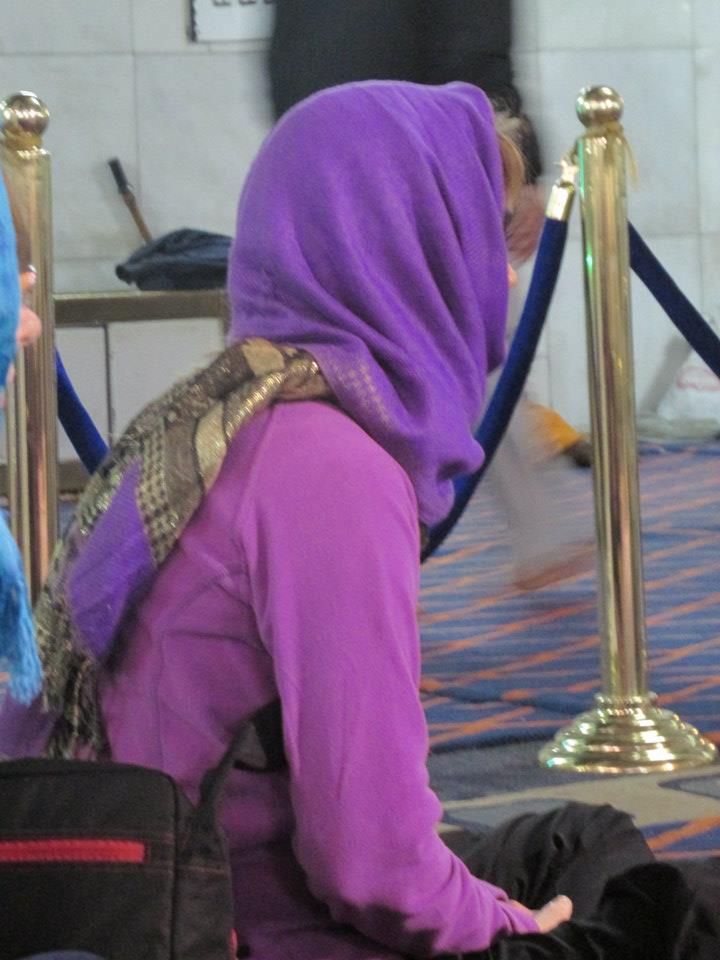
Another short walk through North Delhi took us to a Sikh temple which provided food for the poor. This was the first of perhaps hundreds of times we took our shoes off when visiting a Hindu temple. I tried my hand at making chapati, which could have gone better. For a short time we knelt at the back of a hall where the local community were praying and making offerings to one of the numerous Hindu gods. I took one of my favourite pictures of Sus here (she was wearing a headscarf), which I briefly considered putting on Hindulovematch.com.
Then back to Connaught Place for a spot of lunch and the discovery of the wonderfully tasty dosa.
Leaving Delhi, Agra and a blinged coffin
Our transport taking us to Agra and the Taj Mahal was, according to Chatrishal, waiting around the corner. Unfortunately he and the driver were talking about different corners. The van, basically a big Trannie which proved perfectly adequate over the coming week, duly arrived. We spent many hours in that van watching scenery go by, chatting, sleeping, listening to music and swatting the odd brave mosquito. Sus turned out to be a natural at mosquito bashing.
Mosquitos are the only totally pointless creatures known to man – they spread malaria and the truly nasty (and sometimes fatal) dengue fever. We spent many a happy hour chasing the little fuckers around bedrooms or laying down enough bug napalm to make even the American government blush. Many a hotel room had evidence of previous occupants’ battles with the mosquito. Their only saving grace is an inability to fly quickly, presenting many an opportunity to hone those killer instincts. Happy days.
We’ve all been caught short (chaps only this bit) after a few chemically interesting lagers and have had to urinate in places we might not be especially proud of. Mine was a telephone box. Please do not feel the need to email me yours.
In India, particularly Northern India, this is a popular pastime for the male half of the populace. They, however, neither need to be drunk nor for it to be dark. We were first introduced to this local custom in Agra, which was the most notable feature of this town with the exception of the world famous Taj Mahal.
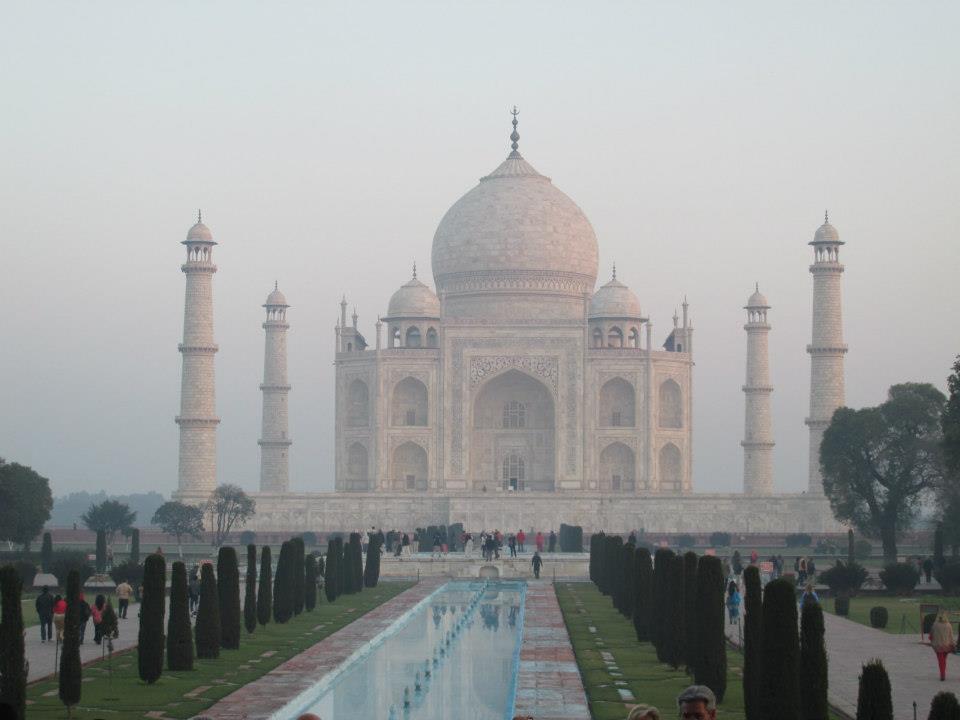
The Taj Mahal is a large coffin with go-faster stripes. Made entirely of white marble this mausoleum dates back to the 17th century, sits on the Yamuna River and surrounded by a vast and attractive Mughal garden. It was built by Mughal Emperor in memory of his wife – devoted he was, skinflint he was not.
Long queues and tight security lead to a frustrating wait at the entrance. Millions (or so it seemed) of gawping, sunburnt tourists try to replicate the famous photograph of Diana without getting another of their kind leering back at them.
It’s also, without a doubt, one of the most stunningly beautiful buildings we have ever seen. It actually appears to be floating. Go and have a peek.
Not far from the Taj Mahal is the Tomb of Itmad-ud-Daula – aka Baby Taj – built by a devoted daughter for her father. Perhaps he’d bought her a pony. Completed in 1628, and considered a template for the Taj Mahal, this marble masterpiece predates its showy cousin and presumably plotting the demise of the same.
Out and about
That evening we ventured out to buy bottled water. Indian tap water is lethal leaving bottled water as our only option – including cleaning one’s teeth. I’ve always drunk large quantities of water. When dehydrated I have an unfortunate tendency to migraines followed by copious vomiting. Finding bottled water was a constant irritant throughout India and can only have added to the already impressive levels of pollution. Biscuits were also on the shopping list. Along with my H2O fetish I have a very sweet tooth.
A paucity of pavements in India (with the exception of parts of larger cities) often has one strolling down busy streets at the mercy of touting tuk-tuks and voracious street vendors. We discovered a scruffy supermarket. Whilst queuing 2 boys stared at us. They didn’t say anything, just stared. To this day I don’t know why.
We scuttled back to the hotel in time to see a Hindu wedding procession go by, a common event in Indian towns and cities. The bride and groom were in a carriage pulled by two white horses, the beautifully dressed guests walking behind. There were lights (it was dark by now), music and dancing. The speakers for the music and, even the batteries powering the speakers and lights, were part of the colourful and enchanting procession.
The next day, a folly named Fatehpur Sikri,
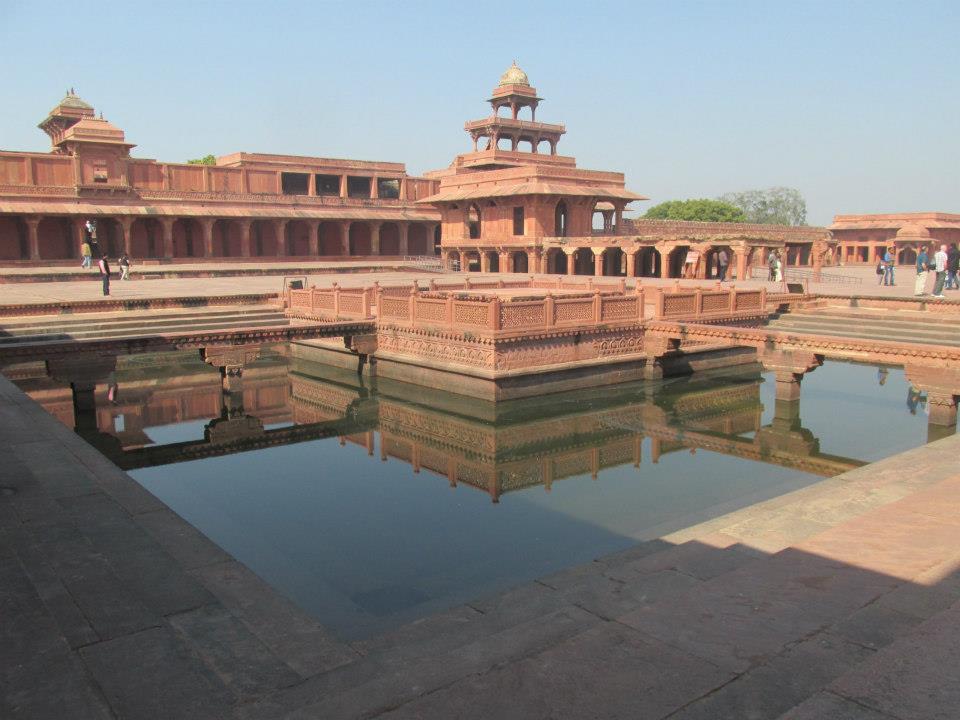
After breakfast and a short drive to the middle of nowhere, an Indo-Islamic masterpiece shimmered into view. Fatehpur Sikri is a 16th century, red stoned mogul fort/city encompassing royal palaces, stables, water features and what appeared to be a giant chessboard. Abandoned shortly after construction, allegedly, because of a lack of water and a lack of interest.
Next a visit to a ‘typical’ village of that region. Neither of us are keen on these little jaunts to see the real this or the real that and spent the year trying to avoid them. The real whatever is normally what the holiday company has deemed palatable to the increasingly savvy traveller wanting authentic. It’s like showing a first time visitor to England a beautiful thatched roof village and pretending all the villages in England are the same. The actual village (Burso) was pleasant enough though obviously prosperous. We weren’t the first, and certainly won’t be the last travellers hoping to find the real India only to be sold a mildly sexed-up version.
The hotel we stayed in had probably been truly fabulous in its heyday. The reception area and public spaces still were. The rooms lost a couple of stars. This was a common theme in India where the public spaces were often a star or two above the actual rooms. And 2 to 3 stars short of any pictures the hotel might helpfully provide on their website. The room had a balcony (faded glory?) from which a family working in the fields was visible. They lived in a nearby shack, were obviously poor and, if they saw you, would come running to the back wall of the hotel begging for money. I stopped going out onto the balcony.
That night the group sat around a bonfire in the garden beer bonding.
 Tony's Travel Blog