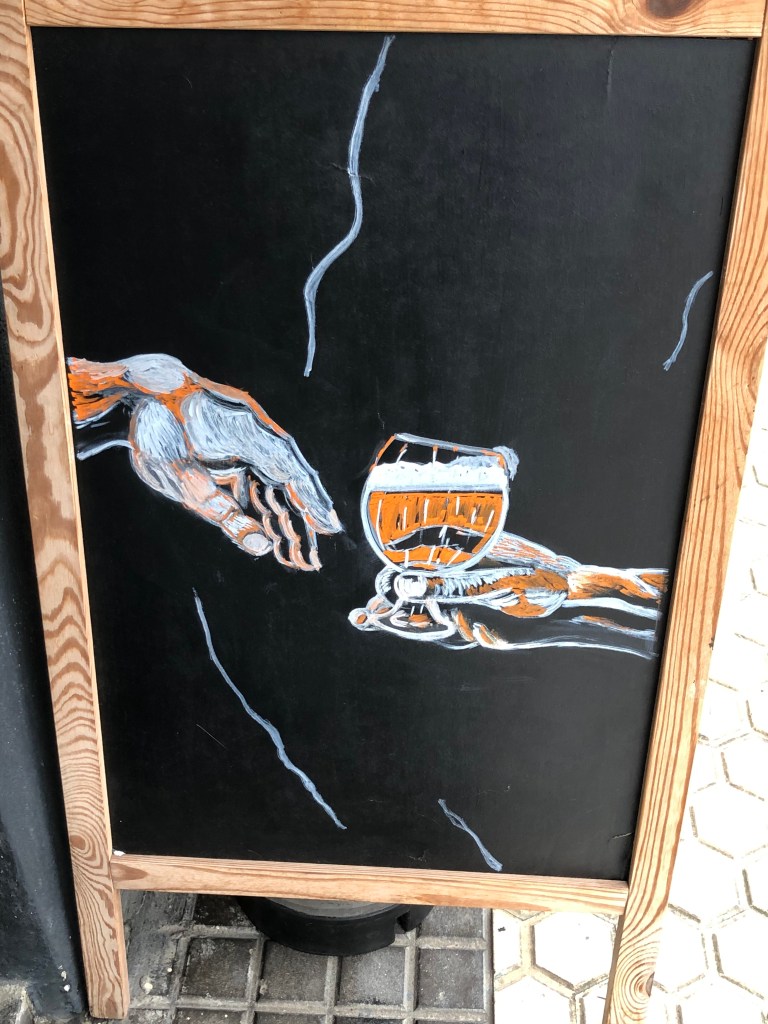
Lisbon / Porto

Lisbon and Porto are inconveniently built on hills. Lots of them. We recently visited both in the same week. And spent an inordinate amount of effort trudging up and then back down said hills. Strangely, cyclists were not a common sight.

For those preferring mechanised transport both cities thoughtfully offer metros, trams and buses.

LISBON

A little light history

Lisbon was originally settled by the Phoenicians back in 1200 BC, followed by the Romans who established it as a municipium called Olissipo. The Moors later conquered the region in the 8th century AD, leaving a lasting mark on its architecture.

After the Christian Reconquista, Lisbon became the capital of Portugal in 1255. During this period, Gothic architecture flourished, seen in landmarks such as Lisbon Cathedral (Sé de Lisboa) and the Monastery of São Vicente de Fora.

Lisbon played a crucial role during the Age of Exploration in the 15th and 16th centuries. The wealth generated from trade with newly discovered territories contributed to the construction of magnificent structures such as Belém Tower and the Jerónimos Monastery, both UNESCO World Heritage Sites.

In 1755, a devastating earthquake followed by a tsunami and fire destroyed much of Lisbon, including many historic buildings. This earthquake is very much responsible for the Libon we see today. An architect by destructive default.

The Marquis of Pombal led the efforts to rebuild the city, introducing a new architectural style known as Pombaline, characterized by sturdy, earthquake-resistant buildings with simple, symmetrical facades.

Lisbon experienced further growth and modernization during the 19th and 20th centuries. The cityscape became a blend of architectural styles, including neoclassical, Art Nouveau, and Art Deco, reflecting the changing tastes and influences of the time.

In recent decades, Lisbon has seen a resurgence in contemporary architecture, with notable projects such as the Champalimaud Foundation by Charles Correa and the Lisbon Oceanarium by Peter Chermayeff.

We checked into our hotel, inevitably uphill, around 7pm. A short stroll from the hotel was the Santa Justa Lift or Carmo Lift. I wasn’t expecting a lift. Crafted in the late 19th century, entirely from wrought iron, it’s a handsome beast. It connects Chiado (top) to Baxia or downtown (bottom). We didn’t take it.

Nope, we took the free, less busy lift close by. Though it deposits tourists from and into the same area it has the look of something from a 3 star hotel lobby.

Baxia is resplendent with restaurants. All apparently boasting the same fare from menus advertising scaringly florescent food. Bit of a tourist trap. However, and far more interestingly, Baxia is quite lovely – classy plazas joust with classic 18th century Pombaline architecture, a delightful spot to stroll and people watch. Pedestrianisation is a welcome bonus.

Back to the lift, the hotel and bed.

Can we walk the whole of Lisbon in one day, day?

Nope, but it felt like it.

First up, São Jorge Castle. I’m not especially bothered about so called Patron Saints though continually surprised how much St George got about. Bit of a tart that lad.

Another lift efficiently elevates one to Castelo, a tiny neighbourhood surrounding the castle. Do take a wander.

The castle dates back to the Moors though much of what we see today is a restoration following that dreadful earthquake of 1755. Nevertheless, chez St George is worth the 15 Euro entrance fee. Several of the towers are climbable and the walls can be promenaded along. The views back over Lisbon are properly spectacular.

As are the many peacocks strutting their stuff within (and on) the castle walls.

Alfama and Graca and Baxia and Pink Street

Though stretching from a smidgen below the castle to the Rio Tejo most tick boxers will head towards the so called Fisherman’s Village. As did we.

But not initially. Nope, we strolled into Graca the adjoining neighbourhood. Graca was a welcome surprise from tourist Lisbon – albeit deservedly. Graca could be where you live, or I live. Normality exists here. We liked it.

We drank coffee at a wonderfully busy and local cafe before eating the tastiest food of our time in Portugal at Graca 77. Their house red also being the best wine quaffed whilst away. A gem of an eatery.

In need of exercise we then wandered uphill to The Church and Monastery of Graça. It’s a huge and handsome beast dating back hundreds of years though has been extensively restored. Expansive views across Baxia and Barrio Alto are a bonus.

Back to that fishy village.

In the 1755 earthquake many Christian churches were destroyed. Alfama, perhaps a tad ironically, survived virtually intact. It’s Lisbon’s oldest surviving district.
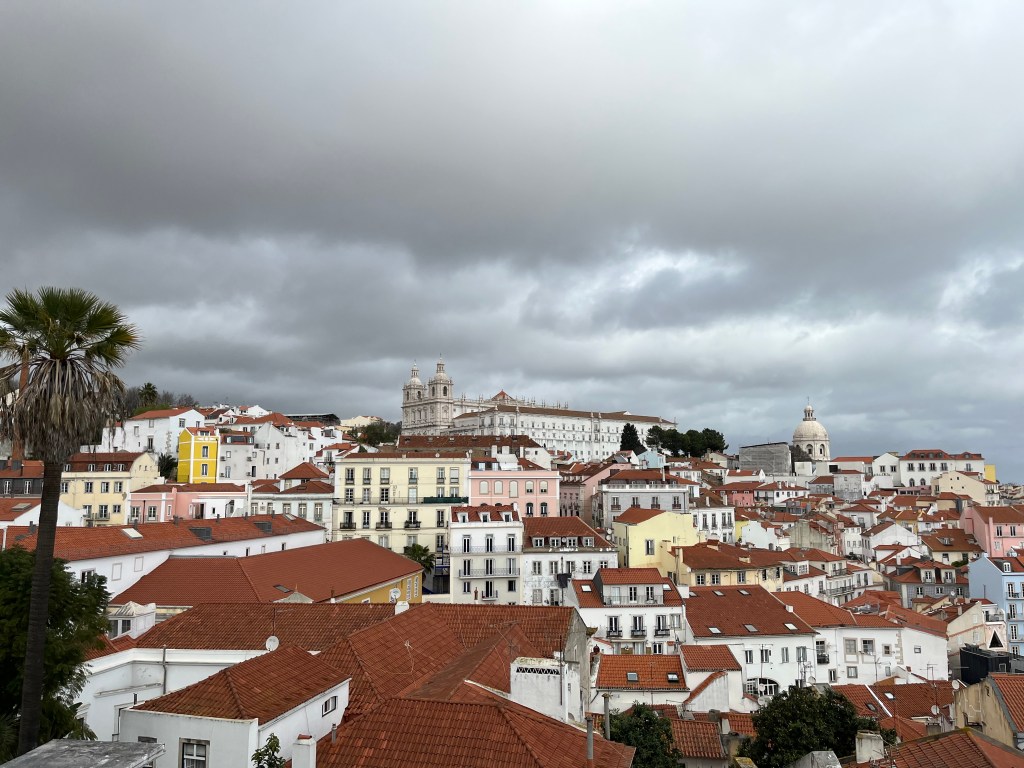
Miradouro das Portas do Sol is a huge terrace, squatting above Alfama, revealing the district in all of its labyrinth loveliness. The streets are stupidly steep, even by the standards of Lisbon, cobbled and narrow. Plazas, churches and alleys make up this characterful area – becoming lost may be the best way of stumbling upon Alfama’s hidden gems.

Historically squatting outside of the castle walls, Alfama was home to home to the poorer and perhaps less fortunate elements of Portuguese society. With Portugal becoming one of the preeminent seafaring nations Alfama soon become home to sailors with a reputation as a tough and deprived district. Essentially that fisherman’s village.

Today Alfama has morphed into an artisan and tourist enclave though some commentators do feel it’s lost much of its traditional vibe. Whatever that was. We felt, after exploring (getting lost) for an hour or so a modicum of old charm had survived the onslaught of gentrification and tourist infestation. Abetting this charm is the total absence of ridiculously rotund and possibly pointless SUVs clogging the streets. No cars of any size do. The streets are just too narrow.

Don’t be fooled though. There are tacky tourist shops and restaurants with those scaringly bright menus aplenty amongst more interesting finds.

Alfama’s populace may has gone upmarket, the architecture hasn’t. It’s worth at least a couple of hours of anyone’s time.

Strolling along the River Tagus we encountered Praça do Comércio, the daddy of Lisbon’s squares. Highlights include Rua Augusta Arch – completed in 1873 celebrating the rebuilding of Lisbon post earthquake – and and Equestrian Statue of Joseph I, the unlucky king on the big chair during the earthquake.
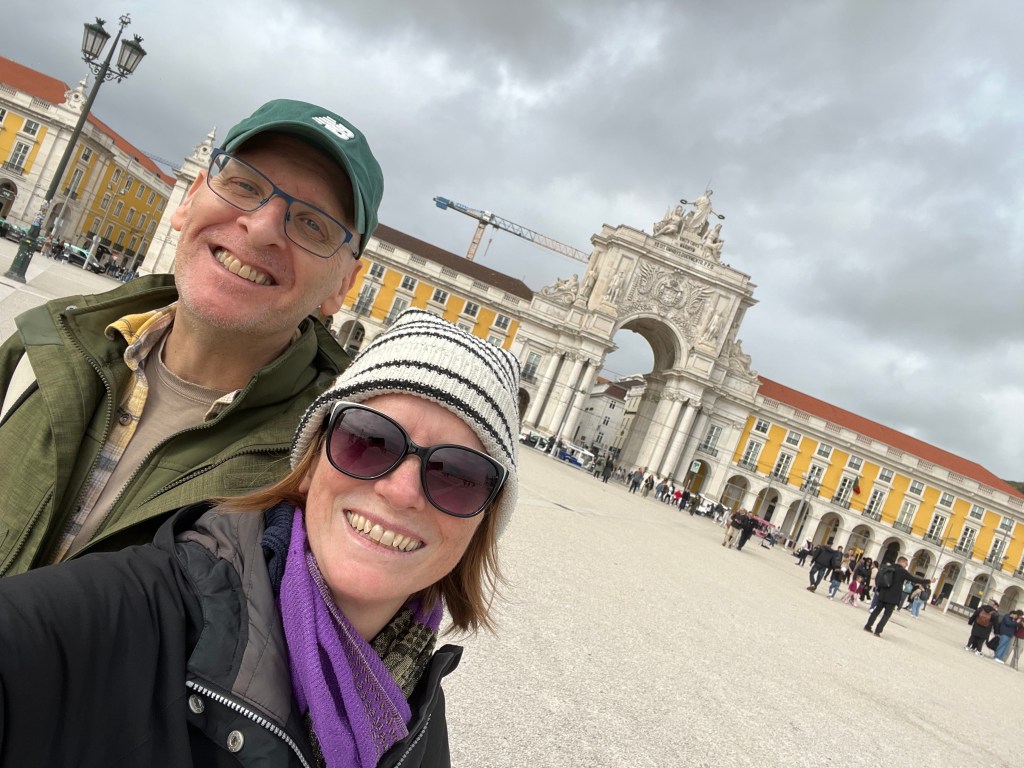
The square back onto Baxia and so rude not to wander back in before meandering our way to Pink Street. A strange little street. Not especially pink and with a bar worshipping all things Liverpool FC. I support Sheffield United (my birth city) so feel unable to criticise. Other bars offer alternative viewpoints though all seem to exist to serve as much beer to as many thirsty punters as possible. I heard many an English accent.

Chiado may be a shopping district but it’s an attractive little number. And where, allegedly, the world’s oldest bookshop contentedly lives. We had a looksee and content it very much was. Locals apparently shop here as well as the tourist hoards – it was, a tad surprisingly, one of our favourite Lisbon districts.

Having walked over 12 kilometers our final stop was the most welcome Outro Lado, a wonderfully atmospheric craft beer bar. More in my beer blog at https://wordpress.com/post/tonysbeersnobblog.wordpress.com/617

Belem

May sound like Gotham’s evil twin but is, in reality, a tad more mundane. It’s Lisbon’s westernmost district, where the River Tagus encounters its watery maker, emptying into the Atlantic.

During the Age of Discovery Vasco da Gama left from Belem and Columbus popped in for a cuppa on his way back from a some unfortunate discovered land.

Getting there proved our very own Age of Discovery. It only dawned, when our intended tram clanked past, that our stop was currently on a hiatus. Even the copper, waiting for that same tram, appeared vaguely perturbed.

Back to the hotel. Coffee, google and a wee (2 in my case) helped us plan an alternative route. Metro, topped up our travel cards for 24 hours, train, Belem. Easy. Unfortunately not. To our frustration the 24 hour top up ticket did not take kindly to the train. Another top up ticket, and a short train journey, finally brought us to Belem.

On arrival, and once a short lived but bad tempered squall had passed, we strolled along the waterfront. It’s all rather agreeable. There’s the river, an opposite bank revealing wooded hills and, alongside the river path, the occasional building (new and older) masquerading as restaurants or hotels.

A short detour took us away from the waterfront and bizarrely through a petrol station. Reunited with the waterfront we were plonked in front of the imposing concrete and limestone Discoveries Monument. Rebuilt in 1960 from an older monument it celebrates 15th and 16th century celebs. Men really. Only a single women is represented and she’s someone’s mum. Nevertheless, it is striking. Though shaped like a ship, architecturally, there’s a whiff of 1950s Russian propaganda about it.

Belem Tower is a bit of a looker. Built in 1515 as both beacon and fortress guarding the entrance to Lisbon’s harbour.
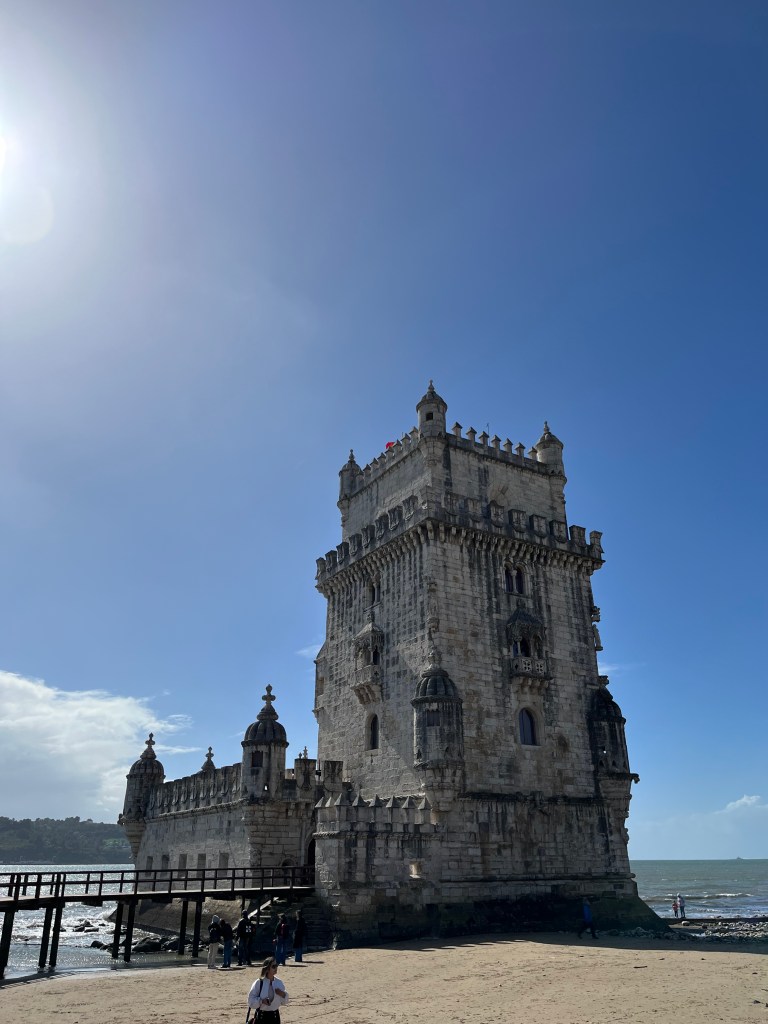
Belem Tower is a stunning piece of Gothic architecture utterly deserving its World Heritage Site status. It’s more Disney than Disney. I loved it.

We reversed our route, moving away from watery wonderland into urban landscape. Belem Palace, built in the 1500s though renovated in the 1800s, is currently the official home of the President of the Republic and pretty in pink. A tad oddly, unlike other royal residences, it lives on a high street. Two ornately dressed guards alerted us to it’s self importance. Nevertheless, it’s a beautiful building even the glimpse we were given.

Next up, more weak bladder than by design, was Belém Cultural Center (CCB). Constructed in the 1990s, it’s an imposing and oddly attractive building – now housing the MAC/CCB Museum and it’s large auditorium, hosts world class performances. The 4 huge living walls especially appealed.

Jerónimos Monastery, a short saunter from the CCB, is a stunning example of 14th century Gothic architecture. No surprise it’s a World Heritage Site and one of Lisbon’s most recognisable attractions. This being a Monday, it was closed to tourists. Perhaps it’s the day of their team meeting.

Established in 1837 Antiga Confeitaria de Belém or Pastéis de Belém is the birthplace of the famous custard tarts. High church to custard desserts. Those Monks, presumably on a Monday, were allegedly responsible for the still secret recipe.

We succumbed. Though an obvious tourist trap said flavoursome fripperies were not extortionately expensive. A small, west London shopping centre hosts a pasteis store as well as Hammersmith tube station.

Nearby is Rua Vieira Portuense with its 16th-century houses. Worth a gander.

MAAT (Museum of Art, Architecture and Technology) is a dramatic modern architecture structure, it’s roof doubling up as a vantage point overlooking the river. The 19th century factory close by, now part of MAAT, is properly gorgeous. If you like that kind of thing. I do.

The weather had become rather bad tempered. A sit down and glass of wine seemed most opportune. And so we did in the museum cafe. A pleasant vibe with river views helped to distract from the overpriced and distinctly average vino.

LX Factory is a complex of industrial buildings – dating back to 1846, underneath the 25th of April Bridge (not my birthday) – has been transformed into a dynamic hub for art, culture, and commerce. Over 50 restaurants, bars and cafes live here and LX Factory is bang on trend and a Lisbon hotspot.

It’s perhaps a little contrived, though likably contrived. Nevertheless, the street art is fab and genuinely inventive.
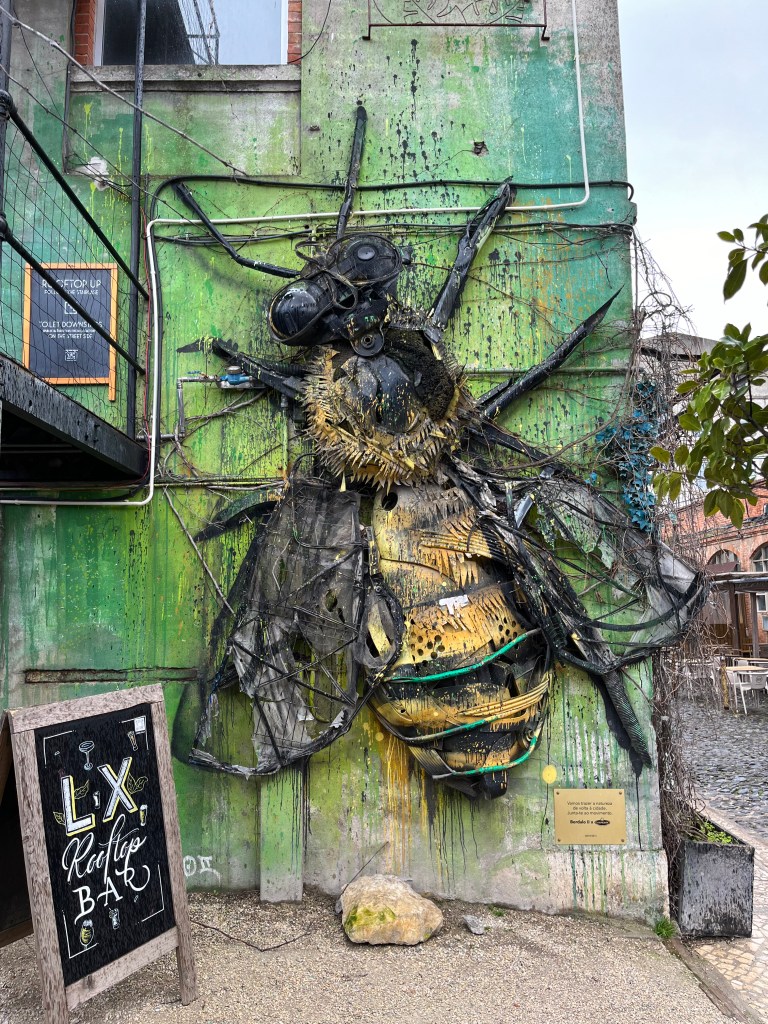
I adore chocolate, always have, always will. Strangely, I’ve never been a hot chocolate devotee. I am now. Sus persuaded me to pause for a hot chocolate whilst in LX Factory. Lush. As young people say.

Belem is a fascinating and hugely significant district with distinct contrasts. We didn’t but Belem merits a day of your hard worked for holiday. We caught glimpses of gardens and museums are aplenty though were unable – and on occasion didn’t wish too – to stop. Hopefully you will.

An 7.5 mile day. We bussed back to central Lisbon.

PORTO

The following morning we checked out, metro to the train station (Santa Apolonia) and jumped – it was a huge step up – onto the Porto train. We (Sus) had bought tickets online the previous evening.

The 3ish hour journey passed comfortably, the scenery was agreeable, the train was pleasant. Highlight was cranes hijacking large metal pylons for luxury living. Fabulous. Though how the highest perches were allocated I’ll never know. Long time residents or new money?

A short trip on a local train brought us into Porto proper. Apple Maps appeared to direct us to our hotel in a somewhat roundabout way. We obviously ignored Apple Maps and went direct. An impossible incline harbouring steps and cobbles quickly showed us the error of our ways. Trust AI.

We checked in, rushed out. Our hotel shared Praça da Batalha with the 18th century Church of Saint Ildefonso and the Royal Theatre of São João. The original theatre dates to 1794 though was rebuilt in 1908 following a fire.

Porto’s town centre or A Baixa roughly encompasses Cordoaria, Praça da Liberdade and São Bento Station – the central station of our arrival and subsequent battle of the cobbles.

Attractive streets (Avenida dos Aliados), squares (Praça da Liberdade), city hall and government buildings vie with locals, tourists and consumerism. Century old trees decorate Cordoaria Gardens providing shelter and sunburnt tourists a place to belatedly lather on suntan lotion. It all feels familiar and rather likable.

Se neighbourhood, one of the oldest and traditional, and especially charming. Porto Cathedral resides in a picturesque square here and dates back to the 12th century. There’s been the odd nip and tuck since though, unlike an aging reality tv star, only embellishes an already beautiful building.

A surviving section of the medieval city wall is also in residence.

A Baixa is not flat. Porto is not flat. Neither is in any sense of the word flat. Sprinkle in a little snow (unlikely), predestination (more likely) and a developer or two and Porto would become a ski resort.

Talking of developers, Porto is undergoing a major refurb. Porto’s tram system is being extended and many older buildings renovated. Cranes and construction dominate the town centre – Porto appears to be a city on the way up.

As to a lesser extent did Lisbon.

We ended up, predictably, at a fine craft beer establishment – Letraria (https://cervejaletra.pt/en/).

And that was that.

A bit of history

Porto began as a Celtic hamlet before the Romans, as they did, popped over transforming the town into a successful trading centre. And renaming it ‘Portus Cale’. Which gives us ‘Porto’ and ‘Portugal’.

It then became a tad messy. In 456, the Visigothic King Theodoric II booted out the Romans, and fairs fair, in 716 the Muslim Moors booted out the Visigoths. In 868 Alfonso III of Asturias reclaimed Porto from the Moors for the other side. The Christians.

Portugal however, as we now understand it, emerged post 1096. Afonso Enríquez, after inevitably bashing other parts of the region, laid the foundation of modern day Portugal. Hoorah.

The 15th and 16th centuries were Portugal’s Golden Age and pinnacle of maritime influence. Porto’s shipbuilding expertise and renowned shipyards helped to drive this exploration frenzy. Famous explorers such as Henry the Navigator discovered new lands, opened up trade routes and generally kicked bottom. Goa in India and the beautiful Parity in Brazil demonstrate the scope of Portugal’s exploration.

Less gloriously, on discovering the African coast, Portugal’s explorers enthusiastically embraced the abhorrent slave trade. Portugal was not alone.

Between 1580 and 1640 Spanish Habsburgs bossed the Iberian Peninsula. Porto was not best pleased and eventually regained independence. Weirdly, this period of Spanish rule, proved a hugely successful period for Porto and its inhabitants. In1756, after shockingly rising against a British monopoly on their famous wines, Porto went through what many believe was a golden age in terms of both commerce and architecture.

Until Napoleon visited in 1807, outstaying this unwelcome intrusion until 1814. In 1820 Porto was at the vanguard of Portugal’s Liberal Revolution demanding a constitutional monarchy. This was achieved in 1822.

During the 20th century Porto and Portugal became a republic (1910), succumbed to a dictatorship before becoming the country we know now.

Like many a larger metropolis Porto is a tasty smorgasbord of historical styles encompassing Baroque, Neoclassical and increasingly modern, cutting edge architecture.

Perhaps ‘rather a lot of history’ would have been a better heading.

A lot of pages day. And Porto’s Ribeira.

Sus keeps a diary of our travel exploits which forms the basis of this blog. Or at least the bits I can read. Many, many pages contributed to this particular day.

Ribeira is the classic picture postcard – iPhone postcard – and a World Heritage Site. It’s Porto’s historic centre and the city’s waterfront. The water in question is the Douro.

The boats in the picture were once used to transport the port.
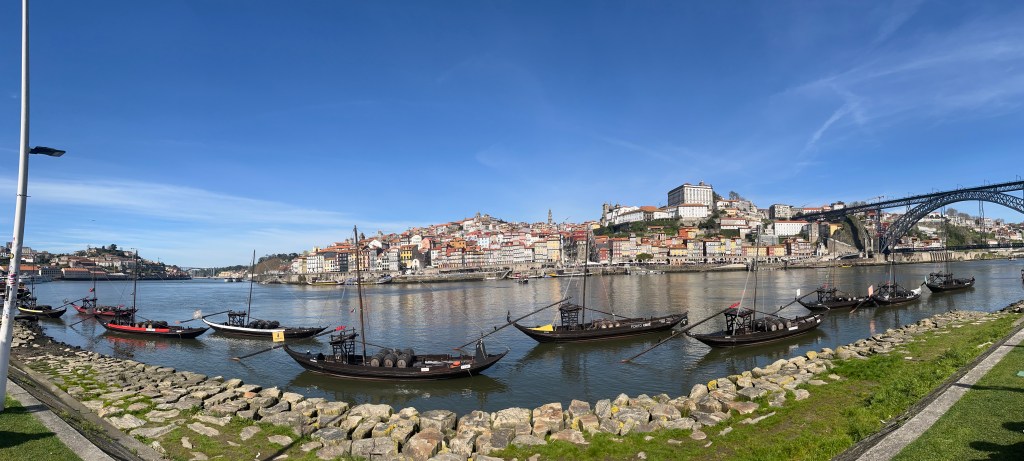
Narrow alleys complete with small squares lead down to the waterfront. The riverfront waterfront is a wonderful pastiche of picturesque and colourful facades. Restaurants and bars vie for tourist Euros.

Who doesn’t love a little bit of Victorian architecture. Or, in the case of the Ponte Dom Luís I Bridge, a lot of Victorian river architecture. Completed in 1886 this metal and concrete monster magically combines handsome good looks with function. Not a bad epitaph.
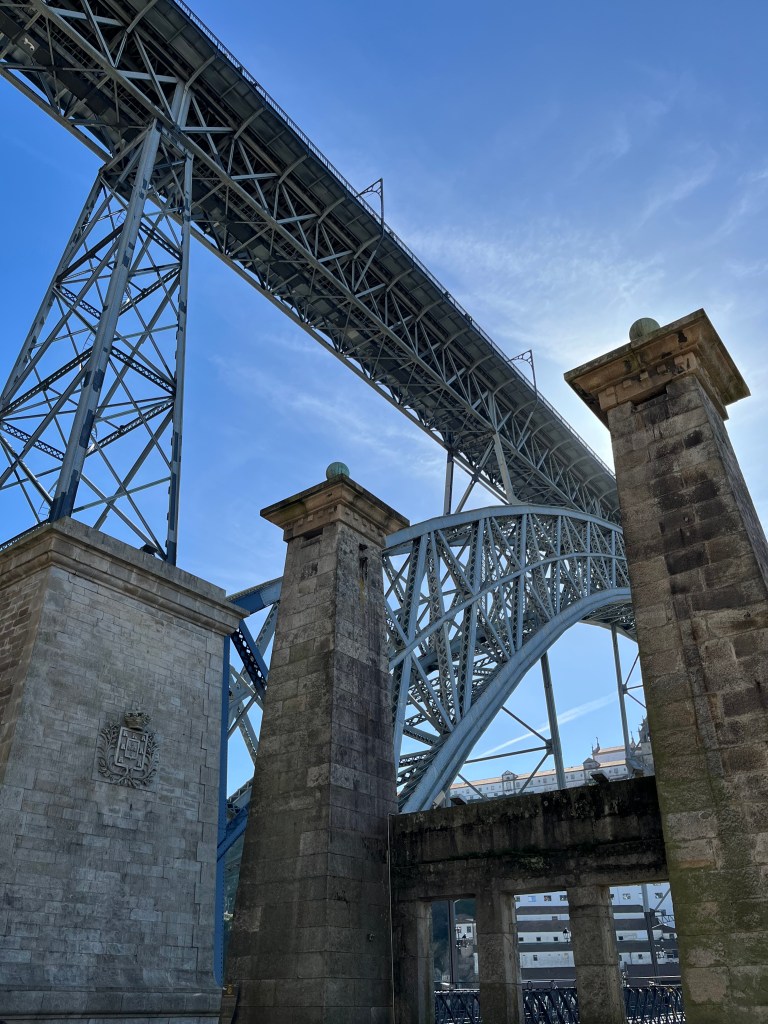
We strolled across. Then up. Again.

To Mosteiro da Serra do Pilar. The monastery, yet another World Heritage Site, harks back to the 16th century. A large square fronting the monastery commands another fabulous viewpoint Porto apparently specialises in.

Wandering back down one encounters the Gaia District featuring gorgeous 19th century warehouses housing the famous wine (port) cellars.

Further warehouses and wine cellars lie behind the Gaia waterfront and give a glimpse of what the area must have been like 200 or so years ago. Wander uphill – this is Porto – and one discovers WOW, Porto’s cultural district. It’s a stunning combination of old renovated warehouses and modern edifices housing museums, restaurants, bars and stores. WOW’s sheer size unfortunately made the absence of humans palpable. Thankfully, as we disappeared, the lunch crowd appeared.

To be honest, we only walked around, went to the loo and considered a coffee. The Chocolate Museum and World of Wine warrant further investigation. The laws of time and space (I watch alot of sci-fi) meant this wasn’t possible.

The Teleférico de Gaia, cable car, gracefully ascends from the waterfront to the Jardim do Morro Metro Station offering pretty peeks of Ribeira and Gaia. It’s a tad expensive, lasting all of 5 minutes and offering only an alternative perspective, not anything new, Nevertheless, a pleasant diversion.

Port is a fortified – usually with brandy – wine. Red grapes are the norm though not exclusively so. Adding brandy shoves up the alcohol level to around 20% also preserving more of the natural sugars from the grapes by stopping the fermentation process. This adds sweetness. Many ports are barrel aged (Ruby and Tawny), Tawney up to an incredible 40 years. We sampled a 60 year old aged sherry at a wedding in Spain a couple of years back. Think what that sherry would have seen. If it hadn’t been stuck in a barrel.

The choice of a top tipple spots are many with port dominating. Now, neither of us are port drinkers, Sus has even less interest than me. Nevertheless, this being Porto, port felt a more appropriate choice than Heineken. I’m a beer snob. If it was Heineken or nothing, nothing would win. And has in the past.

I supped a Tawny, Sus a Ruby and the port, as it turned out, was delicious. And perched on a terrace (Sandeman), in the sun, certainly enhanced our port love in.

I did try a second from further down the port food chain and the difference in quality genuinely surprised me. I suspect cheap supermarket ports are properly nasty.

We wandered back across Ponte Dom Luís I Bridge – incidentally offering wonderful views of its own – and continued exploring the narrow streets that appear to make up much of Porto. Following a brief hotel visitation was wine and fodder at Genuíno. Genuíno, located in another of those interesting districts Porto specialises in, serves both organic wine and food. We tried and enjoyed both though Sus was limited by a small menu. Worth a gander.

Then back to the hotel for a final time. Where they were showing an FA Cup game. Marvelous. An excellent game, lovely staff, mediocre wine.

We’d planned to train it back to Lisbon the following morning. Didn’t happen. We decided to stay in Porto another day. On our brief visitation earlier we booked another night. No upgrade this time.

Stay in Porto Day

The weather was a tad bad tempered the following morning and still raining as we left the hotel. We bravely set forth.

Rua das Flores, dating back to 1521, is a gorgeous street in Porto’s historic centre. And it had stopped raining. Beautiful facades many with charming balconies – a Romeo and Juliet vibe.

The next hour or so we meandered. No set agenda, just choosing streets we didn’t recognise. Or did, halfway down. There’s very little I find more enjoyable, or relaxing.

The Mercado do Bolhão is a large, covered market dating back to 1839 though the current neo classical structure is newer (1914). Perhaps a tad less traditional than it once was locals do mix with the tourist masses. And Mercado do Bolhão still provides a tempting array of fishmongers, butchers, greengrocers and florists across it’s 2 floors. Both bought delicious snacks. We loved it. And would return.

Predictably, as we meandered, craft beer joints magically appeared. Baixa hosts Cerveja Musa on a pretty terrace overlooking the Douro. In stark contrast, Taproom Porto (Dos Diabos) is slotted into a residential street. Both offered friendly natives and good beer. For more details please pop onto https://wordpress.com/post/tonysbeersnobblog.wordpress.com/617.

A return to Mercado do Bolhão, Indiana Jones at the hotel before a final supermarket visit for breakfast goodies.

Lisbon, The Return Of

The following morning a train efficiently returned itself and us to Lisbon. We checked in to our latest home from home before a final exploration of Lisbon.

Tram 28 is tourist temptation – it trundles up and down narrow streets tick boxing many of Lisbon’s famous sights. We initially waiting at a tram stop currently not in use. Deja vu. Walked up to a previous tram stop and waited. And waited. Became bored. Left.

And strolled back up to the lovely Chiado. Attractive streets, pretty squares and a hustle bustle made it a favourite district.

Wandered into Bairro Alto, Lisbon’s party neighbourhood. Bairro Alto has a denser more claustrophobic vibe. It was quiet. Either recovering from the previous night or preparing for that night. Bars are everywhere, party central – and then some – indeed. Attractive though. And steep.

Walking down we passed and popped into another Musa for a cheeky half. Then the huge and crowded Time Out Market. Decent enough though I preferred the feel and food of Porto’s Mercado do Bolhão.

Our final stop was Outro Lado, my third and Sus’s second visit, to what has become a favourite craft beer destination. Anywhere.

Hotel, pack, sleep, wake up, quick breakfast, metro, flight. Home.

Final Thoughts

Our favourite? Porto. We loved the waterfront and the city felt a little less tourist focused, neighbourhoods a tad more distinct.

Nevertheless, Lisbon and Porto are easily recommended. Both charm with beautiful architecture, history and things to do. We could have had a couple more days in each.

Thanks for reading (Tony, April 2024)
Hamburg

Hamburg, officially and rather grandly the Free and Hanseatic City of Hamburg, is perhaps surprisingly Germany’s second largest city (Berlin takes first prize), home to 1.9 million residents and second largest economic centre. By cargo volume Hamburg port is the third busiest after Rotterdam and Antwerp. I’m sure Hamburg wins at something.

It does. Hamburg comprises more waterways than the combined efforts of Venice and Amsterdam. It’s also one of the greenest cities in Europe. Stick that up your portals Rotterdam and Amsterdam.

I have visited before – Sus hasn’t- but that was 40 years ago as a spotty teen maxing out my Interrail card. I suspect it’s changed.

An especially pissed off storm – whose silly name alludes me – delayed our flight by a day and we arrived on the Friday, not the Thursday as originally planned. In fairness we weren’t heading home until the following Friday and busy Wednesdays made any delay less onerous than it might have been. And we went to the pub.

More annoyingly, our BA flight was delayed by about an hour delaying our arrival at our hotel until about 8pm.

NH Mitte Hamburg is a 5-10 minute walk from the magnificently named Schlump (U2/U3) and a 5 minute walk from more traditionally named Christuskirche (U2). If you prefer a stroll, and we generally do, much of tourist Hamburg is reachable within about 30 minutes. The staff were friendly and helpful, our room clean and welcoming and the breakfast – we had it twice – excellent if expensive.

Like any other metro, in any other city the Hamburg Metro is not especially complicated. It’s clean, regular and extensive. The ticket machines less so. We observed the lesser spotted staff member though none appeared equipped to sell tickets to frustrated tourists. Probably wise.

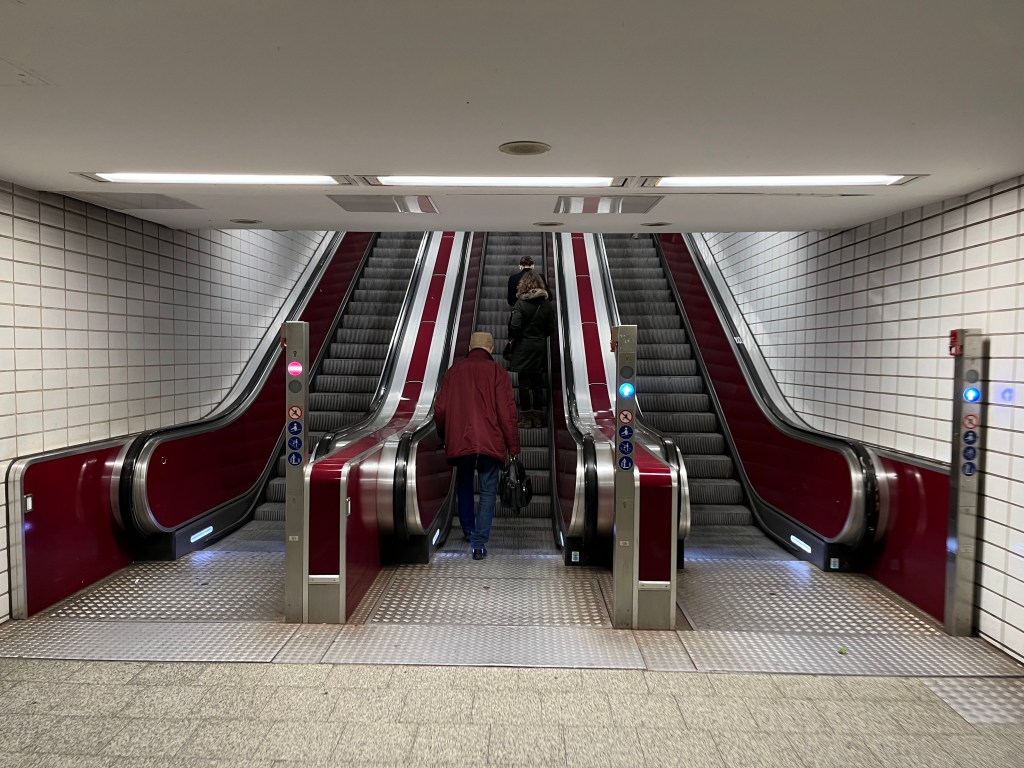
Nevertheless, the most distinctive aspect of Hamburg’s Metro was the total lack of barriers. Anywhere. Now the good folk of Hamburg seemed a decent bunch but a system built on trust? For use by humans? Bizarre.

NH Mitte Hamburg is located in residential and pleasantly upmarket Eimsbüttel – the German language continued giving all week – one of Hamburg’s 7 boroughs. Once checked in, and a chat with the ever helpful staff, we wandered onto the wonderful Weidenallee. Literally around the corner from the Hotel this charming street is packed with interesting restaurants, local bars, bakeries and other speciality shops. And architecturally attractive with many handsome late Victorian and early 20th century buildings.

Weidenallee is a grown up street, witnessed by seemingly hoards of pram pushing parents. This is not the Reeperbahn and much the better for it. Unless you’re under 20 with raging hormones. We, however, loved it.

Denns, an organic supermarket, became a regular haunt (sad but oh so true) as did Beyond Beer (www.beyondbeer.de), a bottle shop full of beery treats. Sus had chosen the hotel. I hid my delight well.

For a little more craft beery stuff please go to https://wordpress.com/post/tonysbeersnobblog.wordpress.com/575

There’s also a Michelin one star restaurant (Jellyfish), annoyingly closed until after we returned home.

Hang a right at Denns and you enter Schanzenviertel, an area nicked from the lovely Eimsbüttel borough by the naughty Altona borough. Hamburg’s Hunger Games. Considered only second to the Reeperbahn for nightlife Sternschanze is chock full of bars, boutiques, takeout food joints and graffiti. Hamburg appears to attract graffiti artists. Must be the climate.

Depending on viewpoint, Schanzenviertel has definitely benefitted or suffered from gentrification. We both liked the area, with it’s Schanzenpark and convenient Sternschanze U Bahn (U3). We often stopped there for a cheeky takeout, a cheekier Denn’s or extremely cheeky light ale at Beyond Beer. All were between Sternschanze station and our hotel, perhaps a 10-15 minutes walk away.

The Long Walk

We had no set plan, just head towards Nord Hauptbahnhof, the Central Station. We took the roundabout route. Very roundabout route. And, I felt a tad unfairly, it rained on us. On and off all day.

Sus. Being Sus.

After starting as we’d finished the previous evening (Weidenallee and Schanzenvierte) we took a left somewhere (probably) before passing Hamburg’s very own entry into ‘Sexiest Telecom Tower’ along with the BT Tower near Tottenham Court Road here in London. Next modern exhibition halls (Messehallen on U2) before a welcome stroll through the quite lovely Stadtpark.

On leaving the park we discovered both the Radisson Blu and Central Station. The Radisson Blu was indeed the Radisson Blu. The Central Station was not the Central Station. It was the beautiful Bahnhof Dammtor and, an in another city, a main railway station.

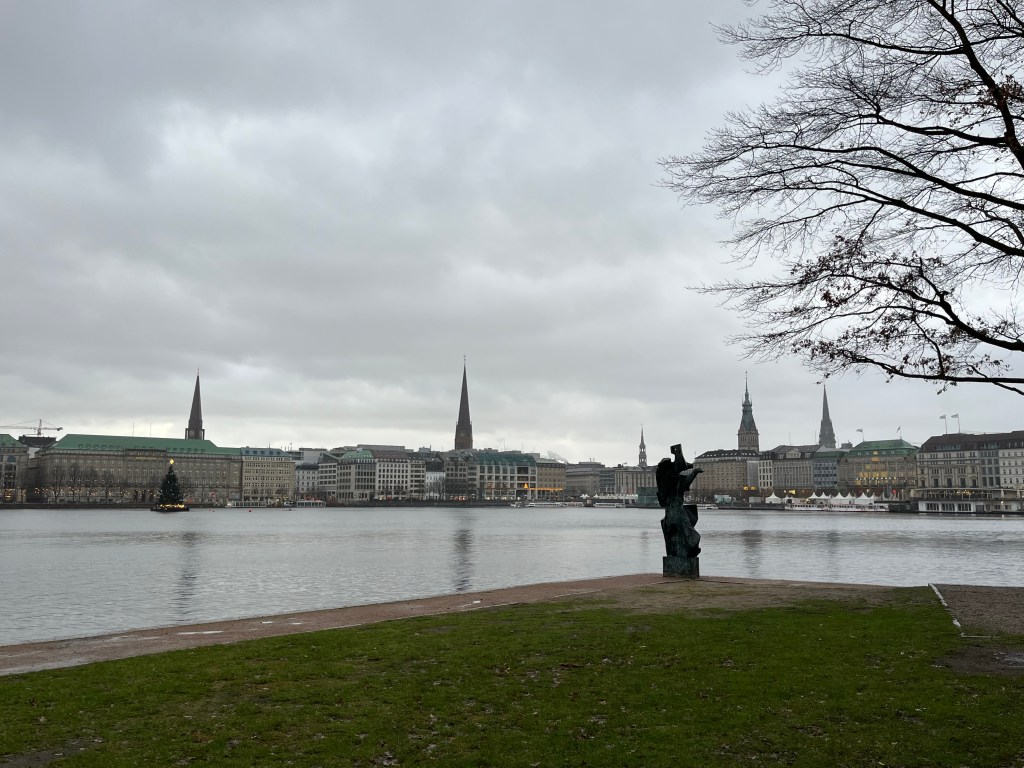
Continuing our wander we came across the Binnenalster (Inner Alster Lake). On the opposite bank spires peeked out from between handsome edifices and a resplendent Christmas tree.

A pretty 19th century bridge took us across – not literally we had to walk – to Hauptbahnhof. Victorian residential architecture is undoubtably handsome though I actually prefer the Art Deco and Georgian period. Nevertheless, Victorian residential architecture pales in comparison to Victorian industrial architecture. Temples to power and influence. Hauptbahnhof is such an example. Hamburg had arrived.

It’s gorgeous, both on the outside and perhaps more so on the inside, rivalling such masterpieces as London’s St Pancras and New York’s Grand Central.

However, it should be remembered many accuse those same Victorians, with some justification, of architectural vandalism tearing down beautiful historical buildings in the name of progress.

The area around the Hauptbahnhof is a tad sketchy though literally across the road is the main shopping centre. High end shops vie with large department stores and chains for that holistic shopping experience. Agreeable enough not necessarily our cup of designer cufflinks.

Perhaps the highlight was a fish ladder enabling finned ones to navigate a difficult stretch of the Elbe. It’s a human solution to a problem often created by humans. Heartening to witness.

The Adam and Eve Soul Food Restaurant (Schanzenvierte) was our chosen eating establishment. And delicious it was too, easily recommended. Cheeky ales at Beyond Beer (https://www.beyondbeer.de/en/) polished off our long walk – 10.5 kilometres according to our suspiciously clever iPhone.

New Years Eve Day/Lubeck

After our first attempt to eat as much as our own body weight at breakfast – as would you at 20 Euros a pop – we began our exploring.

It was a Sunday. Hamburg, with the exception of a few restaurants and bars, closes its doors on a Sunday – vaguely reminiscent of England in the 1980s.

However, if you find yourself need of retail therapy or schnitzel sandwich the larger railways stations, including their shops and bars, are open as near normal. And Hauptbahnhof was our destination, a Lubeck daytrip the purpose of the visit. Not a schnitzel sandwich.

Located at the end of the platforms a small glassed in area served as a bar and smoking den. It was busy at 11.30am and appeared to have been open for some time. Perhaps glassed so that passing passengers might judge and feel better about themselves. I certainly did and did.

From our own observations, smoking was more prevalent in Hamburg than London. Conversely, vaping appeared considerably less popular particularly amongst the young.

Acquiring tickets and the 45 minute train journey were painless. The unfolding scenery, comprising of uninspiring countryside and somewhat dreary conurbations, was disappointing.

Lübeck was neither dreary or uninspiring. This mediaeval marvel, and UNESCO World Heritage Site, is surrounded by water and perhaps surprisingly built to a plan. Which survives intact, in part thanks to 1970s activists, to this day. Mediaeval and Renaissance town houses, 5 gothic churches and canals dominate Lübeck’s old town. Much of Lübeck originates from when the Hanseatic League was top mutt with lucky Lübeck controlling North European long distance trade.

Lübeck is gorgeous even on a wet, cold and windy Sunday afternoon. We spent several happy hours wandering contentedly around only stopping for vegan nosh at NI Vegan. Genuine surprise – it was open and the food was possibly the best we ate all week.

Suitably foddered we explored further discovering the Rathaus – a sometimes appropriate moniker for those town hall folk if a tad unfair on rats – and beautiful churches. Popping into one showed the outside was no fluke. Magnificant.

We had a 27 minute walk back to the train station. Our train was in 29 minutes. Rain added further incentive. A little drama, particularly when cruelly tricked by google (sent down a blocked road). Cue dramatic rousing music as we boarded with minutes to spare. In truth, the next train was only half an hour behind. More ‘Railway Children’ than ‘Brief Encounter’.

Back to hotel, beers bought the previous evening, whilst listening to New Year fireworks. Not the barrage one hears in London.

St Pauli

Knowing New Year morning would offer sparse breakfast options we, at the hotel buffet breakfast, again maximised our food intake against body mass. Including a donut. The fine people of Hamburg – and they really were – love a donut or several.

Predictably, tranquility reigned as we strolled towards St Pauli. With the exception of a Trans club. Apparently and rather admirably still drum and bassing (or whatever) the day after the night before. It was loud. It was after midday. Making it beyond 10.30pm fills us with a sense of pride.

Detritus of Hamburg’s partying masses was, unremarkably, everywhere. Debris from unimaginative beverage and food choices were expected. What wasn’t was evidence of deceased fireworks liberally smeared over the urban landscape. Though Germany has relatively strong laws surrounding the sale and setting off fireworks Hamburg appears to favour the pavement as a launchpad. Bizarre.

On our way to the infamous Reeperbahn we passed FC St Pauli, a football team in the 2nd tier of German footy. So what? FC St Pauli have developed a cult following within Germany and outside for their strong and politically liberal stances. The stadium is sold out game after game. Sales of their merchandise out strips most top tier clubs.

I love football, have most of my life. Nevertheless, occasionally it’s not about trophies, the football on the pitch or owner’s money. It’s about a strong community and a better world. Go FC St Pauli.

A carpark sits in front of the ground and a bizarre construction to one side. Part evil factory, part futuristic garden city in the sky. This bastard child is still under construction. What will it become when it reaches building adulthood. A destroyer of worlds or a bringer of peace?

The Reeperbahn is a street, or neighbourhood, infamous for nightlife, bars, fast food joints and prostitution – legal in this bit of Hamburg. Unsurprisingly, a street both loved and loathed, was quiet early afternoon on New Year’s Day.

Epic levels of detritus from the previous night’s festivities covered the street. The homeless gathered around in small groups. An air of vague menace added to the weird vibe. The Reeperbahn, particularly one side, is all rather nasty. Sus wanted off as soon as she arrived on. I felt similar but wanted to better understand this notorious street.

Not for us, not our cup of fizzy lager. We are in our 50s, not 20s. For any hormone laden, late teen the Reeperbahn might appear a nirvana. Vague memories of my 20s offer insight. If not understanding.

Cold weather and age had adversely affected my apparently shrinking bladder. A Brewdog, at the top of the Reeperbahn, proved most welcome. I chatted to the manager, acquired an ale, went to the toilet a second time. Then left.

On leaving the dog that brews – now that would get the punters in – we ambled over to Hamburg’s Speicherstadt, the warehouse district. Built between 1881 and the late 1920s this UNESCO World Heritage site is the largest warehouse complex in the world. And quite beautiful.

I’ve always admired warehouse architecture – Butlers Wharf being a favourite building in London – and Sus adores miniature worlds. One of these beautiful warehouses contained Miniatur Wunderland (https://www.miniatur-wunderland.com/). Put together my 2 enterprising brothers back in 2000 Miniatur Wunderland happens to be the largest model railway system in the world and been voted the most popular German tourist attraction. Apparently, many agree with Sus. I found it’s often the best way.

Miniatur Wunderland is properly spectacular with numerous miniature worlds including an airport. We spent 2 absorbing hours wondering at both the details and scale. Unfortunately, we weren’t able see all the worlds – somehow missed South America, not easy to do. There’s always next time.

Highly recommended.

Back to our hood for a beverage and food. Then sleep. We’d somehow walked further than the day before.

Harbour Cruise Day

Breakfast was at Denn’s. Obviously. It was an unpleasantly wet and cold day. Thermals were an invisible part of our wardrobe, probably a good thing seeing how figure hugging they were. No one wants to see that early on a back to work day.

We squelched our way down to the harbour – or Sus did. Leaky shoes, each foot encased in a plastic bag, doomed her to freezing feet for much of the day.

An English chap, with a disconcerting resemblance and manner of an ex colleague, explained the merits of the various boat trips. After careful consideration, we chose the first to leave. The weather may have influenced our decision. Being allowed on board to wait out the 20 minutes before departure perhaps played a part.

The small and agreeably serviceable boat was equipped with large expenses of glass, clean toilets and a bar selling snacks and beverages. An improvement on other watery excursions where a tiny wave might turn the boat into a mini Titanic.

We journeyed through the warehouse district, passed streets both recognisable and yet to be explored before the port proper.

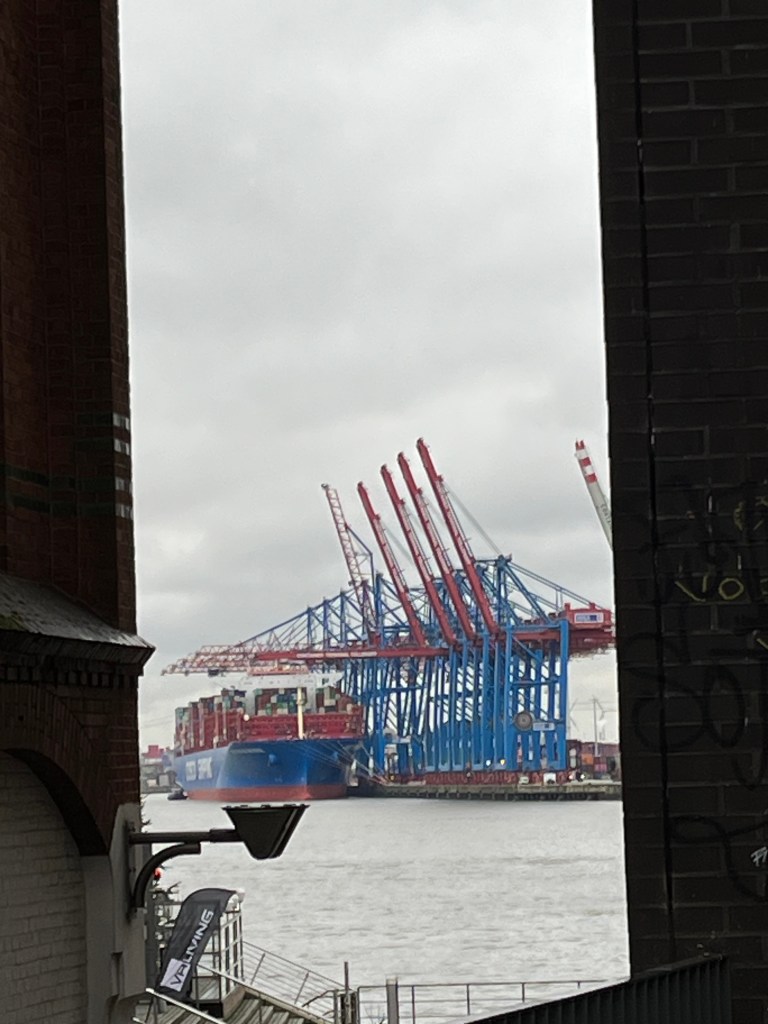
I was utterly captivated by the balletic loading of a huge container ship enduring the freezing cold and rain on a small open area at our boat’s stern. No human activity was visible only adding to this magnificent mechanical ballet.

Though expensive (30 Euro each) and with an overly loud and enthusiastic German commentary (English was available via an inevitable app) this hour long cruise, with and perhaps even because of the awful weather, was hugely enjoyable.

After again wandering around the shopping area, and with the weather unable to compromise, we headed back to the hotel so Sus could thaw out her feet.

You’ve guessed correctly, off to another craft beer spot for an ale or two. A 15 minutes stroll from our hotel brings thirsty patrons to the unimaginatively named Craft Bier Bar. The lack of the oft silly name more than compensated by about 30 taps of quality crafts and delicious pizza.

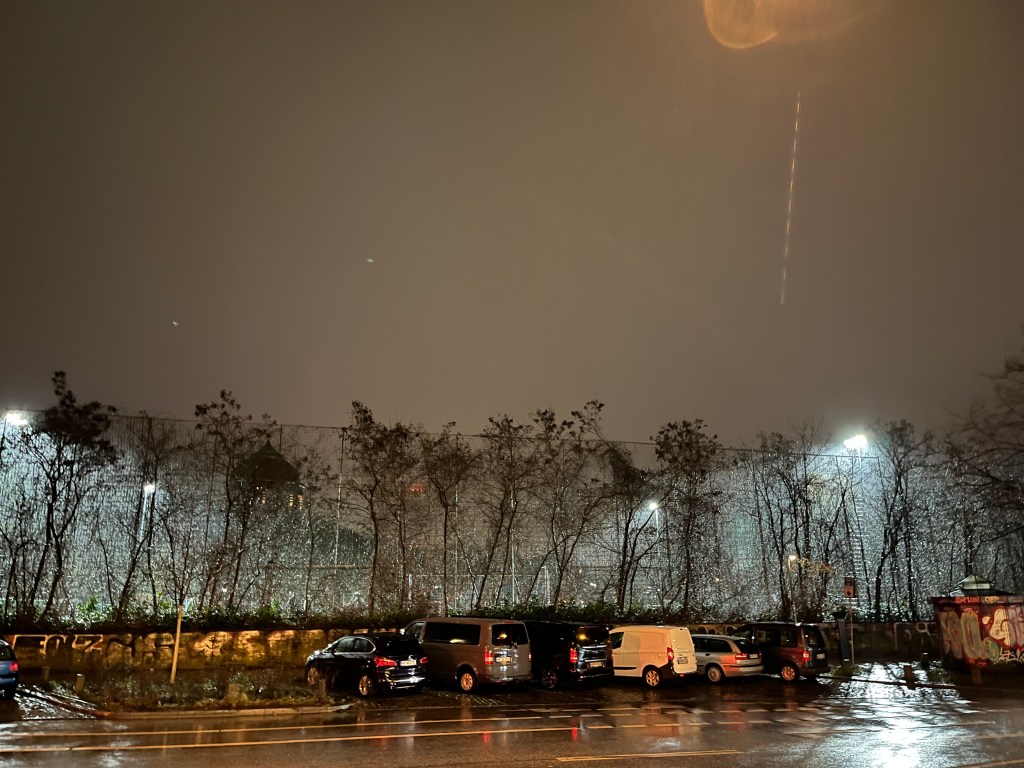
An Alien Invasion. Or a wet carpark outside a supermarket.

Bremen

Bremen is a little more than an hour by train from Hamburg. The charming scenery (a welcome upgrade from between Hamburg and Lubeck) is speckled with similarly attractive towns and villages. Noticeable was the amount of flooding in passing fields.

Bremen is another of those once successful Hanseatic cities this time located on the river Weser.

The UNESCO world Heritage sites of town hall (1405) and oddly named Roland Statue (1404), symbolising the city’s freedoms, both play a their part in Bremen’s beautiful market square. The town hall, in particular, is a proper stunner and worth the train money alone.

Contentedly installed in the town hall cellars Bremen’s Ratskeller houses one of the oldest and finest collections of German wine. St Peter’s Cathedral, dating back to the 11th century, also competes for your affections with its UNESCO chums.

And do check out the wonderfully quirky Bremen Town Musicians statue (1953) close to the town hall. A fan favourite. Including us.

Böttcherstraße (1922 to 1932), and built in the architecturally rare expressionist style according to the Bremen Tourist Site, and a gem to meander slowly down. Bremen’s oldest district, the Schnoor quarter, is a maze of pretty 5th and 16th century lanes lined with similarly pretty shops and houses.

For those craving a little modernity and retail therapy Bremen also has an attractive town shopping heart with all the usual suspects.

We knew what we were getting with Lübeck, Bremen was more of an unknown. Somewhat unexpectedly we preferred the latter to the former.

The return train was at least 30 minutes late. So much for famed German efficiency.

Omnipollo (https://www.omnipolloshamburg.com/) was another craft brew spot. And pink. Undoubtably the quirkiest of the 3 Hamburg craft outposts. Great beer and friendly service were a given.

Very pink.

Große Elbstraße

Our last full day in Hamburg. Late start, metro to Landungsbrücken (harbour) hanging a right and not our usual left towards the town centre. We like to live dangerously.

We wandered into St Pauli. Tiptoeing gentrification apparently replacing ‘don’t ever go there’ to ‘Darling, I think we should buy in St Pauli’. After Reeperbahn nastiness this was both a significant and welcome upgrade.

Große Elbstraße, scampering alongside the Elbe, was especially charming. Original fish market buildings attractively converted into shops, fish restaurants and bars. FrischeParadies is an upmarket supermarket with a fish cafe at one end. We ate there. It was fab. The wine was also splendid. We later discovered it on the shelves for less than half the price. Bugger. Should have stuck to the house wine.

Back to Schanzenviertel, breakfast treats from Denns, beer treats from Beyond Beer. It had been a bitterly cold day, even our thermals were thinking about a holiday, but a thoroughly enjoyable one.

Flying Home Day

It was snowing. Rather alot. A gallery appealed.

We slipped and slithered our way to the Kunsthalle enjoying an hour or two with some Grand Masters.

They say hi.

Back to the hotel, airport, flight home.

Final Thoughts

Highlights? Warehouse district, Miniatur Wunderland, distinct neighbourhoods, the water.

We’ve visited Berlin and Munich each a couple of times. Great cities both. But you know what, we preferred Hamburg. Even with the cold and wet weather. Hamburg is attractive, green and friendly. And perhaps doesn’t take itself too seriously.

Loved it.

Many thanks for reading.

Athens

I mentioned in my previous blog – https://wordpress.com/post/constanttravel.travel.blog/305 – that the Good Ship Croydon cruise originated and concluded in Athens. Our Airb&B was in Plaka, old town Athens. Five nights, six days stretched lazily into the near future.

A bit of history. Annoyingly ambitious Ottomans conquered Greece in the 15th Century. Silver lining? They booted out the Byzantines. The Greeks reclaimed their country, following several unsuccessful attempts, in 1821 during the War of Independence. Happy endings all round.

A bit more history. Much of modern Plaka was constructed, by returning Greeks and non Greek settlers, in the decades following 1821 though remnants of older civilisations dot the city landscape.

Once settled into our commodious temporary home we explored Plaka.

Tourist central and not difficult to understand why. Plaka is charming, close to the bestest touristy bits and resplendent with tavernas, restaurants and shops.

Kolonaki, an upmarket Athens suburb, clambers steeply from the centre making a nip to the shops an endurance exercise. Or torture. Architecturally, uninspiring comprising of mid to late 20th century low rise apartments with an occasional modern block or church offering welcome relief. Nevertheless, the shops, restaurants and people all appear upmarket with a bustling main drag and welcome greenery. The panoramic vista back down into plebeian society emphasising perhaps where you came from.

An inevitable craft ale before Netflix and bed. More on the genuinely surprising Athens craft beer scene can be found at https://wordpress.com/post/tonysbeersnobblog.wordpress.com/525

Athens and the Acropolis. Synonymous with one and other. A total love in. And after queuing for about half an hour Acropolis tickets were ours. A 2 hour wait until our allotted entrance afforded us time for light shopping and to arrange a trip to Delphi for later in the week.

History thing again.

The Acropolis site has been occupied, and unsurprisingly fought over, for 6,000 years. But not by the same 2 adversaries. That would be silly.

In the mid 5th century BC, at the golden age of Athenian culture and power, the Acropolis became the seat of the Athenian League – a little like a modern day protection racket.

Perikles was a renown general and politician from a moderately wealthy background who found himself top dog through this so called golden age. Thankfully, he happened to be rather good at war whilst conversely promoting democracy and the arts. One of those irritatingly good at everything kind of chaps.

The Parthenon. And Chums

Perikles initiated an ambitious building project lasting the entire second half of the fifth century BC. The most important buildings visible on the Acropolis today – the Parthenon, Propylaia, Erechtheion and the Τemple of Athena Nike – were erected during this period.

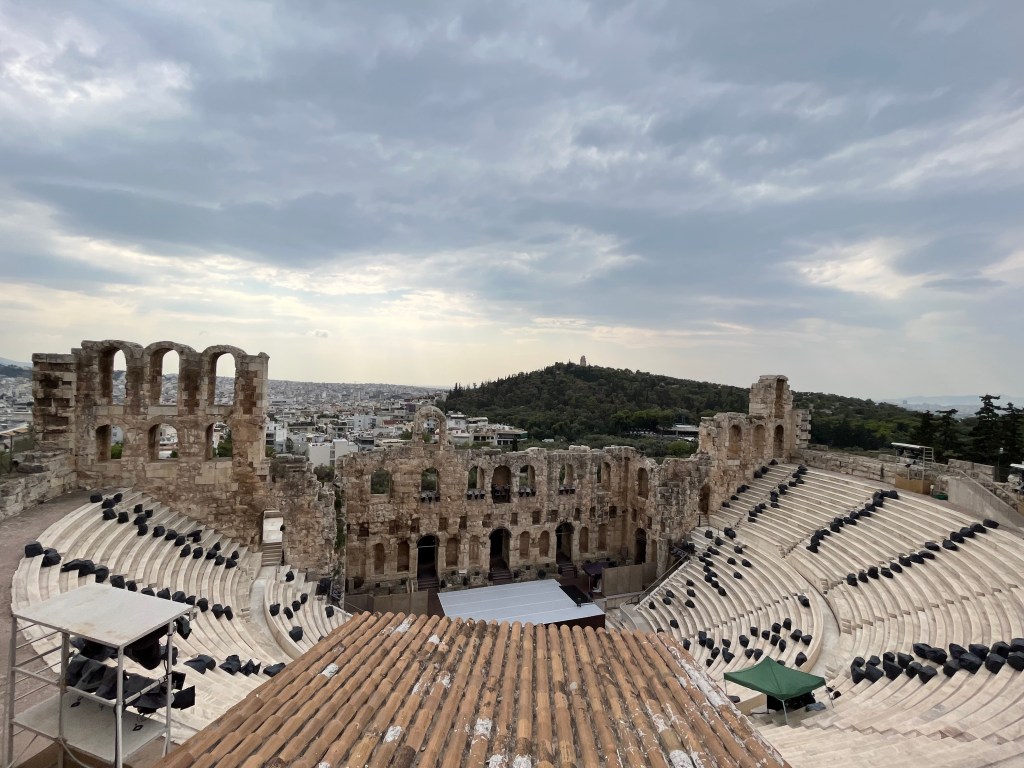
The winding, though not overly taxing, route upwards (obviously) meandered pleasantly by a number of ruins including a quite beautiful amphitheater.

Once the acropolis is reached, even with some modern reconstruction, it’s impossible not to marvel at these 2,500 year old buildings. And it never occurred to me that it wasn’t just the Parthenon up there – it was the Parthenon and chums.

We took our time, taking in the architecture and vista over Athens. My favourite – apologies Parthenon groupies – was actually the Τemple of Athena Nike.

It had been teeming on the way up but, to our surprise, it wasn’t on the way down. Perhaps mid afternoon is the time to visit.

On descending we popped by the Ancient Athens Agora (meeting place and triple alliteration) and the beautiful Temple of Hephaestus dating again from a bewildering 2,500 thousand years ago. Our final cultural delight was, not to be outdone by those show off Greeks, a Roman Agora gate opening into what had been the centre of public life during Roman rule. This Roman upstart is a relatively modern 2,000 years old.

We relaxed with a predictable craft beer at Strange Brew (again, check out my beer blog), probably our favourite of the craft beer tipple houses.

Strange Brew, walkable from Plaka, is located in Koukaki. We’d stayed in Koukaki a week earlier – before our cruise – and peeked around. Our verdict wasn’t encouraging.

‘Koukaki is well kept – as we discovered Athens to be generally – though architecturally uninspiring. Late 20th century, low rise apartment blocks make up the vast majority of Koukaki with only colourful awnings offering any interest or glamour’.

Our second Koukaki outing challenged these initial thoughts. A week didn’t beautify Koukaki – I doubt several years would – though modern apartment blocks added a little architectural glamour. Nevertheless, exploring Koukaki further we discovered an up and coming neighbourhood with a creative, bustling vibe. It very much appealed with both preferring Koukaki to the posher Kolonaki.

And wouldn’t Koukaki and Kolonaki make great children names. Better than Brooklyn. Or Croydon.

Zeus, Hadrian and a Museum

The following day was a tad more tranquil. After breakfast – good reviews, average breakfast – a short stroll took us to the miraculously surviving 2,000 year old Gate of Hadrian. The gate is, somewhat congruously, situated close by a busy main road only emphasising it’s survival instincts. Hadrian would not have been best pleased.

Next up was the Temple of Olympian Zeus opportunely located alongside Hadrian’s Gate. Yep, the same rather busy chap who built Hadrian’s Wall in the north of England to keep out those troublesome Scots. If you wish to get close up and personal to the temple and into the architectural park there is an entrance fee. If you’re skint, tight or short of time the temple is easily observed from outside of the park. We went down the close and personal route and, even today, it’s mightily impressive. What an incredible spectacle it must have been in ancient times.

The temple was started in 515 BC and consisted of a 104 columns. The actual construction spanned an incredible 650 years – reminding me of London’s Crossrail – and finally completed by Hadrian. Somewhat cheekily, Hadrian put statues of himself into the sanctuary. Like his style.

Tragically, during mediaeval times, columns were destroyed or reused for construction. Upcycling isn’t always a good thing.

Our final culture adventure was the Acropolis Museum. We queued for about 20 minutes for tickets.

Wrong queue.

Another similar amount of time in the right queue deposited us in front of a lovely lady who promptly sorted 2 tickets. We loitered in the museum for a good hour and a half and, on leaving about 2pm, discovered both queues inexplicably disappeared.

Even so, the Acropolis Museum is a fine way to wind away an hour or more. And queuing. Twice.

Wine was our choice of tipple late that afternoon. Finewine (https://www.finewine.gr/) was the venue. It’s small with a couple of tables outside with ample people judging opportunities. The wine and service were both top notch – the last wine the owner recommended is particularly memorable.

A couple of days later we popped by a second time but it was closed. A pity.

We ate – the setting better than the food – before heading back to our digs.

Delphi

Delphi, our destination the following day, necessitated an inevitable early start. Transport options include driving, public transport or an organised tour. We chose the latter. And enjoyed a personable, knowledgeable and refreshingly honest guide.

The journey, by bus, was to stretch to around 2 hours. The outer Athens suburbs and the outskirts of the city are a tad drab. Not on the tourist trail and you won’t need a town planner to work out why.

I’d been expecting an arid and brown landscape but once clear of said drabness Delphi trail tourist are greeted by mountains, rolling hills, woods and farmland. Genuinely striking and a most welcome surprise. Delphi itself is situated at the base of Mount Parnassos.

Quite alot of history time.

There’s architectural evidence that the Delphi site was occupied 6,000 years ago with the cult of Apollo established in the 8th century BCE. Prompted by this Apollo chap Delphi developed into both a sanctuary and the oracle. Athena, fashionably late, appeared a little over a century later.

According to literary and archaeological evidence many other gods were associated with the sanctuary including Artemis, Poseidon, Dionysus, Hermes, Zeus Polieus, Hygeia and Eileithyia. Must have been irritating.

The Amphictyonic League, an association of twelve tribes of south-central Greece, controlled the sanctuary and, under the protection and administration of the League, made it autonomous in the 6th century BCE. The oracle blossomed boosting its territory, political and religious influence throughout Greece.

Between the 6th and 4th centuries BCE, the Delphic oracle, was kicking ass. The Pythia, a priestess delivered the prophecy, typically interpreted by a bunch of blokes, the priests of Apollo. The oracle was for all – cities, great rulers rich and poor – with all leaving gifts enriching the already enriched.

The Aetolians conquered the sanctuary in the 3rd century BCE before they themselves were driven out by the Romans in 191 BCE. Some Roman emperors favoured the Delphic oracle (Hadrian), others just nicked anything valuable (Sulla).

In the 3rd century BCE, the Rationalist philosophy movement damaged the oracle’s authority. People stopped believing. Later abandoned, partly destroyed and left to ruin the village of Kastri was ignominiously constructed over the site in the 7th century AD.

Still atmospheric over 2,000 years later. As is the scenery.

We toured the main site, along seemingly with most of Europe and the US. Below is the theatre and the pillars bottom left are the remains of Apollo’s Sanctuary. Where many an unfortunate goat met an unhappy – for the goat – sacrificial end.

Briefly abandoned to our own devices, and as had been suggested, we trudged to the pointiest bit of the Delphi site. Here lies a well preserved ancient stadium – the best in Greece – originally built in the 4th century BCE though tinkered with for the following 200 hundred years or so.

An incredible 6,500 sports fans could ogle their favourite atheletes win, lose or fake an injury. Online gambling would be all over it.

Next up for our weary travelling companions was a small but interesting museum followed, after a very short bus ride, the Temple of Athena Pronaia. Told you it was a long day.

Built in the 7th century BCE, and in keeping with much of the Delphi Sanctuary, was in ruins with only small sections still standing. Nevertheless, in those surroundings, with only a few people around it was properly atmospheric. Back in it’s heyday chez Athena must have been spectacular.

Perhaps surprisingly, my favourite old bit of the Delphi Sanctuary, along with that stunning scenery, was The Stadium. Undoubtably the most complete, a tad more secular and, to me, more real.

We stopped at a village for fodder – I spent the 45 minutes exploring, others sat down for a meal – before our return to Athens. It’s a lengthy day but, if you have the opportunity, a worthwhile one.

Chilling was the goal for our last full day in Athens. We wandered aimlessly exploring neighbourhoods we’d yet to explore. Some upmarket (Psiri), others less so (Omonia), all interesting.

We drank a little ale (Tales of Ales) listening to Jazz, ate delectable food at Ferouz (https://feyrouz.gr/) and completed our Netflix series smugly discovering the murderer before the big reveal. All in all a perfect day to end our 2 week jaunt.

Athens from Anafiotika, a pretty village within a city

Final Thoughts

Athens. Grows on one. Stunning ancient ruins are sprinkled pleasingly across the city, the Acropolis chief amongst them. Pretty neighbourhoods such as Plaka and buzzing neighbourhoods such as Koukaki are certainly not the exception but neither are they the norm. Much of the city, from what we observed, is a tad drab, lacking personality.

Nevertheless, if Athens isn’t on your tourist trail list, give it a go. No-one should be unmoved by those ancient ruins and the city has much to offer.

Would it be our favourite European capital? No but we’re very glad we went.

A Cruise, a Virgin and Democracy

We both prefer holidaying in the off season – cheaper, often better weather, less children/parents of children – and had 2 weeks booked off for end of September, beginning of October.

A fact both had been aware of for several months. And yet again, delayed any concrete plans to less than a month before. It was beginning to look like a caravan in Scunthorpe until Sus spotted a decent deal on a week long Virgin Cruise. Adults only. The non orgy kind.

Athens, Briefly

The cruise left and returned to Athens – not Scunthorpe – and meant a stupidly early flight to Athens that had us standing outside at 4.15am waving hopefully at any vehicle resembling our taxi. Thankfully, and in keeping with the taxi company we hire for such journeys, our driver arrived promptly, delivered us safely to Heathrow for an uneventful flight and passage through Greek customs.

A train, a tram and short walk deposited us in Koukaki, an Athens district a little south of the centre and ye olde stuff. I should add this wasn’t random. Our hotel for a one night stay was located in Koukaki. This being around midday – we were to board our cruise 4pm the following afternoon – left us plenty of time to explore.

Koukaki is well kept – as we discovered Athens to be generally – though architecturally uninspiring. Late 20th century, low rise apartment blocks make up the vast majority of Koukaki with only colourful awnings offering any interest or glamour.

We wandered and discovered – after conferring with Google – Blame it on the Sun taproom. A pleasant way to conclude out first evening.

Graffiti is omnipresent in Athens – if there’s a surface there’s a daub. My favourite was a neatly written ‘Pasta’. Presumably meaningful to someone. Nevertheless, I like to imagine some kid, on his first foray into the world of graffiti, panicked and daubed what he’d eaten for lunch.

Koukaki was meant to be a district on the up and up. On the OK and OK felt closer to the truth. We revisited Koukaki several days and several thousand words later.

We overslept and then kicked politely out of the swimming pool. An incredibly apologetic security chap explained the lack of a lifeguard was a safeguarding (read liability) issue.

After securing a late checkout from a lovely reception lady we troughed breakfast, showered, checked out and, leaving our bags with the hotel, happily meandered off.

To the National Gardens. A genuinely lovely green space in the very urban Athens. Numerous species of trees complemented attractive plantings and ponds full of turtles. The latter somewhat stole the show. This being Athens it was hot. The turtles competed to clamber onto rocks set in the ponds presumably to sunbathe. It made fascinating viewing. A very, very slow motion Ninja Turtles movie.

The Ship

Back to the hotel, bags picked up, taxi to our Virgin Cruise. And a genuine shock. The ship was an absolute monster, rising 16 floors – 4 times the height of the apartment block we live in. Naively we’d assumed a smaller ship, not something the size of Croydon. Boarding was efficient and quick.

Subtle

Our cabin was located on the 10th floor (still sounds wrong) which was serendipitously splendid – the 15th floor was habited by multiple food outlets with the 7th floor hosting the majority of bars and speciality restaurants. The 6th floor boasted duty free shopping with the 16 floor reserved for a small pool, several jacuzzies and yet more bars. It was the party floor. Not our cup of seawater though a running track, cage for shooting hoops or kicking a football and a decently equipped gym all lived alongside partyville.

We righteously declined the efficient lifts and chose stairs to navigate between floors. A little like those seeking a carbon neutral solution, we felt stairs would offset our food intake.

The corridor our cabin was housed (berthed?) was distinctly dystopian – an updated 1984 if you will – in its length. There was a kink about two thirds of the way down only increasing the feeling you’d never escape.

Nevertheless our cabin, though compact, became a peaceful haven, a place to rest and rejuvenate. And it was quiet. Some corridor noise occasionally intruded though the slight hum from the aircon and a slighter thrum from the engines were never intrusive. Almost soothing.

A comfortable bed, a modern TV with an up to date library of films, all added to the serenity vibe. Everything was efficient – shower, air conditioning and storage space. A small fridge proved useful on occasion. The toilet was typhoonesque in its execution. Nothing – medium sized children, a decent sized dog or less important bits of furniture – would block it.

All cabins come with a view, ours was no exception with a small balcony large enough for 2 chairs and a small table. And a ridiculously comfortable hammock. Sus fell asleep ensconced one evening not waking up until the early hours. Though later in the season the weather was warm and the balcony, for us both, a regular haunt. And weirdly, the only time and place I ever saw our neighbours. On their respective balconies, not on ours. That would have been weirder still.

Bookings for restaurants, activities and shows were booked through an inevitable app. Customer services located on the 6th floor would also happily oblige without haptic feedback.

A rather clever tablet in the cabin controlled the TV, lights and opened and shut the curtains. I spent an enjoyable few minutes trying to break it.

Food

The previous evening we’d bagged a place at The Test Kitchen, one of the speciality restaurants, The food and ambience were delightful, would certainly recommend. Razzle Dazzle was another speciality restaurant where booking was part of the game. Again very palatable, posh gastro pub fodder. The Korean speciality eatery was less recommendable. The concept felt contrived and the food was at best average.

However, along with The Test Kitchen my favourite dining experience was undoubtedly the 15th floor. One could graze at 15 different food outlets. Until one exploded. In that week I must have tried most if not all of those outlets. The food was invariably excellent. Only the coffee was a tad rough and the orange juice sweetened rubbish. Fresh orange juice and proper coffee could both be purchased.

Fabulous outdoor seating at the stern (back) of good ship Croydon, often with gorgeous views, was to prove irresistible. A little like the dessert eatery I frequented. Quite a lot.

A Sea Day

Our first full day on fab ship Croydon was spent at sea. Our first breakfast, and all those that followed, were taken on the 15th floor. All good, non bad.

We spent time on the balcony hoping to spot a whale or pod of playful dolphins. Never did. We watched a film and read before heading to the 7th floor (stairs obvs) to catch an excellent 3 piece blues band. Next a bungey, yoga class (google) earning the right to demolish excellent pizzas. A wonderfully relaxing day finished with ‘Guardians of the Galaxy’ and a bottle of red.

Split, Croatia

Our first proper destination was Split, a city we’d wanted to visit on a previous Croatia jaunt but unable due to being somewhere else.

After breakfast and a fascinating few minutes watching the manoeuvring jets do their thing – the rear ones were below our balcony – we disembarked and ambled into Split’s beautiful medieval old town. Initially established as a port by those clever Greeks Split was later developed by several empires including the Romans, Byzantines, Venetians, and Ottomans. That’s one distinguished list of invading hoards.

Remarkably Split is Croatia’s second largest city of about 400,000 souls. And the largest on the Dalmatian Coast.

If one craves more than another Medieval city, Roman ruins lie carelessly dotted about.

Diocletian’s Palace is the most famous of Split’s attractions,  part luxury residence, part fortified military garrison. The palace complex was constructed in the 3rd and 4th centuries AD for the Roman Emperor Diocletian, Gaius Aurelius Valerius Diocletianus, to his chums. It was hot. Very hot. There was a long queue. We didn’t go in.

What we did do was promenade along the sea front and stroll aimlessly through the conveniently pedestrianised old town. Lovely.

Then we walked up a hill. A lot of hill. Marjan Hill. What started as a stroll around interesting bits of Split ended with panoramic views and loss of body mass. After an agreeable halt in a small though rather finely formed communal, green space we chanced upon a popular restaurant with outdoor seating and fabulous views back over the city and bay. Good ship Croydon, clearly visible, sparkled in the sunshine.

Remember, this was October though the sun had apparently forgotten. Global warming in action. Another sweltering, uphill yomp brought no views – trees obscured even our ship – but a level area resplendent with a pretty if tiny church.

Stairs gleefully beckoned. Mercifully shaded by a wooded area. After some debate we resolutely set forth. As we generally do. An English couple were descending and we swapped a few words. Their preparation was to ‘sink a couple of pints’ before setting of. Makes you proud.

More steps, more uphill before we reached the Marjana-Telegrin viewpoint. Which wasn’t. There was was kid’s zoo, an observatory but little to view. Smug looking trees blocked most of what might have been there to see.

We struck up a conversation with an equally confused and disappointed 20 something American girl. Our band of 3 was literally heading down when an American family, who must have overheard, intervened. They kindly revealed a short walk and inevitable stairs would quickly plonk us on the viewing point proper. They were right. And it did.

To a large concreted summit with stunning 360 degree views.

We three wandered down saying our goodbyes to our young American chum at a fork in the path. Sus had left her bag somewhere on the trek up necessitating walking the same way we’d trudged up. We successfully rediscovered the bag in the community garden we’d briefly rested on our way up. Result.

Now able to deviate from our original route we discovered another sumptuous slice of Split to explore. Duly explored, time for a light ale. Apple maps unearthed one craft beer spot that appeared to use the word ‘craft’ to attracted the unwary. And ultimately disappointed. We left before we arrived.

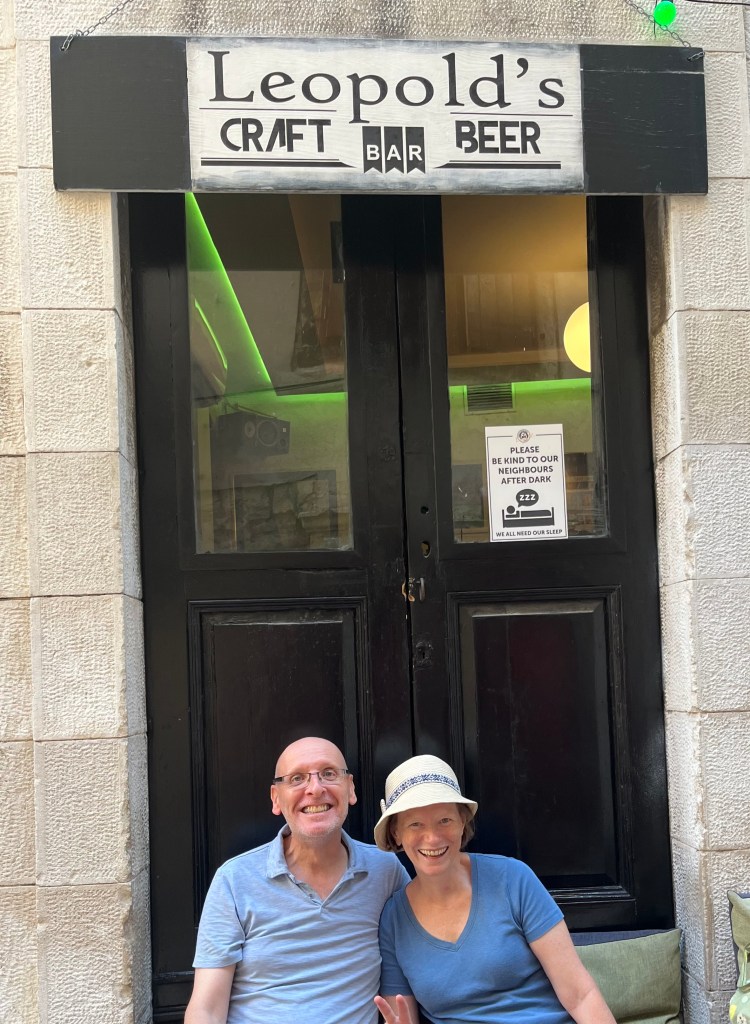
However, a lovely spot, Leopold’s Bar (see beer blog) proved a saviour.

Back to the ship, necessary showers before a cocktail and an excellent dinner. We’d walked 13 kilometres – most seemingly uphill – that day.

And Split? A lovely city we’d happily pop back into sometime.

Dubrovnik, Croatia

A confession. We’d independently visited Dubrovnik and Kotor back in 2019 during the off season. Both agreed never, never to return to either on a cruise ship. That went well.

The notes below are taken from a blog from that time. I’ve added further thoughts at the end of each section.

If you only do one thing in Dubrovnik have a stroll around the city walls. It’s expensive (everything in Dubrovnik is) but gives fantastic views of the old town, the Adriatic and the surrounding hills. And then lose yourself (and you will) in the beautiful streets of the old town. Once you find yourself passing the same souvenir shop for the fifth time head up to the fort – those of you who are Game of Thrones devotees will be particularly excited. There’s the Rector’s Palace, another expensive option, though worth a peek if you’ve run out of ideas.

We didn’t but it’s worth considering the Dubrovnik Card if you intend to visit the many attractions the old town has to offer. We, by accident, walked to a second harbour about 40 minutes from the old town. Though quite pretty, with large banks and shopping malls, the area felt more a commercial centre. Again, if you’re running out of tourist delights, it might be worth a stroll.

Kawa sits just outside the city walls and sells only Croatian goods – handbags, scarves, oil etc. They also have a cracking selection of local craft ales and a small selection of similarly local wine. This may not be the cheap option but it’s certainly the quality option. And a huge improvement from those omnipresent souvenir shops selling tourist trap crap. Most of which is probably manufactured in China.

Old town Dubrovnik is undeniably beautiful (even the newer bits aren’t exactly horrible) plonked in an equally beautiful setting. We found it a little soulless. Too many tourist apartments, too many bars, restaurants and shops peddling the same tourist rubbish. Much of the old town was rebuilt after the tragic Balkan wars of the early 1990s giving an almost Disney feel – especially with Games of Thrones and, to a lesser extent, Star Wars tours advertised everywhere.

That’s a shame. I suggest you avoid the summer (and therefore most of the cruise ships) and overcrowding. But go. Dubrovnik is worth it.

October 2023 Update

On leaving our ship, a little tiresomely, we joined a vaguely disorganised queue for a bus – the good bits were some distance from our berthing spot.

The centre of Dubrovnik was tourist carnage. Seemingly enthusiastic tour leaders dragged around increasingly disinterested tourists wondering whether they’d be missed if they popped into that bar passed recently.

Nevertheless, wandered we did again appreciating the city. Quickly tiring of the teeming masses we booked a boat ride around the bay and island reserve of Lokrum.

It was a charming 45 minutes viewing the town, island and shoreline from the water. Boat trips hadn’t been an option on our winter sojourn. A small nudist colony took us by surprise. Not so them apparently.

Once returned to terra firma we explored the appreciatively less hectic steep side streets – I suspect a correlation between steep and less hectic. Earlier, we’d strolled by a Michelin starred restaurant. A lovely young lady explained a glass of vino two would unfortunately not be possible though was happy to pass on a recommendation. Which was unfortunately closed. After negotiating a bus queue resembling a rugby scrum we returned to our floating hotel.

As many will undoubtably be aware, board games are becoming increasingly popular. Analogue is the new digital. Vinyl and books, consigned to yesterdays’ heroes, both having been successfully resurrected.

As it happened, good ship Croydon had a fine selection of board games. We played 3, I lost 2 though like to believe the one I did win was down to my incisive and calculating mind, not pure luck. The standout game was ‘Redneck’ which Sus won on account of her ending the game with more teeth. My choice. Classy.

And what about Dubrovnik? It wouldn’t be our first recommendation for a holiday destination. We both preferred Split and Kotor. Should you visit, absolutely.

Montenegro – Kotor

It’s about a month since the trip and I contrived to omit both Montenegro and Lake Bled from these scribblings. A lake is perhaps forgivable but a whole country?

Makarska to Kotor (surprisingly located on the Bay of Kotor) is a four hour plus drive down the E65 – you will learn to love the E65 if you drive down the Croatian coast. More quality time with our UP! Bizarrely, because of the brutal Balkans War in the 1990s, you leave Croatia, pop into Bosnia and Herzegovina, pop back into Croatia before meandering into Montenegro. I can tell you little about Bosnia and Herzegovina apart from its unsurprising similarity to Croatia. It used to be the same country after all. And we were there for less than half an hour. Twice. 

Kotor’s old town, encased by staunch, defensive walls, is a collection of mediaeval streets, squares and Romanesque churches. If this isn’t enough, Kotor is surrounded by water and mountains. It is genuinely gorgeous. Cruise ships arrive with the regularity of the Victoria line. Thankfully not when we were there.

We spent a number of hours during the next few days wandering around this mediaeval gem. Like everywhere else, little was open allowing us to enjoy the splendour of the place without the distraction of tourist hoards searching for the next Lonely Planet must do.

One numbingly cold evening the main square hosted a local band. The annoyingly good looking, English speaking and undoubtedly charming lead singer also played lead guitar. Brilliantly. Their covers of 1970 rock classics made for a mildly surreal experience. I remember a number of food and drink stalls. Everything was free.

October 2023 Update

In total contrast to our 2019 Kotor visit our second coming coincided with cruise ships, teeming hoards and heat. Sailors, as Virgin enjoyed calling their cruise ship customers, were able to book any number of paid for excursions. Tagging dutifully along with an obviously organised tourist gaggle is something I find, a tad unfairly perhaps, deeply distasteful.

The ship anchored in the bay and a short boat ride – or long swim – was needed to deposit one onto dry land. From there it was an easy stroll into the delights of Kotor. Lifeboats ferried passengers to and from Good Ship Croydon which made sense. One bonus was being lowered into the water on winches. The ‘Titanic’ music would have been a nice touch.

And so the only excursion we booked was a guided tour of Kotor’s city walls. Other excursions appealed though not enough to entice. Uphill and steps played a significant part though, once at the top, the views were fabulous. The walls would not now prevent an invasion by school children but enough remained to glimpse their violent history. A tiny 11th century church had miraculously survived.

On returning to sea level we meandered again through the old town before stumbling into the wonderful Nitrox Pub and Eatery. The service was friendly, decent own beers on tap with a fine selection of cans. Their cocktails appeared positively decadent. And presumably lethal. Wonderful spot to chill and watch tourists drift by.

We loved Kotor back in 2019, we still love Kotor in 2023. Put on that checklist.

Back to the ship, dinner and then to bed.

Corfu

Was new to new to us both neither having visited. We docked at the imaginatively named Corfu Town, passed through possibly the grumpiest customs in the known world and never discovered the bus that allegedly dropped us in the town. Not an auspicious introduction.

Nevertheless, we bravely persevered and chanced upon a hop on hop off bus. We paid our money, completed a circuit and vaguely wished we hadn’t. We were struggling to understand the attraction of this, admittingly, small slice of Corfu.

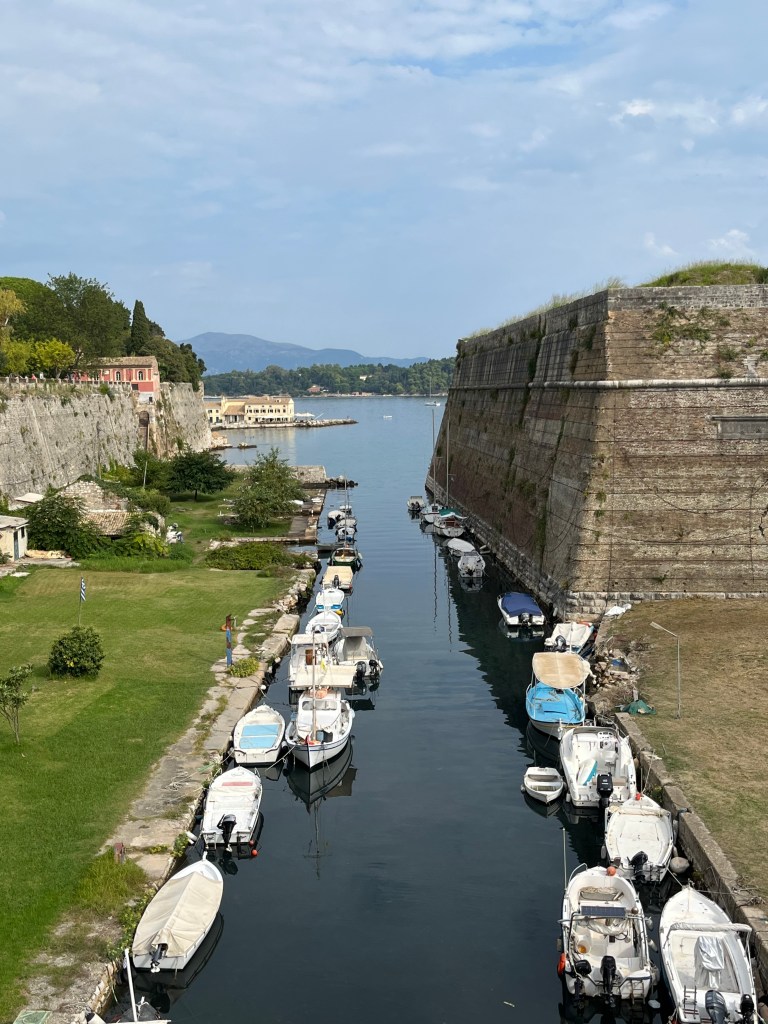
Next up the Old Fort. Corfu really does need another ad agency. The Old Fort was constructed by clever, empire chasing Venetians in the 15th century, and kindly rebuilt by occupying forces latterly by the British in the 19th century. Including barracks now repurposed as a considerably friendlier music school. Not surprisingly the fort dominates the promontory, the site of the original 6th century old town.

The Old Fort, Corfu Town

Clambering to the highest point within the fort offers panoramic views of town and bay. Strangely, from within the fort, access to the friendly Corfu Yacht Club is possible. We ambled in for coffee, toilets and charming views.

We spent an affable couple of hours meandering through the fort before heading to the old town. It’s a pleasing place to wander. Much of the old town dates back to those clever Venetians, though parts are from later periods particularly the 19th century. 

There’s plenty of tourist trap crap to choose from thankfully interspersed with stores crafting genuinely beautiful products.

A wine bar, conveniently on the way back to the ship, appeared to be a splendid option. Never found it. We’d optimistically carried swim suits and towels hoping to discover a beach we could swim from. Never found that either.

What we did find, across from the port, was an attractive and friendly feeling district. Not something you often hear about a portside neighbourhood. It was a genuine and welcome surprise. Outside of the Old Town Corfu is an utterly non-descript, some might say unattractive, town.

As you may have deduced, Corfu Town was not somewhere we’d recommend. If you’ve already booked, too late. Presumably a convenient destination for Good Ship Croydon. Others agreed.

Nevertheless, Corfu Town is a small segment of the island and shouldn’t be judged on that alone. It’s an island, from the little I’ve heard, with much to offer.

Back on board our go to routine – food, cocktail, high brow boardgames – ‘Exploding Kittens’ was one – bed. We should have been pirates.

Day at Sea

Our final day on board was on the watery stuff. A leisurely breakfast again taken outside, something we’d both miss.

Next, back to the 16th floor. It was only now we discovered that cage for shooting hoops – missing hoops – and kicking a football. We spent an enjoyable half an hour working off that leisurely breakfast kicking a football around. I haven’t lost it. Regrettably, there was never a huge amount to lose.

Another film, reading, further balcony time all contributed in pleasingly wiling away the early afternoon. A cracking rock band – the guitarist looked at least 10 – and a games of shuffleboard on the deck – Sus won that too – completed the afternoon.

To shake up our evening we packed before heading for a last meal, cocktails and boardgames. Party on.

The following morning an early breakfast before disembarking at around 10am. Athens beckoned.

Final Thoughts

Our favourite? Kotor with Split a close second. Dubrovnik has it’s delights , Corfu Town less so.

And the cruise? We both thoroughly enjoyed that week. Boredom never visited, even sea days meandered amicably by. I’m not and never will be particularly children friendly and so the adult only aspect of the cruise especially appealed.

The destinations, including Corfu Town, all had something to offer, the staff were fabulous and I miss those 15th floor food outlets with wonderful outdoor seating. Onboard entertainment entertained – though much passed us by because we were asleep – and our cabin proved a perfect haven.

Gripes? The transport between the ship and touristy town bits occasionally frustrated. And the so called craft beer bar was a bit rubbish. Niche though an irritatingly irritant for beer snob such as myself.

Would we cruise again? Yes. Particularly a river cruise. Nevertheless, cruise holidays would not be our first choice. We both prefer a less regimented regime and greater independence.

And you may be disappointed to hear the ship’s name was not Good Ship Croydon. Nope, it was the tad classier – apologies to Croydon – Lady Resilience.

Luxembourg City

Why Luxembourg? It was cheap. It was half term. It was 2 weeks before our intended departure. It all went rather well. Flights booked, Airb&b secured, splendid times to come.

Then not. BA comprehensively fucked up Sus’s flight plans. I won’t bore you with details, suffice to say, I arrived on the Friday morning as planned, Sus didn’t. She landed the following Monday morning. ‘Sorry for the inconvenience’ doesn’t really cover it. We were not happy. And offered some constructive criticism to BA. Along with out of pocket receipts. Of which there were many.

I’d not idled away my 3 day start slurping craft ale in a local bar. Only Saturday evening. I explored the city in readiness for Sus’s arrival.

I’m a petrol head (battery head?). From the amount of high end German metal, and similarly posh offerings from other European manufacturers, it quickly dawned that Luxembourg – or certainly Luxembourg City – was not poverty stricken. And following an early supermarket forage, expensive. More so than London.

French is widely written and spoken though German occasionally inserts itself – certainly, during our stay, in posters pushing specific mayoral and council candidates. And most everyone appeared able to fluently converse in English.

Travel within the confines of Luxembourg is considerably cheaper that buying a banana from the supermarket. Whether propelled by bus, tram or train it’s all free. All the time.

And wandering around before Sus’s delayed arrival, I discovered Belair. Belair, lying west of the main shopping district, is one of 24 neighbourhoods in Luxembourg City. It’s expensive and somewhat exclusive. The name afforded little choice. Populated with beautiful mansions and lush gardens, it’s a magnet for expats and their families. Made for an interesting interlude.

In contrast the Gare neighbourhood located in the south of the city, not unlike other areas embracing the train station, is a tad rundown. Small groups of inebriated or otherwise men inhabit the station square staring menacingly at each other. Sadly, some are undoubtably homeless, others probably on the way to being so. We never saw any violence and the locals appeared to treat them more of a nuisance than a threat.

Within a few blocks creeping gentrification transforms the area into a desirable and mixed area to live in. And considerably cheaper than Belair. As one ambles into the neighbouring bohemian Bonnevoie things become positively upmarket.

Both Gare and Bonnevoie are undergoing extensive building works – apartments, office space and tram line extensions. It will transform both neighbourhoods, in particular, the area around the train station.

Sus eventually arrived on Monday morning. By the early afternoon we were ready to together explore Luxembourg. And I keen to show off my insider knowledge.

Scene Setting. And a Little History.

Luxembourg is a Grand Duchy, apparently the only one in the world.

Luxembourg City (who names a capital after the country it governs?) is draped, rather majestically, across the deep gorges of the Alzette and Pétrusse rivers. The old town is a UNESCO World Heritage site and, contrastingly, Luxembourg City is famed for its financial and EU institutions. Counter intuitively weekend stays are often an ideal time to pop over – hotel prices drop dramatically as the suited and booted ones vacate the city.

Luxembourg City’s history is generally considered to begin in 963 when a chap called Count Siegfried acquired a rocky promontory and its Roman-era fortifications, known as Lucilinburhuc, “little castle”, and the surrounding area from the Imperial Abbey of St. Maximin. Which is close to Trier in Germany. Trier will re-appear a few 100 words further along.

The settlement that developed was protected by a stone fortification wall extended in the 14th and 15th centuries. Luxembourg – the Grand Duchy – has been been tarted around Europe with previous owners including the Netherlands, France, the Habsburg dynasty and Germany during the second world war. They should have built a bigger wall.

In 1869, the Treaty of London generously donated the western part of Luxembourg to Belgium giving the principality its modern day borders.

However, though Luxembourg has suffered some shrinkage during the past few centuries it’s had the last chortle. It’s now one of the world’s richest countries, with a hugely successful financial services industry, political stability and European integration. Nicely played Luxembourg.

Centre and Shopping

The Corniche is a large road and pedestrian bridge depositing eager tourists across the 2 gorges into the city proper. Peering over, one side consists of a disappointing trickle masquerading as a river, the beginnings of the picturesque old town and what appear to be works constructing recreational facilities.

The other boasts a beautiful park encompassing surviving and gorgeous city walls. A skatepark adds modernity.

A short stroll deposits one in the main shopping area. Shops, bars, restaurants, with a couple of large and attractive squares thrown in, make Luxembourg City’s shopping district a most appealing spot to shop, eat or drink. And people watch. Architecturally attractive showcasing the 18 and 19 hundreds with some older structures dotted carelessly about. Though still wishing I’d bought a pair of alluring shorts form the always quality and good value Mountain Warehouse (fashion not our cup of designer labels) purchasing opportunities are generally limited to chains you’d find in Paris or Croydon.

Adjacent to consumerism central are modern office blocks creating the business district.

Kirchberg’s public park is a green and well used oasis close to that shopping heaven. The park has a natural (probably) bowl acting as a focal point. Nature bathe whilst admiring your new purchases. The park is delightful.

A city centre highlight was a busker all over an electric violin. The 2 compositions I heard – Adele’s ‘Someone Like You’ and the much copied ‘Hallelujah’ were both gorgeous and haunting.

Trier

An hours train ride transport one to another town and another country. Doesn’t that sound great? Trier is Germany’s oldest town boasting 9 UNESCO World Heritage sites. Bit greedy.

A pleasant 10 minute stroll from the station bring eager sightseers to the old town and Porta Nigra. The remarkedly preserved Roman Gate welcomes visitors a tad more enthusiastically than perhaps it did 2,000 years ago.

Behind the imposing Porta Nigra is the main square – Hauptmarkt. Half timbered buildings dating back to the 15th century surround the 1595 Market Fountain depicting something religious.

Trier is a genuinely lovely place to wander. A Basilica dates back to the 4th Century, a Jesuit Church traces its origins to the 14th century, the House of the Three Magi demonstrates how to keep up with the Schmidts -13th century style. A wander through the burbs rewards worthy wanderers with a Roman Amphitheatre. And on the return wander other assorted Roman ruins magically appeared.

Trier is situated on the Mosel River, a tributary of the Rhine. We couldn’t find it. A friendly, if mildly bemused local, directed us. It was pretty. Not a feature of Trier. All that fancy architecture perhaps giving it an inferiority complex.

Food consisted of a bratwurst mit bread and an obscenely large slice of cherry crumble. We shared the latter. Though disgustingly disgusting that Bratwurst was delicious.

Beer in Trier

Trier, though smaller, proved a better destination than Luxembourg City for crafted liquid sustenance. Trierer Petrusbräu Brewery (www.triererpetrusbraeu.de) was an odd place. No tap room, no seating (a bench was kindly provided) and possibly a car repair garage in a lesser incarnation. We sat in their petit carpark shaded by one the brewery’s Transit Vans. We received perplexed peeks. And tried to appear as if we had planned this all along. Which we hadn’t.

Beer is served out of a hatch looking straight into the brewery workings. The only one they had on tap was an amber ale. And when I say on tap this necessitated a spanner, baby blow torch and a certain amount of effort. Basically, straight from the tank.

It slowly dawned, being the clever people we believe ourselves to be, that the carpark was for punters, usually in cars, ordering bottled beer or filling – or returning – growers and kegs.

Nevertheless, the beer – more old school than the hugely hopped varietal – was excellent, cheap and cold. The chap who went to so much effort, and spoke better English the me, couldn’t have been friendlier or more helpful. I felt almost guilty.

We think it’s opposite a convent. Give them a go. The brewery not the convent.

Craftprotz Kreativbierbar (https://craftprotz-kreativbierbar.de/) is – dare I say – a conventional tap house – great beer, friendly staff and presumably dog friendly. Their logo is fab.

Twelve taps, a bottle shop next door (both with seating) on an attractive thoroughfare create a wonderful locale to enjoy an ale and people ogle. I likely would still be there if Sus hadn’t suggested (strongly) a train back to Luxembourg might be a marginally better option.

Trier is an hour train journey from Luxembourg. It’s a beautiful and fascinating town, a must if you have the time.

Old City of Luxembourg

Is stupidly pretty. Located on the confluence of the Alzette and Pétrusse Rivers, protected on one side by a steep, rocky outcrop, the old city had been continuously fortified since that clever Count Siegfried in the 10th century. Some chaps from Burgundy and the Habsburg’s continued the process before the Spanish properly went to town in the 17th century. In later centuries, the French, Austrians and Prussians all arrived, built and left leaving their own legacies. It became one of the strongest fortresses in Europe.

Following that pesky 1867 Treaty of London the majority of the fortifications were tragically demolished. Happily, for tourists with little more than a spot of lite carving on their minds, many vestiges representative of all these eras remain. These include a number of gates, forts, bastions, redoubts and casemates.

Encased by these structures of war is the late mediaeval old city itself – a wonderful place to explore, eat and drink. Again. Any stroll should include time by the river and a clamber onto what those Victorian vandals left of the walls. The latter affords stupendous views down into the old city.

The old city has 2 Michelin star restaurants – conveniently opposite each other – a French style wine bar and a recently reopened pub offering live music. Lucky locals.

The old city is genuinely gorgeous and, if you only have a day, spend it there.

The Store was easily the choice locale for a spot of the craft stuff in Luxembourg (11 Av. de la Liberté, 1931 Gare Luxembourg). I’d discovered The Store before Sus’s arrival and returned after several million steps (iPhone pedometer) meandering the old city. The Store has 6-8 taps and several beer fridges. Inside space is limited though a number of large benches outside offer alternative people watching options. The staff are fabulous.

We’d booked, that evening, seats for a tap takeover by the French (yep, French) Piggy Brewing Brewing Company. Excellent ales (‘Abeba Groove’ a particular favourite), friendly locals and gorgeous weather all made for a most palatable end to the day.

Chateau de Vianden

Is a little under an hour by train plus a 25 minute bus ride to Vianden from Luxembourg. And because the Chateau is in the Grand Duchy all that travel is free. Incredible. And, as with the train trip to Trier, offers passengers a glimpse of the Luxembourg outside of eh…Luxembourg (City). Lush and dotted with small towns and villages from what we saw.

Chateau de Vianden was constructed between the 11th and 14th centuries, criminally sold piece by piece in the 19th century before falling into a state of ruin in modern times. In 1977 the Grand Duke of Luxembourg transferred it to state ownership instituting a restoration to its former glory.

From afar you might be walking into a Disney fairytale – without fireworks or talking animals. Once inside the restoration becomes apparent, and for me, diminishes a little the overall spectacle. However, don’t go thinking Chateau de Vianden is a cheap Disney pastiche of its former self. It isn’t. The mediaeval building is very much in evidence offering a peek into what the Chateau once was. Spectacular. And, in many ways, still is.

And do make time for Vianden, the town Chateau de Vianden (spoiler) looms over. Benignly I like to think. The small town, sitting charmingly on the River Our (yep, really) is worth an hour of anyone’s meandering.

The following day was our last. An evening flight meant, once luggage safely deposited at the train station ($5 per bag), we were free to explore. Sus suggested riding the tram to its final destination. We did. It went 2 stops. Should have gone the other way. So we did.

The Trams are delightful. And busy. It’s not difficult to understand why – air conditioned, efficient, airy and plentiful. The half hour journey glided serenely past – all adjacent to the route – the University, National Library, the Philharmonic, European Parliament and Luxexpo, a huge conference and concert space.

This part of the city appears modern, recently developed and worthy a gander. Use the trams, as we did, as a hop on hop off bus service. But better. And cheaper.

Final Thoughts

Some cities are just a bit rubbish – LA and Rio spring quickly to mind. Others, though perfectly pleasant, are over hyped – Paris and Sydney. Luxembourg quietly exceeds expectations. We both loved it and I, especially, was sorry to leave.

Luxembourg City is expensive and, perhaps for some, lacks a little soul. I, however, could happily live there. Just not for ever.

And finally, Sus has recently become an Independent Travel Agent for InteleTravel. You can book your next trip on her website: https://susantuttle.inteletravel.uk/booktravel.cfm OR contact her for great deals: susan_tuttle_2006@yahoo.co.uk. She’d be happy to help! 

Many thanks for reading (Tony Leigh, July 2023).

MALTA

The Morning

Malta is windy.

We didn’t know though a later trip on an open top hop on, hop off bus eloquently demonstrated this.

A week off in the middle of March, after ruthlessly – in a similar fashion to the Tories – discarding various bits of Europe, led to a week in Malta. A stupidly early Gatwick flight – not ideal from our West London home – meant we landed in Malta one early Friday afternoon. We were to stay in Valletta, the capital, for the entire week using it as a base. Malta is small island chain and the local buses and ferries proved effective and cheap.

History Bit

The Maltese Islands had a golden Neolithic period – more of them later – and enjoyed and subsequently abandoned by the Phoenicians, Carthaginians, Romans and Byzantines.

In 60 AD St Paul was shipwrecked on Malta while on his way to Rome. Careless. He brought Christianity which is still in evidence.

The Arabs then conquered the islands in 870 AD influencing the native language though English is an equal partner. Until 1530 Malta was an extension of Sicily and hence, whoever ruled Sicily ruled the Maltese Islands. This motley bunch included the Normans, Aragonese and other assorted conquerors before Charles V bequeathed Malta to the Sovereign Military Order of St John of Jerusalem. What a nice chap. They ruled Malta until 1798 ushering in a golden age and metamorphosing Malta into in a rather big cheese of 17th and 18 century Europe. The Knights went onto make wads of cash through trade commissioning artists such as Caravaggio and Mattia Preti to embellish Maltese churches, palaces and auberges.

In 1798 Napoleon Bonaparte kicked out the Knights on his way to Egypt. The English subsequently kicked out the French around 1800 and ruled Malta until 1964. Apparently the Maltese actually requested the English to distribute the French elsewhere – usually the French have been asked to redistribute the English.

British rule lasted until 1964 when Malta became independent though the Maltese did adopt the British system of public administration, education and legislation.

The Afternoon

The X4 bus from outside the airport, for a very reasonable €2, takes you into Valletta and deposits one and all at the central bus station. Somewhere you’ll, if you haven’t hired a car or have a handy helicopter, become very familiar with. We did.

We, Sus, found our Airbnb within 15 minutes. We couldn’t get in. In a cognitive leap, worthy of our ancient ancestors, I recalled an email explaining that the electronic lock would be effective from 3pm. It was a little after 2pm. Whoops. Less than a minute away was a local cafe in which we enjoyed excellent bruschetta and fresh orange juice.

Back to our Airbnb a tad after 3pm followed by an effortless entrance. ‘Tide by Savynomad – just got that – Harbour Residences’ proved to be a delightful base and Martin a delightful host. It’s in the basement of a 500 year old building but has natural light from the door and a very contemporary interior. There’s a microwave, washing machine and even Netflix for that feel good holiday romcom.

Once suitably freshened up we wandered. Nowhere in particular though quickly discovered Valletta is a rather attractive and hilly city. If walking up and down slopes is really not your cup of sea water, or you’re perhaps not able, Valletta may not be that special short break you were looking for.

The Beer Bit

For those who read these blogs or tonysbeersnobblog.wordpress.com you’ll know my appreciation of a craft beer. Or two. Like any self respecting beer aficionado I’d already researched the best spots to try for a cheeky craft or 2. And that’s how we found ourselves at 67 Kapitali (www.67kapitali.com).

They had about 10 taps mainly pouring the wonderfully posh sounding Lord Chambray beers interspersed with an occasional interloper from the UK. Magic Rock when we were there. A fridge housed further local beers (Huskie) and a small selection from outside of Malta.

Over our 4 visits I managed to sample most with all proving most palatable. A favourite was the 67 IPA which Chambray brewed especially for the bar.

One evening we ate there – I ordered a platter Sus couldn’t eat and she ordered a vegan platter I could but didn’t. They were huge. These could easily be shared between 2 people. We both had take outs. And watched a film.

The Trek

The next morning, after buying several days of breakfast supplies from the exotic Holland and Barrett we decided on a yomp from Valletta to Sliema – via several townships including Msida, Ta’ Xbiex and Gzira – forming a continuous urbanisation around the bay. Msida, Ta’ Xbiex and Gzira all amiably blended into one.

The roughly 5 mile trek is not a recognised walk – though some blogs do provide vague directions – and without Sus and Apple maps we may well still be walking.

Typically, when wandering aimlessly – or vaguely misplaced – one discovers many a treasure. We happened upon Hastings Gardens plonked on both St John’s and St Michael’s Bastions (painful) with wonderful views across the harbour. Renovated only a few years ago and, with striking groto-esque art work, merits a gander. It wasn’t busy and a worthy opponent to the Upper and Lower Barrakka Gardens. I’m not sure I didn’t actually prefer it to them.

Valletta’s architecture, it’s streets and piazzas range from mid-16th century Baroque to Modernism with a unique collection of churches, palaces and museums. It all adds up to a striking capital city.

For contrast we trudged through what appeared to be Valletta’s government administrative centre – not horrible though certainly not a FOMO moment. Apple maps amused itself by directing us down a steep and busy winding main road – with pavements disappearing only to reappear on the opposite side – with a couple of similarly bemused travelers making their way up. Oh, and one mad jogger running up.

Thankfully, this did drop us into the harbour inducing a certain amount of boat envy. I don’t even have a great desire to own a boat. Observing the posh boats, on the other side of the road running alongside the harbour, were some beautiful though often dilapidated buildings. Incongruously, there was a large modern block – mercifully incorporating one of the older buildings – adorned with the KPMG logo.

Trotted through a slightly scruffier area – Valletta is perhaps the cleanest European capital either have visited – with the bay still on one side. Only when we went inland a little later did our friendly watery friend vanish from view.

Sus is the most generous and best natured person I’ve ever met. Until she gets hungry. She decided Ayu, a modern looking restaurant was for her. And me. It was the best meal either ate our whole week in Malta (https://ayu.mt/restaurant-menu/).

After leaving Ayu we ventured inland into Sliema proper before coming back down to the waterfront where we gracefully danced on the extensive rocks and rock pools presumably exposed by an outgoing tide. Sliema is the most densely populated town on the island – though still attractive – making it a centre for shopping and cafes with lively bars and nightlife. We liked Sliema and I can understand why many tourists choose it as their island base. There’s a conveniently large Lidl for those self catering though I’ve a sneaking suspicion that for many it’s the nightlife and not a fresh food counter that appeal.

The nightlife not being our cup of Cisk we caught a bus back to Valletta – number 13 taking 15 to 20 minutes.

Mdina, Wind and Loud Noises

The following morning, post a Holland and Barrett inspired breakfast, we bussed to the village of Rabat located a few minutes walk from Mdina. Mdina, home to only about 250 people, is a magnificent walled city and generously populated with Norman and Baroque palaces, churches and homes. It’s a miracle the Game of Thrones producers missed it.

On arriving we were welcome by an insane wind and loud bangs. Thankfully Mdina wasn’t having a wind assisted collapse – these, we believe, were artillery shells exploded close by. Above, we could even see puffs of smoke, akin to a failed firework.

After entering the citadel, and having a quick coffee at the first tourist trap we discovered, we wandered around the small but pleasingly proportioned Mdina. It is properly magnificent, a wonderfully preserved slice of medieval history. Mercifully, the wind was flaying us alive, we found a sunny and protected square happily habited by a pub. The wine was mediocre but the shared bruschetta excellent. The influence of Italian cuisine is everywhere in Malta and an excuse to eat unhealthy amounts of pizza.

We decided on another look around – discovering what we’d already seen – before heading to the romantically titled Ditch Gardens located at the base the walls.

Exiting Mdina I saw a bus readying to leave for Valletta – at the loss of a few calories we made the bus. Rejoice.

Back in Valletta we went wild. A couple of ales at 67 Kapitali, a glass a glass of vino at a nearby wine shop, all washed down with chocolate and Netflix. Lovely.

Gozo, Not Gozo, Three Cities

If we have to be at an airport, on the other side of London, by 6 o’clock then we’ll be outside waving at Ubers. In the rain. If, however, there is no early start we tend not to get our poo together until mid to late morning.

And that’s why we missed the ferry to Gozo. Be warned, the last morning ferry leaves at 9.45am, the next one is not until an inconvenient 1.45pm.

The Three Cities, the neighbourhoods of Vittoriosa (also known as Birgu), Senglea and Cospicua, sit across from the Grand Harbour and surround the Vittoriosa Marina. The marina is a happy home to large, expensive looking floaty things. Some of said floaty things are house size and appear to have their own staff.

Vittorosia, with that harbour and must have fort, is especially attractive though with beautiful buildings from the 16th century mixed with modern renovations and restaurants with views the 3 cities are a lovely way to wile away an afternoon. Throw in a seriously relaxed wine accompanied lunch and it was our most chilled day. And perhaps my favourite.

Then the short return scenic ferry trip back across to Valletta. With the added bonus of watching a chap in a very large boat making a complete bollocks of reversing into a decent size space. Great fun.

Gozo, Definitely Gozo

So keen were we not to miss the 9.45am ferry that we surpassed ourselves and caught the 9am ferry. From the Grand harbour in Valetta to Mgarr on Gozo takes about 45 minutes. It’s not particularly cheap, about £15 each return, though convenience won out – our Airb&b was less than 10 minutes walk.

Disembarking at the mildly pleasant Mgarr we went searching, along with our fellow bemused passengers, for some sort of transport. The taxi driver I asked wanted a ridiculously extortionate amount, the buses inconveniently absent and presumably packed.

Wandering into the modern terminal we were accosted by an incredibly persuasive and efficient lady flogging a hop on, hop off bus tour. There was another booth next to hers selling a rival hop on, hop off bus tour though without the all important persuasive and efficient lady. Our buses were red, the rival’s green. We saw both at the same locations, often at the same time. I doubt either is better than the other.

We bought 2 day passes – about £20 each. It proved an excellent compromise between a taxi driver financing a mistress and the lesser spotted local bus service.

Perhaps a tad tacky but a hop on, hop off bus was a convenient way for us to witness Gozo and get to those must see – or not so must see – tourist destinations. It’s not perfect, buses were often late, 45 minutes between each bus is not especially opportune and buses will become crowded in peak season. For us, on a day trip from Valletta in March, they worked well. However, if we were staying on Gozo, local buses or hiring a car would prove better alternatives.

Like most passengers we gravitated to the upper deck for the views. Fuck it was windy and a smidgen chilly. A few less hardy passengers abandoned the upper deck for the hurricane free lower deck. We bravely endured, literally holding onto our hats. We criss crossed Gozo, twice passing through the attractive capital Victoria, and briefly stopping at Dwejra with its pretty coastline.

We finally left the bus at the ‘quaint fishing village’ of Marsalforn. Marsalform is neither quaint, a village or particularly pretty with the exception of the bay it happens to be located on. It very much has the feel of a town developed to accommodate and entertain the tourist hoards. Who were conspicuously absent in March.

Highlights included a stroll along the rocky foreshore and spotting 2 holidaying octopuses in the bay. Along the foreshore was the odd small saltpan though more impressive specimens are located some distance from the bus stop – not mentioned in the advertising blurb. A Romanian tourist was especially excited. We decided to eat and bugger off – we’ve seen huge saltpans in Bolivia.

Our only other stop, with the exception of the ferry, was the magnificent 5,500 year old Ggantija Megalithic Temples – that’s older than the Pyramids and, not surprisingly, a UNESCO World Heritage Site. These 2 remarkably preserved temples have a common wall but separate entrances. Properly incredible. To think these same stones were touched by people like me and you over 5,000 years ago.

As I’ve mentioned 45 minutes between buses is not ideal and, having visited the small museum and the temples, we missed the next one. Nevertheless, this gave us the opportunity, suspiciously scrutinised by a security guard, to wander around these wonderfully evocative monuments a second time. And wandered we did.

We arrived back at the Mgarr and the ferry terminal early and strolled around the harbour front before our return journey to Valletta.

I wasn’t convinced by Gozo with the obvious and worthy exception of the megalithic temples and possibly Victoria. Sus was more forgiving. To be fair we only saw and visited parts of the island accessible by an open top bus. Even so, not somewhere I’ll be poetry penning about.

Inevitably we finished our day with 67 Kaptali and Netflix.

St Julian’s, Hard Hats, Tacky

A 13A bus took us to the town of St Julian’s. We explored the likeable sea front and discovered some very expensive apartments in an area going through a huge amount of redevelopment and renovation. Some had private harbours. Nice.

After continued exploring we discovered the vaguely Superman sounding Paceville. There’s the small, slightly scruffy St. George’s Bay beach behind which sits numerous clubs, bars, restaurants, casinos and cinemas. Many are open to the early morning attracting a younger crowd with the more mature preferring the upmarket wine bars and restaurants. Hotels of all flavours cater for the presumably drunken masses.

Again it’s part of the island that has gone huge development in recent times. Paceville is undoubtably going for sophisticated. We thought it horrible and tacky.

A stroll back to St Julian’s harbour and a bite to eat. The food was decent, the wine better and an ongoing shouting match between our waitress and one of the chefs thoroughly entertaining.

Back to Valletta and a stroll around the city exploring parts we had yet to see.

I won’t ask you to guess how we ended the day. Memorably, we added humus and tortillas to the mix.

More Megalithic, More Valletta

Malta has it’s own Megalithic temples – Hagar Qim. No relation to everyone’s favourite comic strip Viking. A 72 bus bus, after about 45 minutes, drops megalithic devotees in the small and agreeable town of Qrendi. Apparently closed on our visit with the exception of those ubiquitous 2 blokes plus digger, digging, Presumably a very important hole. From there it’s a 20 minute-ish meander to the site itself.

There are 2 sites separated by a easily walkable 500 metres. Both are of a similar age to our megalithic friends on Gozo – 3,600BC to 3,200BC. That’s before Elton John. They sit in a picturesque landscape with wonderful sea views though partly restored by over zealous Victorians.

As with the Gozo megalithic temples Hagar Qim is a worthwhile tick in a tourist checklist. Make it a big tick.

Then a 74 bus directly from Hagar Qim to Valletta. The reason we didn’t travel on the 74 directly to Hagar Qim was an hour wait. We live in London, not even trees stand still for that long.

The bus ride is interesting in it’s own right. Small towns, countryside and small farms all come into then out of view. Be proud to be a tourist, stare out of the windows and not at your phone.

Back in Valletta we explored Floriana a short stroll from the bus terminal. The late 18th century Saint Publius Church dominates one end of a large square featuring what I thought to be the unfortunate stumps of a much larger and presumably older building. However, after consulting the intrawebby, it appears they were grain granaries the stumps being stone covers. The space is now used for concerts and the always fun political mass meetings.

Floriana burbs are an interesting mix of government buildings and a slowly – but inescapably – gentrifying area of dense and attractive buildings. The Argotti and Mall Gardens beautify the area – Valletta does gardens better than most.

Rambling aimlessly brought us to the Lower Barrakka Gardens, which along with Upper Barrakka Gardens, offer wonderful views across the Grand Harbour. Our digs were just below the Upper Barrakka Gardens – built on top of a bastion they date back 1661 when those lucky Knights used it as their private garden. When we had visited, a couple of days previously, students along with proud parents, were utilising the gardens as a background for, sometimes inventive, graduation photos. Those Knights would be proud. And probably charging an entrance fee.

And, each day at noon, members of the Malta Heritage Society (dressed in British Artillery uniforms) fire a salute.

That evening we ate at Gugar (gugarmalta.blogspot.com) which was cheap, cheerful and a proper hippy hangout for those pretending to be in India. And then, in contrast, we found WHY NOT? It’s one of those places you wish you’d discovered earlier in the week – the staff were friendly, the wine was excellent and, though we didn’t eat, the cheese and meat platters looked spectacular. Recommended.

Home

The following morning was our last. We had a leisurely morning before heading to the airport and London.

One oddity before I go. Malta’s tap water is not the best. However, it is safe to drink. And we did. On a couple of occasions, when asking for tap water we were warned of the dire consequences of drinking said water. Strange.

We both loved Valletta – it’s architectually interesting, fortuitously located with numerous spots to eat, drink and be as merry as you might wish. Beyond Valletta it’s megaliths and Mdina that charm. For a short break we’d certainly consider popping over to Valletta again.


CHEDDER GORGE

CHEDDAR GORGE

Arrival

On Monday 2 November we departed West London for Somerset and Cheddar Gorge for another of our cheeky 4 night staycations. The country was again locking down, this time on Thursday 5 November. We had booked until Friday 6 November.

London, as I write a few days before Christmas, is toying with tier 4. I was blissfully unaware there was a tier 4. My, living in a Herefordshire field brother, gleefully pointed it out.

Somerset is inconveniently distant from West London taking us 2 hours plus – without major holdups – to reach our self catering accommodation of choice, Middlewick Farm. For those living in countries vastly vaster then my own 2 hours might only entail a stroll to the garden shed and back. However, for many of my fellow islanders, a 2 hour plus drive generates a certain degree of excitement.  

Middlewick Farm (https://www.middlewickholidaycottages.co.uk/) is able to cater for upto 50 touristy types in a mix of cottages, glamping pods (why?) and even a Shephard’s Hut (seriously, why?). Our one bedroom cottage, the civilised option, was one of several converted from farm buildings.

There are a number of walks directly from the farm and a swimming pool, sauna and farm shop all on site.

As we were transferring an inordinate amount of belongings from car to cottage Jonathan, one of the owners, dropped by. A lovely chap, he nonchalantly announced staying until Friday was not a problem. Fabulous. 

If you stray Somerset way Middlewick Farm will make a splendid base. We loved it.

Wells

After a non-fried, self catered breakfast the following morning we drove to the cathedral city of Wells.

Wells, unimaginatively named after wells it was founded around, is only the size of a small market town. Nevertheless as an ancient diocese with that all important cathedral Wells graduated to city status. Nicely played.

The town centre embraces all the usual chain suspects though is perfectly pleasant with its mixture of architectural styles.

Most visitors, I sincerely hope, don’t arrive for the mediocre shopping but rather the historical historic cathedral, Bishop’s House and Vicar’s Lane. Those 3, though not the shopping, are all listed. Built between 1175 and 1490 Wells cathedral is a masterpiece. By following the ‘Pilgrim’s Path’ modern day pilgrims and tourist alike are able to explore this magnificent beast of a building. The famous and stunningly beautiful scissor arch, rather helpfully, keeps important bits of the cathedral vertical. Still doing its job after 700 hundred years said arch shames many modern buildings. Outside the west portal has, what many believe, to be the greatest collection of mediaeval statuary – of once self important religious types – in Europe.

Wells Cathedral and Salisbury Cathedral claim to have the world’s oldest working clocks with both dating back to the late 14th century. Unfortunately for Wells Salisbury’s timepiece (allegedly) predates Well’s timepiece by a mere 5 years. How annoying. Fortunately for Wells their timepiece is original, Salisbury’s having been partly restored in the 1950s. Every quarter of an hour the Wells clock much loved jousters do their thing. It amused me to think one pitiful knight has had his ass handed to him for the over 600 years. ‘Fuck this, my turn to win’ is surely overdue.

As with most religious arguments this particular one is set to rumble on. At least civil war is unlikely.

Whichever church you happen to be visiting please do make time for these wonderful timepieces. I love all things mechanical and these clocks are marvellous examples of mediaeval, mechanical ingenuity.

A quick coffee in the cathedral coffee shop – guessing not mediaeval – before braving the cold and damp weather. The Bishop’s Palace, thankfully for those Bishops amongst you, sits close to the cathedral. The palace dates to the 13th century with numerous additions throughout the centuries including our oft vandalising Victorian chums. Surrounded, as it is, by a moat and high walls, to my eye, it’s architecturally more pleasing than the cathedral. One does have to wonder why any bishop would need such a grand home. The church prioritising status over its flock perhaps?

Whatever I, or anyone else believes, these buildings are tribute to the wonderfully talented craftsman, architects and others who built them. These fabulous manmade structures need to be treasured and celebrated for their architecture and huge historical significance.

Time and historical masterpiece fatigue necessitated skipping the interior of the Palace. We consoled ourselves with a wander around the picturesque moat and watched swans, a tad comically, preen and wash. Or so we assumed with all their splashing and head ducking. They may merely have been letting off steam – appearing one’s best for your general public could do that.

Encircling the cathedral green are a number of beautiful historical buildings and, a little further afield, the mediaeval St Cuthbert’s Church and Vicar’s Close. Vicar’s Close dates back to the mid 15th century with mod cons such as chimneys and gardens thought essential added in later centuries. Vicar’s Close, originally constructed for the men’s choir, is claimed to be the oldest purely residential street with original buildings surviving intact in Europe. And it’s absolutely fucking gorgeous.   

The Close (a soap opera beckons) probably was my favourite listed gem of Wells. People, the same as me and you, have resided in that street for nearly 600 hundred years. That’s 600 hundred years folks. And for the vast majority of those 600 hundred years they lived their lives without a smart phone. Mind blowing.

A Tor, a Town and Pagans

The weather was interesting as we headed towards Glastonbury Tor. After driving up a wide path masquerading as a road we parked outside a random collection of houses. This presumably is a parking hell hole during non COVID-19/peak season.

There was a path of sorts which we followed until I got bored and decided the shortest and steepest route was my pathway to success. It proved more scrambling struggle than elegant ascent. Sus sensibly walked the paved and stepped path that followed the contour of the Tor. Longer undoubtedly, wiser definitely.

The Tor, perhaps surprisingly, is natural and was once, before modern drainage, an island. The terracing on the hillside is Neolithic, the tower a tad newer dating back to the 14th century. It’s the only surviving remnant of a church quarried for stone.

The summit was, on a blustery and damp day, unexpectedly busy. Being the highest point for miles around, and visible from the same, the vistas are indeed stupendous.

Glastonbury Tor has been the focus of religious, pagan and spiritual devotions since humankind discovered this remarkable oversized grass hummock. I’m originally from Yorkshire in the north of England where spirituality comes someway after football, rugby league and pork pies. And even with the opportune appearance of an exquisite rainbow the whole spiritual thing passed me by. Nevertheless it’s not difficult to grasp why people are drawn to this ancient site. May it continue to be so.

Glastonbury is a strange place and you may spot a 21st century hippy trying to recreate a time long since vanished. The high street shops are mostly peddling the same tourist tat (with a mystic twist) recreating the feeling of past times past. It’s all a tad naff.

Which is a shame as Glastonbury is architecturally attractive with genuinely old pubs – the George Hotel and Pilgrim’s Inn and the Mitre both hark back to mediaeval times. There’s also a ruined abbey where reality and myth collide (ouch). The abbey is thought to be the cradle of English Christianity and the supposed burial place of King Arthur and Guinevere.

Back to base, the farm shop, a swim and bed.

The Seaside, the story of 2 Cheddars

The following morning a trip to the seaside. Burnham-on-Sea. Unfortunately, as with many seaside resorts, the town is little rundown though with obvious and welcome signs of regeneration. The high street is resplendent with cafes, charity shops and beauty salons. It’s not a place to linger even with a sprinkling of finer establishments and decent cafes.

The beach, in total contrast, is quite fabulous. Our visit coincided with low tide exposing vast expanses of sand. It’s clean, well maintained and must be a joy for locals and tourists alike during warmer days.

Next a drive to Cheddar. If Burnham-on-Sea town centre was a disappointment Cheddar was plain weird if pretty enough. It resembles a large hamlet rather than a small village with only a large pub, café and butchers open for our visit. I suspect the large pub, café and butchers were the only establishments ever open in Cheddar.

Where was the gorgey bit? Where was the cheesy bit? Where were the cafes? Why was Google lying to us?

We nipped into the café for a coffee and, in Sus’s case, a panini. While having a wee I noticed a poster quoting JC – Jesus Christ not Jeremy Clarkson. In a secular country becoming more so each year this Christian café was a proper oddity. It was, strangely, more overtly religious than the café in the cathedral. Funny old world.

The splendid butcher sold me a delicious, large steak and kidney pie (my favourite). That pie did me for 3 meals.

Predictably, a trip to a local brewery was next – Cheddar Ales. When considerably younger I drank many a traditional, hand pulled cask ale. The taste was variable, the quality often dubious. I always remember reasoning, as part of my heritage, I should enjoy them. I never did and switched to lager in my 20s. However, many traditional English breweries had a range of bottled beer which can still be found in supermarkets to this day. I enjoyed, and still do, this motley collection of bottled beers. Arguably these golden oldies were craft beer before craft beer was craft beer.

Cheddar ales was steeped in this tradition and, after chatting with one of the owners, purchased a 6 pack. And very quaffable they were too.

A short drive from Cheddar we discovered the Cheddar Gorge bit of Cheddar explaining our earlier disillusionment. Apologies to Google. Cheddar.20 is squashed charmingly into the lower end of the gorge with café’s and shops galore. We had our pick of parking spots, presumably impossible in pandemic free summers, before wandering through pretty streets menaced by the steep sided gorge. The river Cheddar Yeo ambles contentedly on through adding to an already picturesque scene.

Though not normally lovers of cupcakes, on the outskirts of Cheddar, we spied a local baker selling the very same (https://www.thecheddarcakery.com). We purchased, we ate, we liked.

Tillamook Cheese Company is to be found in Oregon. We both adore cheese and, whilst visiting that beautiful state, dropped in for a sampling fest. The staff were lovely, samples plentiful, the cheese mediocre. The Cheddar Cheese Gorge Company proved disappointedly similar. Though an improvement on Tillamook’s offering there’s finer fare to be unearthed in your local deli or even supermarket. Stick to those cupcakes.

Lyddie – Lydford Leigh III, Eighth Earl of Wessex to give him his full title – is our 11 year old Mini Cooper. Sus named the little chap, not me. Lydford comes from the registration plate, Leigh is my surname. The rest is an utter mystery.

We love our Mini, Lyddie loves corners. Excels at them in fact. Much to Sus’s chagrin, Cheddar Gorge became his own personal race track. Sus squealed a lot. As occasionally did the tyres. The gorge is considerably lengthier than I remember or Sus thought. It’s also stunningly beautiful. This being a late Autumnal afternoon with humans scarce, the gorge had a primeval quality. A loss of 4G signal, until clear of the gorge, only added to the Jurassic Park impression. At least we could have taken pictures of any dinosaurs spotted. Apparently dinosaurs are camera shy.

We headed back to base, ate and relaxed in front of the tele. Rock and roll.

A Walk, Fibs and a Red Herring

We woke up to lockdown Thursday, swam and showered all before breakfast. Predictably lockdown encouraged the best in the weather and, so returning to Cheddar Gorge, we parked and chose the ‘Gorge Walk’. Classed as moderate this ramble required a reasonable hour and 40 minutes. So many fibs.

We scrambled, sometimes literally, through a wood towards the summit though rewarded with picturesque panoramas.

On the, often slippery, sporadically muddy, descent we spotted a wild goat. The size of a large dog, with bonus horns, we decided against engaging in conversation around what to consider in a good goat’s cheese, and hurried on past.

After about an hour and half our descent brought us to a road, parked cars and self-congratulations. The road and cars proved, in classic Agatha Christie style, a red herring. All signs pointed to another steep climb worryingly resembling a (merely damp thankfully) stream bed.

Cue further ungainly clambering and scrambling. At the summit fellow human beings had magically materialised and continued to magically materialise from whence we never discovered. The vistas were again fabulous as were spectacular views down the gorge.

We spent a few minutes admiring the views before descending towards Cheddar coming out, after a final 241 steep steps aptly named Jacobs Ladder, opposite the car. Result.

The walk/hike/expedition had taken us a little over 3 hours. We may have missed a big sign saying ‘this way idiots’ though, not being idiots, neither believe this to be true. And we now understand the reason for those cars smugly parked at the bottom of the second climb.

Even red herrings and my moaning can’t disguise how much we both enjoyed that walk. The weather behaved and the views and scenery were worthy of the behaving weather. However, this is not a walk to take elderly relatives or those who may have eaten too many pies. A reasonable fitness level will be needed as will some tasty snacks. And their definition of difficult may well incorporate Everest base camp.

We were knackered. In a very good way. And like those cars, perhaps a little bit smug. We drove back to Middlewick farm (self driving cars can’t come soon enough), ate and relaxed.

The following morning we drove home.

Somerset, Cheddar Gorge and even Glastonbury (especially the Tor) are staycation staples and easy to recommend. Cheddar Gorge is indeed spectacular and I’ve a sneaking suspicion Somerset has significantly more to offer.

And finally, a heartfelt thanks for taking the time and effort to read these electronic scribblings. I do hope you’ve enjoyed a wonderful Christmas with, where possible friends and family, and wish all a happy and healthy 2021.

Tony

December 2020

THE NEW FOREST

That’s been a decidedly odd few months. And, writing as I do in October, continues to be so.

I’m working from home for the first time in my life and initially discovered separating one from the other annoyingly difficult. This I’ve come to terms with by burying my work laptop in the deepest, darkest corner I can find once my working day is over. In a one bedroom flat this has meant a little creative thinking.

I’m based in our kitchen/diner; Sus is set up in the bedroom. With a recently acquired executive chair no less. Sus, who’s a total guru in all things project management and expertly delivers project management courses, has taken to the home working lark splendidly well and would have no qualms with this way of working becoming her norm.

After rebooking a Seville trip for February 2021 – a re-rebook a distinct possibility – we decided on a September staycation. The New Forest is the new Seville.

Lymington

West London to Lymington took us a remarkably reasonable hour and 45 minutes. Britannia House (www.britannia-house.com/), our B&B, was ideally located 2 minutes from the harbour, 2 minutes from the high street and 20 seconds from the train station.

The posh Victorian bit was one side of the residential street, the less posh bit (part of a small apartment complex) was on the other. We were in the less posh bit, having booked late, though this proved a splendid base for our 4 night stay. And there was off street parking. Beware of centrally located establishments advertising ‘self parking’. Self parking often necessitates driving around your chosen destination desperately searching for that elusive spot less than a 2 mile hike back to your chosen place of rest. And morning fry up. We checked in and chatted with our ever amiable and helpful host Tobi before exploring the very un-mean streets of Lymington.

Lymington is a picturesque Georgian town set on the equally picturesque Lymington River on the equally picturesque Solent. Lucky Lymington. The old town quay was indeed quaint though, surrounded by pubs and independent shops, annoyingly busy. Clutching our packed lunches – anything remotely perishable from our fridge – we moved on. As we were – and still are – playing ‘avoid the human’ game a little more space was needed to enjoy the fruits of my morning labours.

We car and people avoided along a busy road, passed a very private yacht club before discovering a small though lovely park overlooking the marina. No suitable water facing perch was available so lunch was eaten facing a row of pretty houses that unlike us did face the water. After deciding on a favourite (thinned to 2 fortunate contenders) and a very pleasant 15 minute amble – the marina on one side, a large outdoor pool on the other – we came upon an impressive working boat yard. A number of organisations were based there along with a tempting selection of dry docked boats one in particular Sus took a liking to.

More ambling took us through attractive neighbourhoods and returned us to our B&B. Once refreshed we explored the quaint and attractive Georgian high street before a long walk (cue more pleasant neighbourhoods) brought us to a craft beer haven. Actually it wasn’t. However there was just enough to entertain my beer snobbery. And the food was excellent.

Beaulieu – Cars, monasteries and green bits

The following morning, after heroically dispatching the first of 4 splendid fry ups, we drove to Beaulieu and our allotted time slot. Sus is still trying to understand how a word spelt Beaulieu is pronounced ‘Buley’. I explained the whole English destroying the French language thing though she’s still a tad vexed. I felt it counterproductive to argue that as an American her fellow countryman had mangled any number of words and spellings.

The short drive takes one through a sliver of the National park that is the New Forest. Horses and donkeys amble randomly oblivious to traffic and humans alike. Can’t say I blame them. With thousands of acres to munch on one does wonder why their chosen and presumably choicest green bits have a tendency to cause a traffic jam. Neither of us cared – the horses are beautiful and the donkeys utterly adorable. The latter show a curiosity that means windows are better left closed.  

Beaulieu is an 8,000 acre estate housing the National Motor Museum, The Palace House and the ruins of Beaulieu Abbey. There are lots of green bits too.

My car test was passed at 17 and a full bike license collected at 21 – though I’d been riding motorised 2 wheelers since the age of 12. I’m huge petrol head and the National Motor Museum is a mecca for such as I. Sus, who has only a passing interest, indulged me. For 2 hours. There are nearly 300 fabulous cars and motorbikes on show with a fondly remembered favourite around every corner. If you love cars then please do go. If you love someone who loves cars please indulge them.

A petrol head I may be but I’m a petrol head fully embracing the electric car revolution. Electric cars are capable of ludicrously quick acceleration and with ever improving battery technology it is only a matter of time before they ride and handle as well as their petrol cousins. Most importantly electric cars, though not without their own issues, are considerably environmentally kinder to Mother Nature. And the petrol engine will live on in the wonderfully diverse and often eccentric classic car world.

Suffering a tad from combustion engine fatigue we emerged into the outside world, gratefully removed our masks enabling a leftovers chow down. Refreshed we headed to what is left – thank Henry VIII and his libido – of the 800 year old monastery. To our surprise much more survived than either had envisioned. The original monk’s refectory survived, became the parish church and is now a popular wedding venue. The cloister walls remain and, 800 hundred years later, still are an oasis of tranquillity. However, it is only when one explores the pretty gardens that you understand the sheer scale of what was once here. It must have been magnificent.

Palace House, once the gatehouse of the medieval Beaulieu Abbey, was upgraded to the Montagu family home in 1538 and remodeled Victorian style throughout the 1800s. Because of this deeply unpleasant lurgy, queuing was necessary. We both preferred the atmospheric abbey and, though the pub might be beckoning and the kids demanding their iPads, the Palace House is a worthy indulgence.

We wandered back via the lovely Beaulieu River millpond which that lucky Palace House overlooks. The weather had become a little annoying with the vast majority of day trippers deciding on a direct route to shelter. A shame (for them, not us as we were virtually alone) as it’s a pleasant stroll. It’s hard not to notice (unless you’re embedded in your iPhone) the intricate wood carvings fashioned into branches of dead trees across numerous, managed open spaces – parks, National Trust properties, common, heaths. These are fabulous, creative pieces of art and Beaulieu has a few of its own.

Beaulieu is a truly magical day out – and it is a day, plan on it. It’s not only the amount of entertainment on offer it’s the sheer diversity of that entertainment. Beaulieu is not a cheap option, especially for a family, though bringing one’s own lunch will help in mitigating this. And if you did decide to pop back within a year of your visit – and still have your original tickets – entrance is free. Very civilised.

We celebrated with wonderful fish and chips from Elderflower restaurant. Being a take out, and as such understandably not encouraged at our B&B, we ate ensconced in our car overlooking the harbour.

Towns, villages and pedaling

The next morning, once a nourishing fully monty had been dealt with, we journeyed into the New Forest. First up was Brockenhurst – underwhelming with an overwhelming bakery; then came Lyndhurst – larger and prettier; and finally Burley – small, pretty with bike hire. The young chaps at the bike hire were friendly and efficient; we were quickly furnished with our mounts and let loose onto New Forest cycle paths. This was the first time either had been a something with pedals for an embarrassingly long time.

We rode along established cycle paths and ventured off road actually losing any inkling of a path at one point. Though the trails were virtually human free traffic was always audible. Never were we in danger of being eaten by a hungry and grateful mountain lion. We did rest briefly to eat those delicious muffins.

1 tree, 2 bikes, no muffins

I’ve 2 brothers – I’m the eldest – with less than 3 years separating us. We’re close in a middle class, middle aged English kind of way. Both are keen cyclists, middle brother prefers road biking – which I don’t totally get; youngest brother prefers mountain bikes – which I do. I sent a picture of our hired bikes. They sneered. Seems snobbery runs in the family. However, Sus and I were amazed how easily we came to grips with our 2 wheeled chums. We loved the whole experience.

Our day’s drive was wonderfully interspersed with the beautiful New Forest landscape of unenclosed pasture land, heathland, forest and occasional water. Plus those randomly roaming horses and donkeys. That scenery undoubtedly stole the show.

Where’s the chippie?

Back in Lymington we popped into Solent Cellar for a glass of wine. M&S provided dinner.

Conversation, wildlife and pork pies

Breakfast passed pleasantly nattering to our fellow B&Bers. Socially distanced fellow B&Bers. Post socially distanced breakfast we drove to the National Trust Northern Commons confusedly not located in Yorkshire but in the very southern New Forest. To be honest we never properly found it or them. Perhaps they really are in Yorkshire. However we did discover the wonderful Blashford Lakes.

Hampshire and Isle of Wight Wildlife Trust (www.hiwwt.org.uk/) manage over 50 nature reserves – Blashford Lakes is one consisting of 159 hectares of what were once lifeless gravel pits. Woodlands, lakes and grasslands make it a haven for wildlife particularly migrating birds. And again we had the place pretty much to ourselves happily wandering for an hour and since made a small donation.

Next up, pork pies. Award winning pork pies. I’ve had a fondness for pork pies since birth though, appreciating such are not one of life’s healthy pleasures, eat lamentedly few. Nevertheless, an awarding winning and nearby farmshop was shouting my name. I purchased an artery worrying 2 pork pies, one sausage role and a cheese and onion pasty. The pork pies were delicious though the sausage role and cheese and onion pasty were perhaps even better – eaten over a couple of days to prevent a pork induced heart attack.

Ringwood Brewery (www.ringwoodbrewery.co.uk/) was only minutes’ drive away (rude etc). I acquired a 4 pack of their traditional English ales all since proved an excellent alternative to the equally excellent modern session pale ale.

Returning to Lymington via that gorgeous New Forest scenery, and after a brief hiatus to freshen up, we went shopping. Without buying anything. Blubambu (https://www.blubambu.co.uk/) severely tempted both with its stylish furniture crafted from reclaimed wood. Temptation may become reality at their next sale.

An excellent wine flight was provided by The Cellar along with conversation with locals including Stephen Lees a well known artist. Check out his shop opposite, you won’t be disappointed. Waitrose provided dinner.

Last breakfast, checkout, a beach with no name

After our final breakfast Tobi pointed us towards a beach frequented by locals and not necessarily by tourist hoards. We checked out and drove straight there.

Beautiful

We’ve visited some fabulous beaches over the years including Bondi, San Sabastian and those of Rio de Janeiro – though Rio itself was a huge disappointment. This small estuary beach in the southwest of England is one of our favourites. And it doesn’t even have sand.

The tide was out exposing small green hummocks encircled by water channels and small pools. Mud was prevalent as my shoes can testify. Predominately a pebble beach it backs onto a private wood and large 18th century country estate.

Visible from the beach were the Needles, sailing boats and the Isle of Wight. Having recently visited the latter both felt the island somewhat improved from distance.

Two small SUVs were parked on the beach accompanied by 2 fisherman preparing their rods and tackle. Cows lounged amicably close by. An actor might seem smaller in real life, our four legged milk producing chums don’t. When one of these lumbering beasts wandered your way, possibly because you’d strayed near a calf, you didn’t hang around to ask why they preferred a beach to a field.

We had a stroll, the sun was shining. A perfect ending to our time in the gorgeous New Forest. We both adored the area – for me perhaps even beyond that perennial people’s favourite, the Cotswolds.

Staycations are nothing new, to us or to anyone else. However, the inability to travel to the more exotic has necessitated longer and more frequent trips within one’s own country. Where ever you live in this troubled world you will have discovered or had reinforced the beauty and diversity of your homeland. Familiarity does not always breed contempt but an appreciation of what you might already have. And that’s a huge positive.

The drive back to West London was painless and we were happy to be home. Nevertheless the New Forest made a huge impression on me and we’ll certainly be back.

SPAIN

I’ve chosen not to dwell on COVID-19 and have only mentioned in passing. Nevertheless we’re both fully aware of the truly unpleasant nature of this virus and hope you and your families are safe and well.

And my thanks for reading this blog – I genuinely do appreciate it.

Wishing all good health, Tony and Sus

Bilbao – San Sebastian – Bilbao

When travelling abroad we endeavour to pick places yet to be blessed by our presence. Unusually, this trip, we chose as already visited bit of Basque.

Our reasoning; a dodgy shoulder kyboshing skiing, generous flight and hotel deals plus a chance to further explore an area we’d both loved. A democratic 3 nights in each.

And, only adding to the reader’s excitement, for the first time, I’m including the odd photograph. For those interested in what we look like there might even be a Sus approved mugshot. Please don’t become too excited. 

Bilbao

Arrival and Re-acquaintance

Our outbound flight was scheduled for late evening on 8 March – I was genuinely concerned the deeply unpleasant coronavirus would decide otherwise. It didn’t.

Yet another strike by French air traffic controllers did. Though only for an hour. Is it instinct? Was it because it was Sunday? I doubt the strikers themselves remember.

A short bus trundle trundles one from the airport to the centre of Bilbao. A shorter non-motorised trundle to our hotel. Tiredness and the lateness of the day meant only a 45 minute stroll re-acquainting ourselves with the city. On our last visit we’d discovered the wonderful Bodega Urbana – superb wine and service. Tragically it has since closed its doors for good. More tragically still, the Hollywood burger bar a few doors down was thriving. And had been since 1971. Spanish teenagers love that authentic taste of America. I could have cried.

New town, old town, concrete beanstalks and tasty breakfasts

Less than 30 seconds from our hotel is Sua San or Susan’s as it became known (https://suasan.com/). We ate breakfast there the following morning and the following, following morning. The food is neither clever nor healthy but is cheap and tasty.

With morning ablutions completed we continued our Bilbao re-acquaintance. The Bilbao’s shopping and commercial districts are agreeably agreeable coming liberally garnished with late 19th and 20th century architecture.

Meandering but gravitating towards the old town we discovered steps. A lot of steps – a concrete and less plant based beanstalk. Once we’d clambered to the summit it started to rain. Heavily. A tree provided cover until this weather malfunction rebooted. The panoramic views across Bilbao and the surrounding hills were (thankfully) agreeably pleasant. Sus loves funiculars. I prefer beer. Bilbao does have one. It was being renovated. In a sudden (and rather too late) flash of insight we realised said stairs were the free, healthy and open air option.

On our previous visit we contrived to completely circumvent the old town (Casco Viejo). No idea why and so, having descended from Mount Bilbao, we headed directly there.

With the exception of the Catedral de Santiago, dating back to the 14th century, Bilbao old town is not actually that old. Dating back to the 19th century some cities would consider it their new town fit only for peasants. Oh the shame. And this older Bilbao quarter was devastated in a 1983 flood necessitating major restoration. And the first street we happened upon was rather run down and rather closed.

Do not be put off. These so called seven streets are a charming place to wander window shopping and shop shopping with sustenance needs thoughtfully met by numerous bars and restaurants.

Craft beer and chocolate

Google discovered Singular (http://singularbar.com/) a cracking craft beer bar with a relaxed vibe and great music. After a thoroughly deserved beer or 2, and equally deserved pintxos (Basque for tapas) or 2, we wandered over to Azkuna Zentroa – Bilbao’s Contemporary Culture Centre. Though devoid of culture or culture types at that particular time, and reminding me a little of an underground carpark, it’s a genuinely impressive space. The centre incorporates early 20th century wine and oil warehouses with the 43 pillars holding the structure up individually decorated. There’s also a swimming pool on the roof with swimmers clearly visible from below – a human aquarium. Prefer fish.

We both adore chocolate, a genuinely life affirming pleasure. Searching for a little sweetness in our lives we stumbled across a local chocolatier and, feeling a need to investigate, popped in. As is our way we began chatting with the 2 charming young ladies behind the counter – one surprisingly English, the other Spanish. They offered us a sample, then another, then another. Sus, by this time was feeling a little guilty. Me less so. All is fair in love, war and chocolate. After spending an enjoyable 20 minutes chatting and sampling we made a purchase or 2, said our goodbyes and left. The chocolate was excellent, the company perhaps more so.

Unfortunately neither remember when we went, where we went or what it was called.

For stupidly expensive but stupidly fabulous chocolate take a peek at Melt (https://www.meltchocolates.com/), a London based chocolatier. Though only a rare treat this is the finest chocolate either has ever eaten.

Our final stop that evening was the Penguin Bar – another craft beer spot which, on arrival, we recognised as a previous haunt. Yet more taps of beery loveliness to choose from. Back home brewery/tap rooms offer samples to the uninitiated and beer snobs alike. In Spain trying means buying. Or certainly did in the Penguin Bar. You live and learn.

Bustling Bilbao, bus station, bus journey

The following morning we checked out and moseyed on down to the bus station. Which had moved and improved since our last visit. Tickets bought we had a couple of hours free before our hour and a half bus ride to San Sebastian – trains are a pain and do not take the strain on this particular Basque A to B.

The latest incarnation of the bus station is perfectly pleasant though not a place either wished to devote 2 hours of our lives. Thankfully, habitually travelling light enabled us, even with luggage, to explore Bilbao’s close by Alameda de Recalde district (City Centre). This bustling neighbourhood, though not architecturally grand (Croydon rather than Venice), comes with a wide and tree lined main thoroughfare, local shops, cafes and bars. We liked it.

We sat in the main square for perhaps half an hour watching a world, seemingly consisting almost entirely of the older generation and often with carers, wander by. Slowly. At 55 I was just a babe in arms. Surreal, uplifting even, one was very much aware of one’s own mortality.

I loathe littering and litterers – ignorance and an utter disrespect for the environment and those inhabiting it. It’s not as if bins and, better still, recycling are complex concepts to grasp. Anyway – and who doesn’t enjoy a righteous rant to make themselves feel a worthier human – the assortment of roads, towns and villages between Bilbao and San Sabastian were probably the cleanest I’ve witnessed anywhere. The journey was only let down by one stretch of the river (which we followed most of the way) that had acquired an unfortunate plastic habit – the unlucky recipient of same plastic holidaying downstream.

San Sebastian

Digs, pintxos, new town, old town

Our self catering digs, a 5 minute walk from the bus station, was from a time architecture took an extended holiday. A large 70/80s vintage block of flats only town planners of the day could love. And, preferring a semi in the ‘burbs, certainly never lived in. The interior, or at least the fragment owned by Atotxa Rooms, was an antidote to our ‘70s town planner chum – modern, clean with shower, air conditioning and TV all functioning splendidly. Alas, not always a given.

Our ever helpful hosts explained where we were, where everything else was and how to get to everything else. Atotxa Rooms is situated on the wrong side of the Urumea River for most of the loveliness, including the old town, San Sebastian has to offer. Dishearten not, all that charm is walkable within 15 minutes. And having to cross the Urumea everyday is never a chore, only a delight.

Fortune favours San Sebastian. There’s an attractive Centro, a 19th century old town and the Bay of Biscay. And, perhaps a tad selfishly, San Sebastian has the Atlantic Ocean on its doorstep along with one of the most beautiful beaches – La Concha – of any town or city visited. Though said beach does have an unfortunate habit of mostly disappearing at high tide.

We had a quick recap of Centro (new town) before an indulgent recap of old town. Centro, though with shops familiar to consummate consumers everywhere, is splendidly likable with handsome architecture, immaculate streets and easy strolling. Though not entirely immune the old town has avoided the worst ravages of tourist tinsel and corporate indifference. The streets are narrower, the architecture prettier and resident eateries some of the choicest on offer. The vibe is bustling, the feeling is local.  

The Spanish have tapas. The Basques have pintxos. Though similar to the untrained eye (mine) these little bundles of joy are differentiated by regional variances common throughout Spain. Pintxos are available in the vast majority of bars largely doubling up as cafes. You get down with the locals, whilst enjoying that well deserved break, by standing up with the locals. For those needing to park a posterior many establishments do offer seating.

And, with one exception we lived on these little beauties. I love the little buggers though Sus is less keen. As a vegetarian – occasionally tempted by our water loving ancestors (she’s partial to fish and chips) – her options were somewhat limited. Often to Spanish omelette. Undoubtedly delicious (cooked recently at home) if a tad tedious when the only alternative.

Early evening was upon us. Gandarias (https://www.restaurantegandarias.com/es/), recommended by those nice people at Atotxa Rooms, is a well known cafe, bar and restaurant. It’s an ideal spot, located in a typically beautiful old town building, perfect for pintxos and wine bashing. We duly indulged. Standing obviously. The food was genuinely delicious, the wine decent if not fabulous.

We polished off pintxos at numerous café/bars while in Bilbao and San Sabastian and, nearly without exception, those bundles of deliciousness were indeed that. Gandarias and Sua San were 2 favourites with a third coming later.

It had been a long and enjoyable day. We strolled some more, ate some more, drank a little more before wandering back to our hotel. No complaints.

Rivers end, the Atlantic, 3 beaches and inconvenient tides

We started the following day with a healthy breakfast before hitting the not so mean streets of San Sebastian. San Sebastian has a charming riverside walk bringing one (if one is going the correct way obviously) to the end of days for the Urumea as she empties into the Atlantic.

The Urumea is not tidal. However, swells generated out at sea find their way back up the Urumea (sounds vaguely painful) causing dramatic changes in water levels. When the locals notice a larger swell there’s a headlong rush to the river by men and women dressed in tight fitting rubber and carrying what looks like ironing boards. The Urumea has become a surfer’s paradise, not a mildly disturbing local custom.

I was born and morphed into an adult in Sheffield, in the North of England. Though some (parents) may contend the ‘adult’ bit. Sus did her morphing in California.  She grew up by the ocean, I didn’t. We both have a deep love of the sea. Tides slowly exposing land and equally slowly stealing it back has forever fascinated me. It’s a phenomenon I find utterly mesmerising, primeval, a living thing. And to think this magic has occurred for millions of years fills both with genuine wonder.

Anyway, after spending several minutes marvelling at this watery love-in, we headed towards La Concha beach. The beach is accessible via the town though we, like many others, chose the peninsula. The sun was shining, we had beautiful vistas over the Atlantic, it could have been worse.

Within half an hour, and after passing the small port and harbour, we strolled onto La Concha beach. This stunning beach very much reminded us of the equally stunning Bondi beach. Though Bondi beach keeps its dignity during high tide Bondi town is nowhere near as attractive as San Sebastian town.

La Concha is 1.5 kilometres of come hither goldenness and our arrival conveniently coincided with low tide. Because of that troublesome and afore mentioned high tide, the golden stuff stays wet between tides, making strolling a doddle. Those clever Basques think of everything.

And let’s not forget Santa Clara Island artistically placed in the middle of the bay. Talk about overkill. This little gem, part of a larger island chain, is 400 metres across and, with jagged cliffs, a green interior and encircled by water. Picture postcard does it a disservice.

Though uninhabited summer brings the tourist masses – temptations include a beach (again disappearing inconveniently at high tide), pleasant strolls and, naturally, a bar and restaurant. There’s also a small port and uninhabited lighthouse.

With floating platforms at opportune moments one can easily swim across to the island from the beaches. Or, for those wishing to preserve holiday haircuts, a regular boat service is also available.

After strolling pleasantly for 20 minutes or so (wishing we’d discreetly worn swimming costumes), we came upon a rocky promontory – submerged during high tide. An easy clamber and one finds oneself on Ondarreta Beach, which for all purposes, is an extension of La Concha Beach. At about 600 metres long it’s somewhat shorter and, because of the angle of the sun, less suitable for sunbathing aficionados and those wishing to imitate cooked beetroot. Neither is our cup of sand. It’s quieter and equal in beauty of its more illustrious neighbour.

On leaving the beach you enter an attractive residential neighbourhood which, certainly for Sus, has one of San Sebastian’s most attractive attractions. A funicular.  The young chap taking our money was friendly, the 20 something operating this Victorian engineering masterpiece less so – perhaps contemplating that his life hadn’t quite lived up to his once youthful dreams. Or suffering from a hangover.

Views, views, views. And a funicular

The funicular rumbles and creaks its way up a predictably steep incline valiantly attaining the summit in a mere minute or 2. It’s genuinely great fun and a must if burdened with children. Once safely on flat land the visitor is confronted by a small and quite dreadful amusement park squarely aimed at young children. Mercifully, this being out of silly season, the park was closed. It proved the only touch of tackiness encountered in Bilbao or San Sebastian. Saying that, kids will quite rightly love it.

However, and worthy of their very own paragraph, were the views. Wow. Seriously, wow. San Sebastian, its 3 beaches, the Bay of Biscay, Santa Clara Island plus the Atlantic are all laid before lucky you. It brought to mind one of those beautiful, scale models. And, yep there’s more. Glance away from the always mesmerising wet stuff and you’re rewarded with green hills and mountains surrounding San Sebastian. Gorgeous.

Reluctantly leaving those various vistas we jumped on the funicular before leisurely (tiredness does that) walking through San Sebastian back to the hotel. After a spruce and reboot, and sticking to our riverbank, we determined to explore the local neighbourhood (Egia) and the adjacent neighbourhood (Gros) – the latter located alongside San Sabastian’s third beach, Zurriola.

Pick of the pintxos, Gros, a space for art

Fodder first. Bergara in Gros (https://pinchosbergara.es/). Which meant majoring on Gros and minoring on Egia – we’d show a little more love to Egia the following day. Bergara is not particularly traditional, overly bright and a little out of the way for those based across the river. Don’t be fooled. The slightly sparking white wine, using a grape local to the area, perhaps the best drink – my wine snob went missing when queried to the varietal – and the pintxos quite possibly my favourite. Sus would probably choose Gandarias as her top tip. Neither will disappoint.

Suitably fortified our exploration of Gros proper could begin. The area bordering Egia, and furthest from the beach, is not unlike Bilbao’s Alameda de Recalde district (scroll up about 1650 words) though a little less prosperous. Nevertheless, perfectly pleasant and where the local population (or part of it) go about their daily lives – without tourists somehow occupying the first 5 places of any queue.

Curiously (or maybe not), as you progress towards the sea and San Sebastian’s third beach (Zurriola), Gros becomes edgier, and let’s be honest, more interesting. Graffiti is common; litter more commonplace (I know, I know) and the populace more diverse. The older architecture is distinct with the shops and bars typically more idiosyncratic. There’s also a large square bustling happily with community – this slice of Gros has long passed up and coming and now considered hip and trendy. We slotted – self consciously – right in.

Strangely graffiti, though often silly and juvenile, offends considerably less than litter. And graffiti can be glorious, an art form very much deserving a place in art history. Who doesn’t love a bit of Banksy or marvelled at a colourful masterpiece brightening up a drab wall. Litter can never be glorious, only rubbish.

You emerge onto the waterfront to be confronted with a main though not especially busy road. If one chooses to navigate said road Zurriola beach is conveniently arranged before you. Peering out over Zurriola beach and the Atlantic Ocean is the Kursaal, a modern modernist structure, trebling up as a concert hall, art gallery and event host. There was a free art show. We popped in. It was enjoyable.

Beach number 3, surfing, more craft beer

Zurri beach – as it’s known by those of lesser years than myself – is 800 metres of sandy comeliness and, usefully, less impacted by high tides. Befitting the area it’s notably younger, hipper and edgier than either La Concha or Ondarreta beaches. Zurriola beach charms larger waves much favoured by surfer types. Who were numerous even on a damp, cool and breezy evening.

Peering out over the main road, beach and surfers is Kanabikana Craft Beer Shop (http://kainabikaina.com/). It’s a little strange. There are 3-4 small high tables without stools or anywhere else to plonk a posterior. Obviously a recent addition to Gros and equally obviously geared for take outs – the taps being set up to pour into assorted receptacles brought in by expectant punters. There’s also a decent selection of cans to run away with.

The proprietor appeared somewhat surprised when we suggested sitting (standing) inside to drink our chosen malted barley beverages – he warmed up over the course of our 2 visits. Amusingly, he needed to tap beer into a plastic bottle before pouring into glasses. A legality or practical problem we were never to discover. Nevertheless the views were always interesting and the beer from the 18 taps – certainly the few sampled – top quality. If you love beer go. If you don’t, don’t.

Egia, old town, a wine dearth and a solution

The following day was Egia day. Or at least the first couple of hours were. Egia is largely residential with a selection of local shops and bars. The community rises up from the river to, as is so often the case, loftier and posher residences. Of which a lucky few have far-reaching views back over San Sebastian. Egia is not especially exciting or especially architecturally fabulous and, located on the wrong side of the river, not a tourist tick box exercise. Nevertheless Egia made for an interesting excursion into tourist free local life.

We returned to old town and searched in vain for a wine emporium of excellence. One looked promising – an uninterested (‘we don’t do tasters’) and phone obsessed shop assistant ruined our wine sipping dreams. A second wasn’t open and a third had long ceased to exist. In a region famed for wine it came as a bit of a shock, that aside from the now defunct Bodega Urbana and possibly Bergara, the wine drunk in both Bilbao and San Sebastian was disappointing. If any of you know of a hidden gem in either Bilbao or San Sebastian then please do pass it on.

There is a solution. It’s the small town of Haro an hour’s bus ride from Bilbao. The scenery between Bilbao and Haro and the town itself are pleasant enough though motivation for such an outing are cunningly concealed on the town’s outskirts – a good 20 minutes’ walk from the centre. Haro is set at the heart of the Rioja wine region. Better still, the outskirts don’t consist of run down trading estates, but pretty bodegas representing many of the region’s best wine houses – including Muga (love Muga) and Cune. You can literally sway from one to another sampling their wares at very reasonable prices. Less Bermondsey beer mile more Basque bodega wine barrio.

We’d visited Haro on that previous jaunt to Bilbao. And don’t be suckered into taking an overpriced bodegas tour. It’s a simple do it yourself excursion and a marvelous way to spend a sunny afternoon. If you enjoy good wine of course. If wine is not your cup of fermented grapes this excursion will not be a highlight.

Having despaired of ever finding a worthy wine establishment  – which was friendly, open or in existence – we grabbed a couple of cheeky pintxos before making for Gros generally and Kanabikana Craft Beer Shop specifically. It was still strange. Beer was still superb.

Architecturally attractive, with 3 beautiful beaches and surrounded by lush green hills San Sebastian is an awfully appealing place to find oneself for a day or 2. Undoubtedly and deservedly a tourist hotspot, and driven by the same, San Sebastian is both vibrant but remains remarkably livable. We certainly could.

Bilbao

Wonderful markets, wonderful food

The following morning an early bus took us back to Bilbao, a successful negotiation of the underground to our hotel. We were kindly allowed to check in and, once cleansed, headed to the old town.

And discovered the wonderful La Ribera market; supposedly the largest covered market in Europe. La Ribera, constructed in 1929, is very much a product of its time boasting elegant proportions and large, beautifully stained glass windows. Across the market’s 2 floors are numerous fishmongers and butchers. If your preference tends towards products once less alive cheese, vegetable and fruit stalls plus a bakery will happily take one’s money. The second floor has an area set aside to sample the produce in the shapely form of pintxos. Wine and beer are also thoughtfully available. Even the toilets were spotless. 

We were severely tempted. And proceeded to be severely tempted for about 15 minutes while deciding, not untypically, where to eat. Hunger and a slight feeling of embarrassment forced a decision. Sus decreed a non pintxo related meal – this being our last day in Northern Spain.

Google directed us to a vaguely downmarket – but transitioning upmarket – Bilbao neighbourhood a few minutes’ walk from both the old town and attractive Atxuri train station. The latter was built in 1912 and definitely worth a quick gawp. Our destination was Sokarrat (http://sokarrat.eltenedor.rest/en_GB/), a local and well thought of neighbourhood restaurant.

We wandered tentatively in. We called tentatively out – of life there was none. The chef, genie like, magically appeared and ushered us to a table. Not especially difficult – we were his only customers. A waitress appeared, again a little genie like, with a menu and wine list. The desert menu, rather charmingly was a handwritten scrawl. We each had a small starter, the seafood paella and desert. There was also a bottle of Lanzarote wine involved. At one point, the same chef, he was probably the owner too, came out to enquire about his culinary creations.

Sokarrat is not posh – more a hip café befitting the area with locals popping in and out (and back in) for a beer, coffee or a glass of wine. Diners are seated on mismatched furniture with the large open kitchen – and slightly scary looking chefs – clearly visible. Do not be fooled. The food was delicious, the wine excellent – the best we’d had in either Bilbao or San Sebastian. The staff were a delight and Sokarrat is rather splendid value. We would not hesitate in returning.

We left Sokarrat late afternoon and wandered, including a short hotel refresh, aimlessly for a couple of hours or so. Said aimlessness brought both to a decidedly edgy neighbourhood, an Aldi for snacks and Singular for a 2 half cheeky recharge. Returning to the hotel we indulged in a snack bashing session before retiring gracefully for the evening.

A strange day, kindness of strangers

Breakfast was weird. A group of perhaps 10 Mexicans, plus staff, were our only company. COVID-19 had reached Northern Spain. Spain would shortly be in lockdown.

Humankind is fucking up the planet; Nature may well be taking her revenge. And, I along with Sus, are part of the problem. We recycle, use recyclable products and avoid plastic wherever possible. However we love to travel. Often requiring planes.

In the UK, as presumably elsewhere, we’ve had the warmest Spring since quite possibly the Ice Age. Only to be told – quite rightly – not to go out for more than an hour. Nature may also be having a laugh.

The rest of the day was weird. Our flight home wasn’t until late that same evening and so, once checked out, we pottered over to Duesto, the neighbourhood we’d stayed our first time in the city. Duesto is a bustling mingling of locals and university students, liveable with easy access to Bilbao, and rather to our liking. In fact the Guggenheim is just a short stroll and is where, enjoying a coffee, you next find us. Oddly the museum was closed, their café open.  A mixed message response to COVID-19. Boris has since become the master of such messages.

With the exception of Duesto Bilbao had felt unnaturally calm – little appeared open, people were scarce, traffic was light. This was Saturday.

Returning to pick up our bags we spied a lovely local bar considerately open. The pintxos looked tempting, a glass of wine more so. After partaking in a glass we collected our luggage and ambled to the airport bus stop. Again, as is our way, we chatted with 2 delightful university students teaching English abroad – one was English, the other German and spoke better English than I do. With their schools closed both were desperate to get home.

The bus duly arrived. There was a problem. Because of COVID-19 the driver, grumpily if understandably, would only allow passengers to board via the rear doors. He wasn’t accepting cash; only the requisite travel card. This we didn’t have. Joy.

Not only did our new found student chums pay for us using their travel cards neither would except a cash reimbursement. The kindness of strangers never ceases to amaze and humble us.

We like Bilbao. A lot. It’s not a beautiful city just an agreeable one. As with Rome Bilbao is one of those rare places we both feel very much at home. Throw in San Sebastian and it’s a region we could happily live.

The journey to the airport, the flight back, even the trek from Gatwick to West London were all uneventful and straightforward.

Home.

Lockdown.

The Cotswolds

The Cotswolds are a range of gently rolling hills in the south of England; the largest Area of Outstanding Natural Beauty in England and Wales; sprinkled liberally with quintessentially English market towns and villages built from honey-coloured stone.

We realised quite recently the delights of this green and pleasant land lie only an hour and a half drive (M40 in a good mood) from Ealing. Splendid. This revelation has led to 2 recent jaunts, one last May and one in January 2020.

May 2019

After a tolerable hour-ish drive on the M40 we fancied a nibble to eat. Sus had found, with a little help from that clever internet, Daylesford Organic Farm (https://www.daylesford.com/). This Gloucestershire mothership has given birth to another 4 outposts in London and included a shop, restaurants, butcher, baker, alas no candlestick maker, fishmonger, grocer and homeware. Much of the produce is grown, reared or hatched on their organic farm. It’s expensive, busy and perhaps a little too commercial but worth a wander and a gander. And our pizzas were excellent.

We drove to our B&B, freshened and made our way to Cirencester. Which appeared closed. Nevertheless, Cirencester is an attractive market town with Roman remains, medieval morsels, 18th century Cotswolds stone buildings and the ubiquitous Victorian architecture. Fortified with a healthy takeout of chips we wandered agreeably for an hour before returning to our B&B.

After a splendid and obviously healthy full English we waddled our way to Stow on the Wold. Another extremely attractive market town Stow boasts many 16th century limestone houses (one even dates back to c1450); a beautiful 11th century church pimped up in the 15th century; a Victorian hall; numerous cafes, pretty pubs and restaurants galore. Originally a wool town Stow on the Wold is genuinely a beautiful place and would make an excellent base.

Next up, the wonderfully named, and perfectly safe, Upper Slaughter and Lower Slaughter. Though sounding like a B horror movie and an equally dreadful sequence the name actually relates to location. Both are blessed with 16th and 17th Cotswold Limestone dwellings, Upper Slaughter acquired a Manor House dating back to the 15th century, Lower Slaughter a 19th century water mill. Both happily share the River Eye and are less than half an hour stroll apart. Both are gorgeous.

And, as luck would have it, Jane Austin’s Emma was being filmed at the time of our visit. Thanks guys. The incongruence between 21st technology and early 19th century costumes was genuinely surreal. Americans were dribbling with excitement, the English stood around looking smug. The reverse is true when the English find themselves gazing into the depths of the Grand Canyon.

We pottered off but only after watching a scene being filmed that really will be on a screen near you quite shortly.

Burton-on-the-Water was teeming with tourists – quite possibly millions of them. We drove through and headed to Cheltenham. After ambling around the sometimes pretty, sometime not city centre we headed back to the car – quite deliberately discarded a minute’s walk from the wonderful Favourite Beer (http://www.favouritebeers.com/). They have perhaps 10 beers on tap and hundreds of cans and bottles to either quaff in or quaff out. Sus drove home.

For reasons unknown I chose this as the finale of our first Cotswolds adventure. And threw away the notes Sus makes on such trips. It wasn’t. We had 2 day left, including the event this trip had been built around.

Whoops. Let’s play a memory game.

Another morning, another delicious and healthy full English. Snowshill Manor and Gardens was our intended venue to burn off, for me anyway, all that fatty loveliness.

Snowshill Manor is a beautiful Tudor manor house bought by a chap called Charles Wade, thanks to an inheritance from his parents, shortly after the Second World War. Charles, an avid collector, revamped the Manor to house his ever growing collection and transformed the farmyard into an Arts and Crafts garden. He lived in the small Priest’s House opposite. It was that or a barn conversion.

His eclectic collection (much admired by the lovvies of the day) includes a magical model village, a room full of bygone bicycles, and weirdly, one of the finest collections of Samurai costumes outside of Japan. 

There is nothing not to like. The Manor, collection and gardens blend superbly to create both a fascinating and beautiful place to be. The National Trust might own half the country but they do it so very well.

And it’s here dear readers where memory and Google fail me. Neither can recall anything of that evening…….

…….segueing seamlessly into the next morning. We drove to a Holiday Inn on the outskirts of Maidenhead for this particular jaunt’s raison d’etre (an expression crafted by the French, destroyed by the English). 

Excited? We were.

We checked in, freshened up and taxied to Bray, a small, pleasant suburban village on the Thames. This bijou Berkshire community boasts, as near neighbours, the Fat Duck and Waterside Inn. The former is the domain of Heston Blumenthal, the latter of Alain Roux. Both are restaurants, both are 3 star Michelin restaurants.

Sus, though certainly not looking so, was to be 50 that June. The Fat Duck was the lucky recipient for this undoubted celebration.

The taxi dropped us outside a 16th century building. We looked around – there was a pub but no neon sign pointing the way to this temple to gastronomy. Thankfully, within a few seconds of our landing in Bray, a door opened, a waitress emerged and a 4 and a half hour journey began. I was genuinely nervous, Sus considerably less so.

And please be assured, what follows will not be an in depth dissection of what we slurped, burped and gulped. With accompanying selfies.  I‘d be bored.

The restaurant was surprisingly small (40 covers only) with tables well spaced. We had the taster menu with matched wines – 16 courses (yep 16), some being small plates, others literally just a mouthful, most inbetween. The incredibly inventive menu is based around Heston’s seaside memories and, for one delectable fish course, includes headphones with sounds of the sea. Astonishingly it really did make a difference. Never saw that coming. I’m presuming the fish didn’t either.

It was stupendously expensive. You could probably purchase a McDonald’s franchise for the same cost. The seaside narrative is occasionally stretched and the food, though of superb quality, very occasionally misfires. However, the waiters and waitresses were fabulous, the wine wonderful and the food, when it does work, was without doubt some of the finest either has ever, ever eaten. One particular small plate was the tastiest I’ve perhaps eaten anywhere, anytime. And we’ve been lucky enough to dine in many a fine establishment.

Taken in its entirety that 4 and a half hours is one of the many highlights of our 10 plus years together.

Would we go again? Fuck yeah.

January 2020

Eight months later, another birthday. Partly in celebration of my 55th birthday, we were back. It was cold.

We based ourselves in the Bear of Rodborough Hotel on the outskirts of Stroud. Two particularly unfortunate bears, having been shot and stuffed, stood as silent sentinels menacing reception. The hotel is a rambling 17th century coaching inn and, though perched on a busy intersection, proved a delightful and quirky place to stay. There’s a lovely bar, real fires, decent bar food and a full English as splendid I’ve bothered in sometime. My mornings are generally reserved for cereal or porridge.

Stroud is yet another market town. The Cotswold’s seem to have a knack of producing such places. Stroud was very much closed. And very much cold. Stroud, once an important wool town, boasts 17th, 18 and 19th architecture, still has a large and successful market and an active local community. Though not postcard pretty Stroud is certainly an attractive spot. When open.

The next morning, and following an obligatory and healthy full English (something non meaty for Sus), we drove to Lacock Abbey. The abbey was founded by one of the most formidable and powerful women of the Middle Ages – Ela Countess of Salisbury. The cloisters, somewhat surprisingly, were incorporated into a Tudor country house in the 15th century. The canny courtier, who purchased the abbey shortly after the Dissolution of the monasteries, presumably picked up a bargain. We should thank him; the cloisters are a rare example of medieval monastic architecture. Cheers Bill (Sir William Sharington).

John Ivory Talbot inherited Lacock in the 17th century and went about pimping up the olde yea place in the totally on trend Gothick style. In the 19th century William Henry Fox Talbot inherited this impressive pile and, depending on your nationality, may or may not have invented modern photography. It might have been a French bloke. However it does explain the rather incongruous appearance of an excellent photography museum in the grounds of a building dating back 800 years. 

In 1944, a surprised recipient of the Lacock estate sensibly entrusted its future upkeep to the National Trust. Of which we’re members.

Parts of the house were undergoing conservation and not open to the public. This is a common practice during the winter months, as we learnt from the guided Conservation Tour we booked on arrival. It may sound a tad drab but was a fascinating insight into the ongoing battle between nature and old buildings. There’s surely a Sky original series in there somewhere. Thinking hobbit but more insect focussed. 

We bravely braved immodest weather to explore Lacock village the setting for many a film and TV series. Most of the village houses date to the 18th century or earlier, there’s a 14th century tithe barn, a medieval church, an inn dating to the 15th century and an 18th-century village school still in use today.

You could easily spend a day wandering around Lacock abbey, town and estate – all are quite beautiful. A half day is the least Lacock and you deserve.  

Our day ended on a trading estate on the outskirts of Cheltenham. Somewhat disappointing architecturally after Lacock. There were mitigating circumstances. This particular trading estate was home to the delightful DEYA brewery and tap room. As Sus heroically volunteered to drive I enjoyed only a couple of halves before we headed back to the hotel. Thoughtfully the lovely chaps and chapesses at DEYA sold their delicious brews in cans. We purchased several.

And shared a couple before struggling to finish a decent and very substantial seafood platter. With an equally decent gin and tonic. It had been a long day.

After another delicious and wholesome full English we said goodbye to the hotel and our 2 bear chums. Our next stop was a literally freezing salvage yard (too cold to get wallet out) before meeting daddy Tony and Bev (second wife) in Stow on the Wold. Dad, a regular visitor, loves the Cotswolds and it’s actually simpler to meet them both here then it is their Derbyshire home. After enjoying a pleasant hour catching up in one of the numerous coffee and cake establishments we headed back to London.

I may not always agree with dad – his worldview, being 80 plus and living in Derbyshire, veers right of my own – but his love of this area is totally understandable. The Cotswolds genuinely are a beautiful part of the world. We’ll be back.