
I mentioned in my previous blog – https://wordpress.com/post/constanttravel.travel.blog/305 – that the Good Ship Croydon cruise originated and concluded in Athens. Our Airb&B was in Plaka, old town Athens. Five nights, six days stretched lazily into the near future.
A bit of history. Annoyingly ambitious Ottomans conquered Greece in the 15th Century. Silver lining? They booted out the Byzantines. The Greeks reclaimed their country, following several unsuccessful attempts, in 1821 during the War of Independence. Happy endings all round.
A bit more history. Much of modern Plaka was constructed, by returning Greeks and non Greek settlers, in the decades following 1821 though remnants of older civilisations dot the city landscape.
Once settled into our commodious temporary home we explored Plaka.
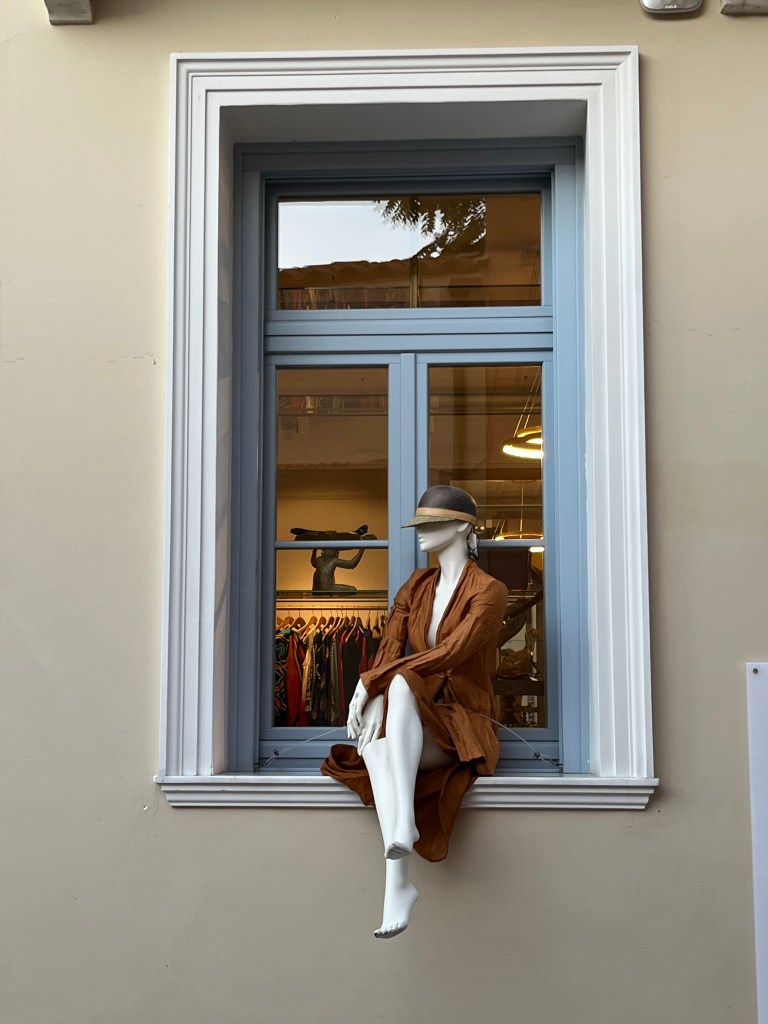
Tourist central and not difficult to understand why. Plaka is charming, close to the bestest touristy bits and resplendent with tavernas, restaurants and shops.
Kolonaki, an upmarket Athens suburb, clambers steeply from the centre making a nip to the shops an endurance exercise. Or torture. Architecturally, uninspiring comprising of mid to late 20th century low rise apartments with an occasional modern block or church offering welcome relief. Nevertheless, the shops, restaurants and people all appear upmarket with a bustling main drag and welcome greenery. The panoramic vista back down into plebeian society emphasising perhaps where you came from.
An inevitable craft ale before Netflix and bed. More on the genuinely surprising Athens craft beer scene can be found at https://wordpress.com/post/tonysbeersnobblog.wordpress.com/525
Athens and the Acropolis. Synonymous with one and other. A total love in. And after queuing for about half an hour Acropolis tickets were ours. A 2 hour wait until our allotted entrance afforded us time for light shopping and to arrange a trip to Delphi for later in the week.
History thing again.
The Acropolis site has been occupied, and unsurprisingly fought over, for 6,000 years. But not by the same 2 adversaries. That would be silly.
In the mid 5th century BC, at the golden age of Athenian culture and power, the Acropolis became the seat of the Athenian League – a little like a modern day protection racket.
Perikles was a renown general and politician from a moderately wealthy background who found himself top dog through this so called golden age. Thankfully, he happened to be rather good at war whilst conversely promoting democracy and the arts. One of those irritatingly good at everything kind of chaps.
The Parthenon. And Chums
Perikles initiated an ambitious building project lasting the entire second half of the fifth century BC. The most important buildings visible on the Acropolis today – the Parthenon, Propylaia, Erechtheion and the Τemple of Athena Nike – were erected during this period.
The winding, though not overly taxing, route upwards (obviously) meandered pleasantly by a number of ruins including a quite beautiful amphitheater.
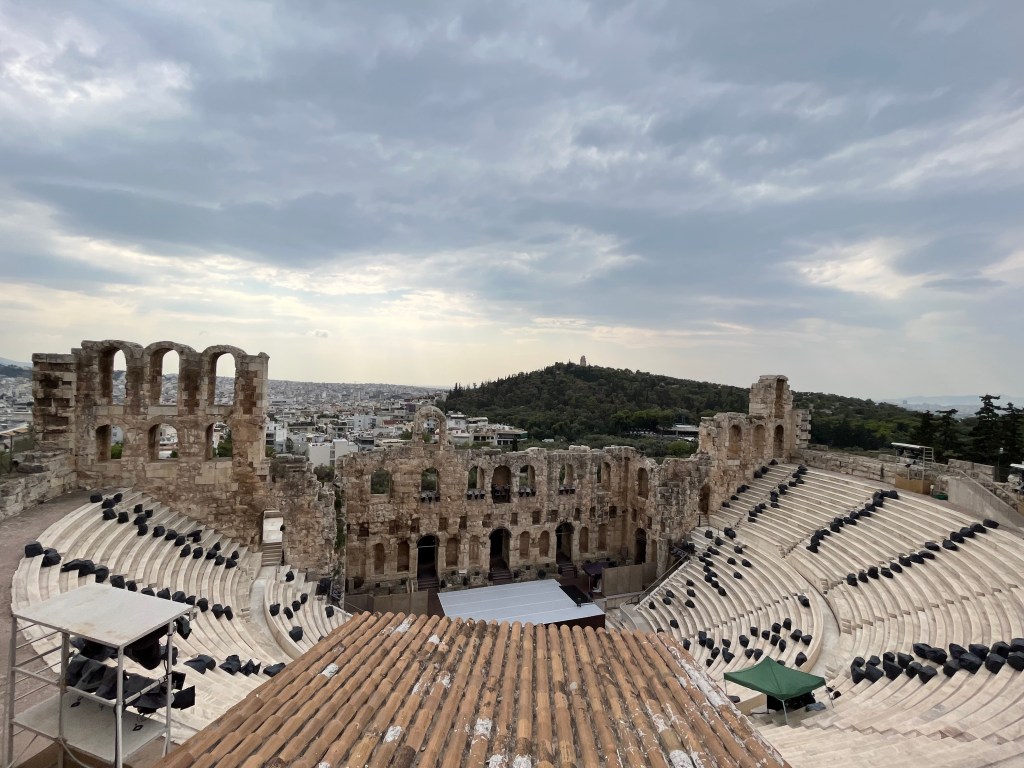
Once the acropolis is reached, even with some modern reconstruction, it’s impossible not to marvel at these 2,500 year old buildings. And it never occurred to me that it wasn’t just the Parthenon up there – it was the Parthenon and chums.
We took our time, taking in the architecture and vista over Athens. My favourite – apologies Parthenon groupies – was actually the Τemple of Athena Nike.
It had been teeming on the way up but, to our surprise, it wasn’t on the way down. Perhaps mid afternoon is the time to visit.
On descending we popped by the Ancient Athens Agora (meeting place and triple alliteration) and the beautiful Temple of Hephaestus dating again from a bewildering 2,500 thousand years ago. Our final cultural delight was, not to be outdone by those show off Greeks, a Roman Agora gate opening into what had been the centre of public life during Roman rule. This Roman upstart is a relatively modern 2,000 years old.
We relaxed with a predictable craft beer at Strange Brew (again, check out my beer blog), probably our favourite of the craft beer tipple houses.
Strange Brew, walkable from Plaka, is located in Koukaki. We’d stayed in Koukaki a week earlier – before our cruise – and peeked around. Our verdict wasn’t encouraging.
‘Koukaki is well kept – as we discovered Athens to be generally – though architecturally uninspiring. Late 20th century, low rise apartment blocks make up the vast majority of Koukaki with only colourful awnings offering any interest or glamour’.
Our second Koukaki outing challenged these initial thoughts. A week didn’t beautify Koukaki – I doubt several years would – though modern apartment blocks added a little architectural glamour. Nevertheless, exploring Koukaki further we discovered an up and coming neighbourhood with a creative, bustling vibe. It very much appealed with both preferring Koukaki to the posher Kolonaki.
And wouldn’t Koukaki and Kolonaki make great children names. Better than Brooklyn. Or Croydon.
Zeus, Hadrian and a Museum
The following day was a tad more tranquil. After breakfast – good reviews, average breakfast – a short stroll took us to the miraculously surviving 2,000 year old Gate of Hadrian. The gate is, somewhat congruously, situated close by a busy main road only emphasising it’s survival instincts. Hadrian would not have been best pleased.
Next up was the Temple of Olympian Zeus opportunely located alongside Hadrian’s Gate. Yep, the same rather busy chap who built Hadrian’s Wall in the north of England to keep out those troublesome Scots. If you wish to get close up and personal to the temple and into the architectural park there is an entrance fee. If you’re skint, tight or short of time the temple is easily observed from outside of the park. We went down the close and personal route and, even today, it’s mightily impressive. What an incredible spectacle it must have been in ancient times.
The temple was started in 515 BC and consisted of a 104 columns. The actual construction spanned an incredible 650 years – reminding me of London’s Crossrail – and finally completed by Hadrian. Somewhat cheekily, Hadrian put statues of himself into the sanctuary. Like his style.
Tragically, during mediaeval times, columns were destroyed or reused for construction. Upcycling isn’t always a good thing.
Our final culture adventure was the Acropolis Museum. We queued for about 20 minutes for tickets.
Wrong queue.
Another similar amount of time in the right queue deposited us in front of a lovely lady who promptly sorted 2 tickets. We loitered in the museum for a good hour and a half and, on leaving about 2pm, discovered both queues inexplicably disappeared.
Even so, the Acropolis Museum is a fine way to wind away an hour or more. And queuing. Twice.
Wine was our choice of tipple late that afternoon. Finewine (https://www.finewine.gr/) was the venue. It’s small with a couple of tables outside with ample people judging opportunities. The wine and service were both top notch – the last wine the owner recommended is particularly memorable.
A couple of days later we popped by a second time but it was closed. A pity.
We ate – the setting better than the food – before heading back to our digs.
Delphi
Delphi, our destination the following day, necessitated an inevitable early start. Transport options include driving, public transport or an organised tour. We chose the latter. And enjoyed a personable, knowledgeable and refreshingly honest guide.
The journey, by bus, was to stretch to around 2 hours. The outer Athens suburbs and the outskirts of the city are a tad drab. Not on the tourist trail and you won’t need a town planner to work out why.
I’d been expecting an arid and brown landscape but once clear of said drabness Delphi trail tourist are greeted by mountains, rolling hills, woods and farmland. Genuinely striking and a most welcome surprise. Delphi itself is situated at the base of Mount Parnassos.
Quite alot of history time.
There’s architectural evidence that the Delphi site was occupied 6,000 years ago with the cult of Apollo established in the 8th century BCE. Prompted by this Apollo chap Delphi developed into both a sanctuary and the oracle. Athena, fashionably late, appeared a little over a century later.
According to literary and archaeological evidence many other gods were associated with the sanctuary including Artemis, Poseidon, Dionysus, Hermes, Zeus Polieus, Hygeia and Eileithyia. Must have been irritating.
The Amphictyonic League, an association of twelve tribes of south-central Greece, controlled the sanctuary and, under the protection and administration of the League, made it autonomous in the 6th century BCE. The oracle blossomed boosting its territory, political and religious influence throughout Greece.
Between the 6th and 4th centuries BCE, the Delphic oracle, was kicking ass. The Pythia, a priestess delivered the prophecy, typically interpreted by a bunch of blokes, the priests of Apollo. The oracle was for all – cities, great rulers rich and poor – with all leaving gifts enriching the already enriched.
The Aetolians conquered the sanctuary in the 3rd century BCE before they themselves were driven out by the Romans in 191 BCE. Some Roman emperors favoured the Delphic oracle (Hadrian), others just nicked anything valuable (Sulla).
In the 3rd century BCE, the Rationalist philosophy movement damaged the oracle’s authority. People stopped believing. Later abandoned, partly destroyed and left to ruin the village of Kastri was ignominiously constructed over the site in the 7th century AD.

We toured the main site, along seemingly with most of Europe and the US. Below is the theatre and the pillars bottom left are the remains of Apollo’s Sanctuary. Where many an unfortunate goat met an unhappy – for the goat – sacrificial end.
Briefly abandoned to our own devices, and as had been suggested, we trudged to the pointiest bit of the Delphi site. Here lies a well preserved ancient stadium – the best in Greece – originally built in the 4th century BCE though tinkered with for the following 200 hundred years or so.
An incredible 6,500 sports fans could ogle their favourite atheletes win, lose or fake an injury. Online gambling would be all over it.
Next up for our weary travelling companions was a small but interesting museum followed, after a very short bus ride, the Temple of Athena Pronaia. Told you it was a long day.
Built in the 7th century BCE, and in keeping with much of the Delphi Sanctuary, was in ruins with only small sections still standing. Nevertheless, in those surroundings, with only a few people around it was properly atmospheric. Back in it’s heyday chez Athena must have been spectacular.
Perhaps surprisingly, my favourite old bit of the Delphi Sanctuary, along with that stunning scenery, was The Stadium. Undoubtably the most complete, a tad more secular and, to me, more real.
We stopped at a village for fodder – I spent the 45 minutes exploring, others sat down for a meal – before our return to Athens. It’s a lengthy day but, if you have the opportunity, a worthwhile one.
Chilling was the goal for our last full day in Athens. We wandered aimlessly exploring neighbourhoods we’d yet to explore. Some upmarket (Psiri), others less so (Omonia), all interesting.
We drank a little ale (Tales of Ales) listening to Jazz, ate delectable food at Ferouz (https://feyrouz.gr/) and completed our Netflix series smugly discovering the murderer before the big reveal. All in all a perfect day to end our 2 week jaunt.

Final Thoughts
Athens. Grows on one. Stunning ancient ruins are sprinkled pleasingly across the city, the Acropolis chief amongst them. Pretty neighbourhoods such as Plaka and buzzing neighbourhoods such as Koukaki are certainly not the exception but neither are they the norm. Much of the city, from what we observed, is a tad drab, lacking personality.
Nevertheless, if Athens isn’t on your tourist trail list, give it a go. No-one should be unmoved by those ancient ruins and the city has much to offer.
Would it be our favourite European capital? No but we’re very glad we went.
 Tony's Travel Blog