
I’ve chosen not to dwell on COVID-19 and have only mentioned in passing. Nevertheless we’re both fully aware of the truly unpleasant nature of this virus and hope you and your families are safe and well.
And my thanks for reading this blog – I genuinely do appreciate it.
Wishing all good health, Tony and Sus
Bilbao – San Sebastian – Bilbao
When travelling abroad we endeavour to pick places yet to be blessed by our presence. Unusually, this trip, we chose as already visited bit of Basque.
Our reasoning; a dodgy shoulder kyboshing skiing, generous flight and hotel deals plus a chance to further explore an area we’d both loved. A democratic 3 nights in each.
And, only adding to the reader’s excitement, for the first time, I’m including the odd photograph. For those interested in what we look like there might even be a Sus approved mugshot. Please don’t become too excited.
Bilbao
Arrival and Re-acquaintance
Our outbound flight was scheduled for late evening on 8 March – I was genuinely concerned the deeply unpleasant coronavirus would decide otherwise. It didn’t.
Yet another strike by French air traffic controllers did. Though only for an hour. Is it instinct? Was it because it was Sunday? I doubt the strikers themselves remember.
A short bus trundle trundles one from the airport to the centre of Bilbao. A shorter non-motorised trundle to our hotel. Tiredness and the lateness of the day meant only a 45 minute stroll re-acquainting ourselves with the city. On our last visit we’d discovered the wonderful Bodega Urbana – superb wine and service. Tragically it has since closed its doors for good. More tragically still, the Hollywood burger bar a few doors down was thriving. And had been since 1971. Spanish teenagers love that authentic taste of America. I could have cried.
New town, old town, concrete beanstalks and tasty breakfasts
Less than 30 seconds from our hotel is Sua San or Susan’s as it became known (https://suasan.com/). We ate breakfast there the following morning and the following, following morning. The food is neither clever nor healthy but is cheap and tasty.
With morning ablutions completed we continued our Bilbao re-acquaintance. The Bilbao’s shopping and commercial districts are agreeably agreeable coming liberally garnished with late 19th and 20th century architecture.
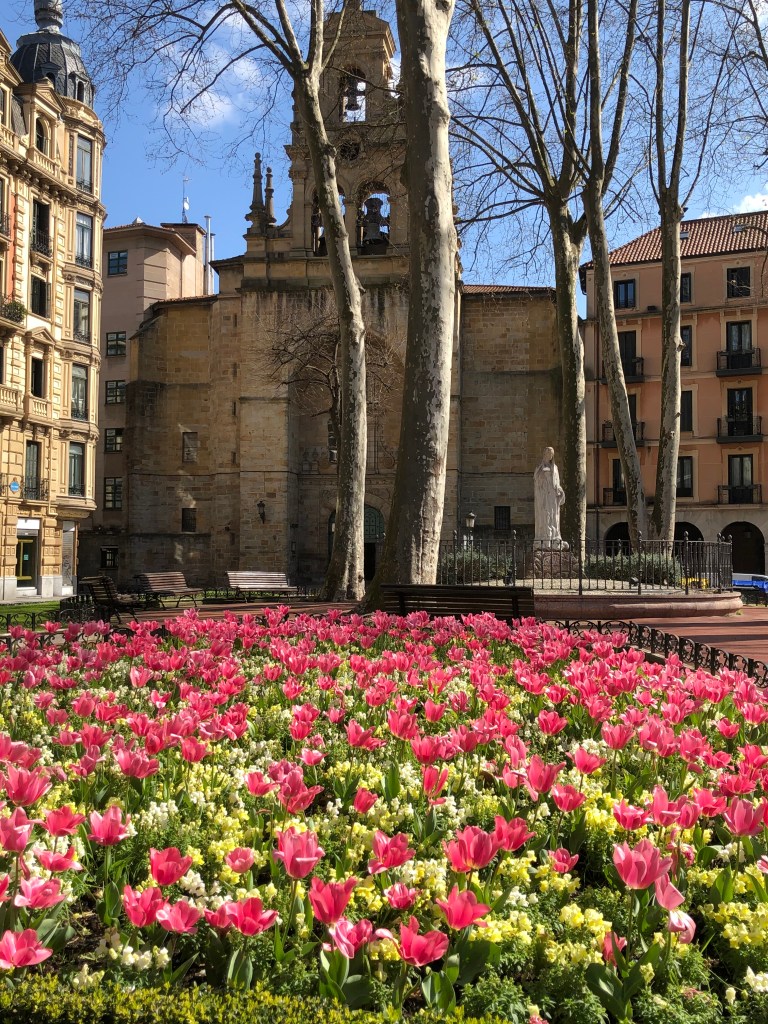
Meandering but gravitating towards the old town we discovered steps. A lot of steps – a concrete and less plant based beanstalk. Once we’d clambered to the summit it started to rain. Heavily. A tree provided cover until this weather malfunction rebooted. The panoramic views across Bilbao and the surrounding hills were (thankfully) agreeably pleasant. Sus loves funiculars. I prefer beer. Bilbao does have one. It was being renovated. In a sudden (and rather too late) flash of insight we realised said stairs were the free, healthy and open air option.
On our previous visit we contrived to completely circumvent the old town (Casco Viejo). No idea why and so, having descended from Mount Bilbao, we headed directly there.
With the exception of the Catedral de Santiago, dating back to the 14th century, Bilbao old town is not actually that old. Dating back to the 19th century some cities would consider it their new town fit only for peasants. Oh the shame. And this older Bilbao quarter was devastated in a 1983 flood necessitating major restoration. And the first street we happened upon was rather run down and rather closed.
Do not be put off. These so called seven streets are a charming place to wander window shopping and shop shopping with sustenance needs thoughtfully met by numerous bars and restaurants.
Craft beer and chocolate
Google discovered Singular (http://singularbar.com/) a cracking craft beer bar with a relaxed vibe and great music. After a thoroughly deserved beer or 2, and equally deserved pintxos (Basque for tapas) or 2, we wandered over to Azkuna Zentroa – Bilbao’s Contemporary Culture Centre. Though devoid of culture or culture types at that particular time, and reminding me a little of an underground carpark, it’s a genuinely impressive space. The centre incorporates early 20th century wine and oil warehouses with the 43 pillars holding the structure up individually decorated. There’s also a swimming pool on the roof with swimmers clearly visible from below – a human aquarium. Prefer fish.
We both adore chocolate, a genuinely life affirming pleasure. Searching for a little sweetness in our lives we stumbled across a local chocolatier and, feeling a need to investigate, popped in. As is our way we began chatting with the 2 charming young ladies behind the counter – one surprisingly English, the other Spanish. They offered us a sample, then another, then another. Sus, by this time was feeling a little guilty. Me less so. All is fair in love, war and chocolate. After spending an enjoyable 20 minutes chatting and sampling we made a purchase or 2, said our goodbyes and left. The chocolate was excellent, the company perhaps more so.
Unfortunately neither remember when we went, where we went or what it was called.
For stupidly expensive but stupidly fabulous chocolate take a peek at Melt (https://www.meltchocolates.com/), a London based chocolatier. Though only a rare treat this is the finest chocolate either has ever eaten.
Our final stop that evening was the Penguin Bar – another craft beer spot which, on arrival, we recognised as a previous haunt. Yet more taps of beery loveliness to choose from. Back home brewery/tap rooms offer samples to the uninitiated and beer snobs alike. In Spain trying means buying. Or certainly did in the Penguin Bar. You live and learn.
Bustling Bilbao, bus station, bus journey
The following morning we checked out and moseyed on down to the bus station. Which had moved and improved since our last visit. Tickets bought we had a couple of hours free before our hour and a half bus ride to San Sebastian – trains are a pain and do not take the strain on this particular Basque A to B.
The latest incarnation of the bus station is perfectly pleasant though not a place either wished to devote 2 hours of our lives. Thankfully, habitually travelling light enabled us, even with luggage, to explore Bilbao’s close by Alameda de Recalde district (City Centre). This bustling neighbourhood, though not architecturally grand (Croydon rather than Venice), comes with a wide and tree lined main thoroughfare, local shops, cafes and bars. We liked it.
We sat in the main square for perhaps half an hour watching a world, seemingly consisting almost entirely of the older generation and often with carers, wander by. Slowly. At 55 I was just a babe in arms. Surreal, uplifting even, one was very much aware of one’s own mortality.
I loathe littering and litterers – ignorance and an utter disrespect for the environment and those inhabiting it. It’s not as if bins and, better still, recycling are complex concepts to grasp. Anyway – and who doesn’t enjoy a righteous rant to make themselves feel a worthier human – the assortment of roads, towns and villages between Bilbao and San Sabastian were probably the cleanest I’ve witnessed anywhere. The journey was only let down by one stretch of the river (which we followed most of the way) that had acquired an unfortunate plastic habit – the unlucky recipient of same plastic holidaying downstream.
San Sebastian
Digs, pintxos, new town, old town
Our self catering digs, a 5 minute walk from the bus station, was from a time architecture took an extended holiday. A large 70/80s vintage block of flats only town planners of the day could love. And, preferring a semi in the ‘burbs, certainly never lived in. The interior, or at least the fragment owned by Atotxa Rooms, was an antidote to our ‘70s town planner chum – modern, clean with shower, air conditioning and TV all functioning splendidly. Alas, not always a given.
Our ever helpful hosts explained where we were, where everything else was and how to get to everything else. Atotxa Rooms is situated on the wrong side of the Urumea River for most of the loveliness, including the old town, San Sebastian has to offer. Dishearten not, all that charm is walkable within 15 minutes. And having to cross the Urumea everyday is never a chore, only a delight.
Fortune favours San Sebastian. There’s an attractive Centro, a 19th century old town and the Bay of Biscay. And, perhaps a tad selfishly, San Sebastian has the Atlantic Ocean on its doorstep along with one of the most beautiful beaches – La Concha – of any town or city visited. Though said beach does have an unfortunate habit of mostly disappearing at high tide.
We had a quick recap of Centro (new town) before an indulgent recap of old town. Centro, though with shops familiar to consummate consumers everywhere, is splendidly likable with handsome architecture, immaculate streets and easy strolling. Though not entirely immune the old town has avoided the worst ravages of tourist tinsel and corporate indifference. The streets are narrower, the architecture prettier and resident eateries some of the choicest on offer. The vibe is bustling, the feeling is local.
The Spanish have tapas. The Basques have pintxos. Though similar to the untrained eye (mine) these little bundles of joy are differentiated by regional variances common throughout Spain. Pintxos are available in the vast majority of bars largely doubling up as cafes. You get down with the locals, whilst enjoying that well deserved break, by standing up with the locals. For those needing to park a posterior many establishments do offer seating.
And, with one exception we lived on these little beauties. I love the little buggers though Sus is less keen. As a vegetarian – occasionally tempted by our water loving ancestors (she’s partial to fish and chips) – her options were somewhat limited. Often to Spanish omelette. Undoubtedly delicious (cooked recently at home) if a tad tedious when the only alternative.
Early evening was upon us. Gandarias (https://www.restaurantegandarias.com/es/), recommended by those nice people at Atotxa Rooms, is a well known cafe, bar and restaurant. It’s an ideal spot, located in a typically beautiful old town building, perfect for pintxos and wine bashing. We duly indulged. Standing obviously. The food was genuinely delicious, the wine decent if not fabulous.
We polished off pintxos at numerous café/bars while in Bilbao and San Sabastian and, nearly without exception, those bundles of deliciousness were indeed that. Gandarias and Sua San were 2 favourites with a third coming later.
It had been a long and enjoyable day. We strolled some more, ate some more, drank a little more before wandering back to our hotel. No complaints.
Rivers end, the Atlantic, 3 beaches and inconvenient tides
We started the following day with a healthy breakfast before hitting the not so mean streets of San Sebastian. San Sebastian has a charming riverside walk bringing one (if one is going the correct way obviously) to the end of days for the Urumea as she empties into the Atlantic.
The Urumea is not tidal. However, swells generated out at sea find their way back up the Urumea (sounds vaguely painful) causing dramatic changes in water levels. When the locals notice a larger swell there’s a headlong rush to the river by men and women dressed in tight fitting rubber and carrying what looks like ironing boards. The Urumea has become a surfer’s paradise, not a mildly disturbing local custom.
I was born and morphed into an adult in Sheffield, in the North of England. Though some (parents) may contend the ‘adult’ bit. Sus did her morphing in California. She grew up by the ocean, I didn’t. We both have a deep love of the sea. Tides slowly exposing land and equally slowly stealing it back has forever fascinated me. It’s a phenomenon I find utterly mesmerising, primeval, a living thing. And to think this magic has occurred for millions of years fills both with genuine wonder.
Anyway, after spending several minutes marvelling at this watery love-in, we headed towards La Concha beach. The beach is accessible via the town though we, like many others, chose the peninsula. The sun was shining, we had beautiful vistas over the Atlantic, it could have been worse.
Within half an hour, and after passing the small port and harbour, we strolled onto La Concha beach. This stunning beach very much reminded us of the equally stunning Bondi beach. Though Bondi beach keeps its dignity during high tide Bondi town is nowhere near as attractive as San Sebastian town.
La Concha is 1.5 kilometres of come hither goldenness and our arrival conveniently coincided with low tide. Because of that troublesome and afore mentioned high tide, the golden stuff stays wet between tides, making strolling a doddle. Those clever Basques think of everything.
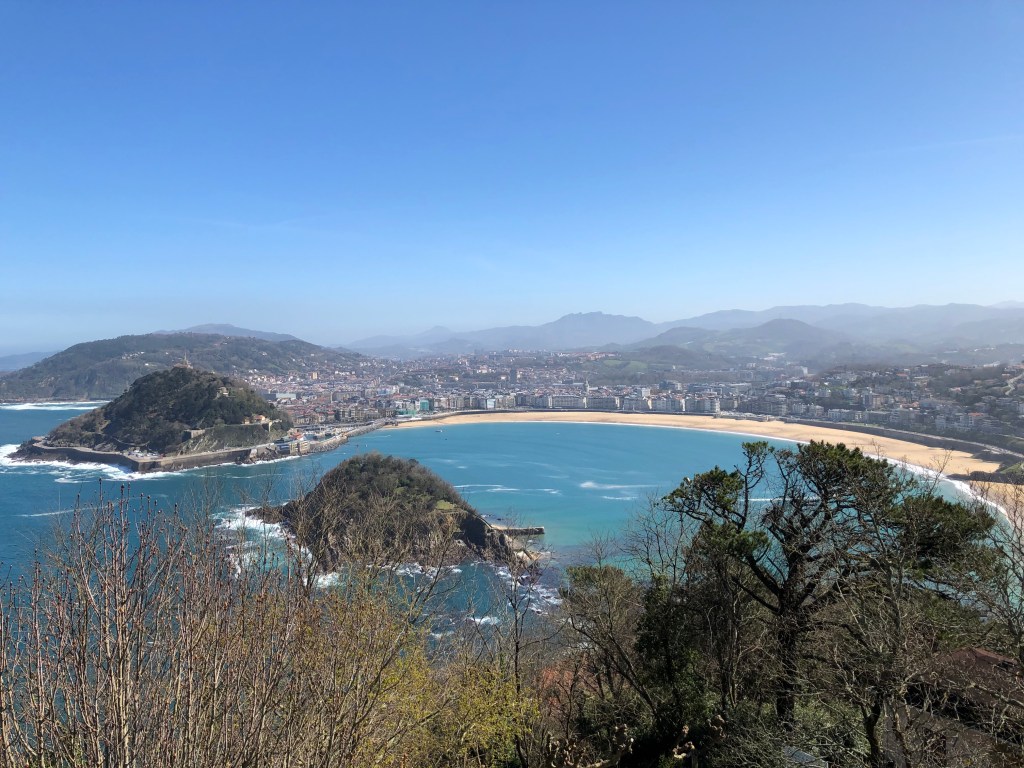
And let’s not forget Santa Clara Island artistically placed in the middle of the bay. Talk about overkill. This little gem, part of a larger island chain, is 400 metres across and, with jagged cliffs, a green interior and encircled by water. Picture postcard does it a disservice.
Though uninhabited summer brings the tourist masses – temptations include a beach (again disappearing inconveniently at high tide), pleasant strolls and, naturally, a bar and restaurant. There’s also a small port and uninhabited lighthouse.
With floating platforms at opportune moments one can easily swim across to the island from the beaches. Or, for those wishing to preserve holiday haircuts, a regular boat service is also available.
After strolling pleasantly for 20 minutes or so (wishing we’d discreetly worn swimming costumes), we came upon a rocky promontory – submerged during high tide. An easy clamber and one finds oneself on Ondarreta Beach, which for all purposes, is an extension of La Concha Beach. At about 600 metres long it’s somewhat shorter and, because of the angle of the sun, less suitable for sunbathing aficionados and those wishing to imitate cooked beetroot. Neither is our cup of sand. It’s quieter and equal in beauty of its more illustrious neighbour.
On leaving the beach you enter an attractive residential neighbourhood which, certainly for Sus, has one of San Sebastian’s most attractive attractions. A funicular. The young chap taking our money was friendly, the 20 something operating this Victorian engineering masterpiece less so – perhaps contemplating that his life hadn’t quite lived up to his once youthful dreams. Or suffering from a hangover.
Views, views, views. And a funicular
The funicular rumbles and creaks its way up a predictably steep incline valiantly attaining the summit in a mere minute or 2. It’s genuinely great fun and a must if burdened with children. Once safely on flat land the visitor is confronted by a small and quite dreadful amusement park squarely aimed at young children. Mercifully, this being out of silly season, the park was closed. It proved the only touch of tackiness encountered in Bilbao or San Sebastian. Saying that, kids will quite rightly love it.
However, and worthy of their very own paragraph, were the views. Wow. Seriously, wow. San Sebastian, its 3 beaches, the Bay of Biscay, Santa Clara Island plus the Atlantic are all laid before lucky you. It brought to mind one of those beautiful, scale models. And, yep there’s more. Glance away from the always mesmerising wet stuff and you’re rewarded with green hills and mountains surrounding San Sebastian. Gorgeous.
Reluctantly leaving those various vistas we jumped on the funicular before leisurely (tiredness does that) walking through San Sebastian back to the hotel. After a spruce and reboot, and sticking to our riverbank, we determined to explore the local neighbourhood (Egia) and the adjacent neighbourhood (Gros) – the latter located alongside San Sabastian’s third beach, Zurriola.
Pick of the pintxos, Gros, a space for art
Fodder first. Bergara in Gros (https://pinchosbergara.es/). Which meant majoring on Gros and minoring on Egia – we’d show a little more love to Egia the following day. Bergara is not particularly traditional, overly bright and a little out of the way for those based across the river. Don’t be fooled. The slightly sparking white wine, using a grape local to the area, perhaps the best drink – my wine snob went missing when queried to the varietal – and the pintxos quite possibly my favourite. Sus would probably choose Gandarias as her top tip. Neither will disappoint.
Suitably fortified our exploration of Gros proper could begin. The area bordering Egia, and furthest from the beach, is not unlike Bilbao’s Alameda de Recalde district (scroll up about 1650 words) though a little less prosperous. Nevertheless, perfectly pleasant and where the local population (or part of it) go about their daily lives – without tourists somehow occupying the first 5 places of any queue.
Curiously (or maybe not), as you progress towards the sea and San Sebastian’s third beach (Zurriola), Gros becomes edgier, and let’s be honest, more interesting. Graffiti is common; litter more commonplace (I know, I know) and the populace more diverse. The older architecture is distinct with the shops and bars typically more idiosyncratic. There’s also a large square bustling happily with community – this slice of Gros has long passed up and coming and now considered hip and trendy. We slotted – self consciously – right in.
Strangely graffiti, though often silly and juvenile, offends considerably less than litter. And graffiti can be glorious, an art form very much deserving a place in art history. Who doesn’t love a bit of Banksy or marvelled at a colourful masterpiece brightening up a drab wall. Litter can never be glorious, only rubbish.
You emerge onto the waterfront to be confronted with a main though not especially busy road. If one chooses to navigate said road Zurriola beach is conveniently arranged before you. Peering out over Zurriola beach and the Atlantic Ocean is the Kursaal, a modern modernist structure, trebling up as a concert hall, art gallery and event host. There was a free art show. We popped in. It was enjoyable.
Beach number 3, surfing, more craft beer
Zurri beach – as it’s known by those of lesser years than myself – is 800 metres of sandy comeliness and, usefully, less impacted by high tides. Befitting the area it’s notably younger, hipper and edgier than either La Concha or Ondarreta beaches. Zurriola beach charms larger waves much favoured by surfer types. Who were numerous even on a damp, cool and breezy evening.
Peering out over the main road, beach and surfers is Kanabikana Craft Beer Shop (http://kainabikaina.com/). It’s a little strange. There are 3-4 small high tables without stools or anywhere else to plonk a posterior. Obviously a recent addition to Gros and equally obviously geared for take outs – the taps being set up to pour into assorted receptacles brought in by expectant punters. There’s also a decent selection of cans to run away with.
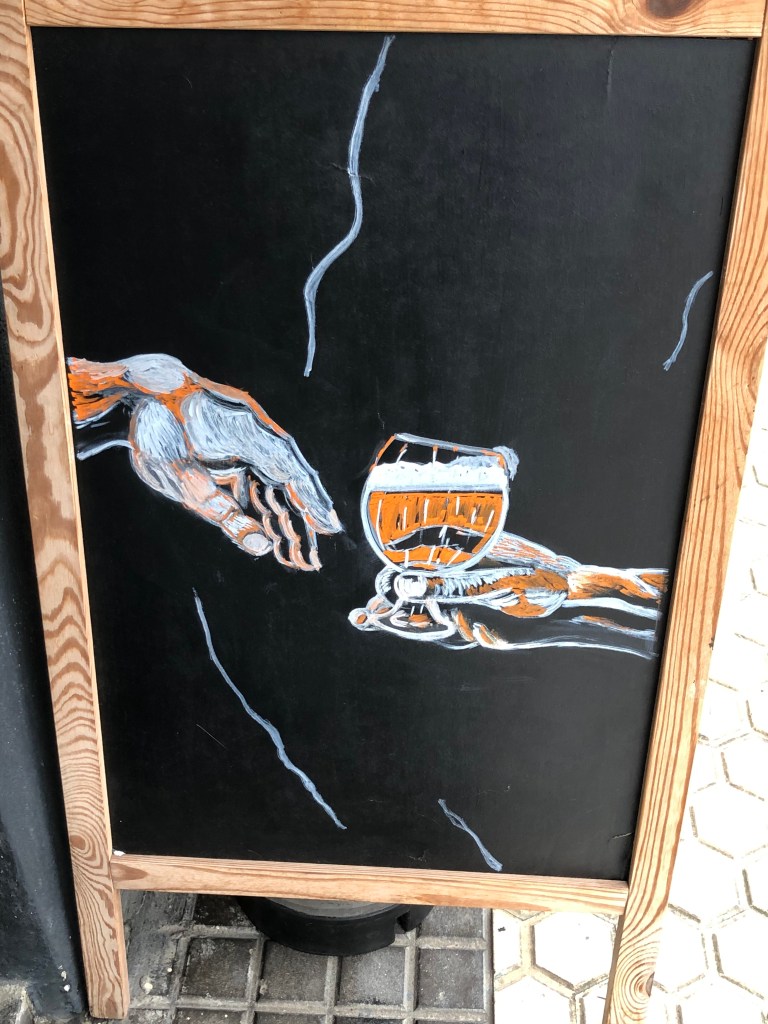
The proprietor appeared somewhat surprised when we suggested sitting (standing) inside to drink our chosen malted barley beverages – he warmed up over the course of our 2 visits. Amusingly, he needed to tap beer into a plastic bottle before pouring into glasses. A legality or practical problem we were never to discover. Nevertheless the views were always interesting and the beer from the 18 taps – certainly the few sampled – top quality. If you love beer go. If you don’t, don’t.
Egia, old town, a wine dearth and a solution
The following day was Egia day. Or at least the first couple of hours were. Egia is largely residential with a selection of local shops and bars. The community rises up from the river to, as is so often the case, loftier and posher residences. Of which a lucky few have far-reaching views back over San Sebastian. Egia is not especially exciting or especially architecturally fabulous and, located on the wrong side of the river, not a tourist tick box exercise. Nevertheless Egia made for an interesting excursion into tourist free local life.
We returned to old town and searched in vain for a wine emporium of excellence. One looked promising – an uninterested (‘we don’t do tasters’) and phone obsessed shop assistant ruined our wine sipping dreams. A second wasn’t open and a third had long ceased to exist. In a region famed for wine it came as a bit of a shock, that aside from the now defunct Bodega Urbana and possibly Bergara, the wine drunk in both Bilbao and San Sebastian was disappointing. If any of you know of a hidden gem in either Bilbao or San Sebastian then please do pass it on.
There is a solution. It’s the small town of Haro an hour’s bus ride from Bilbao. The scenery between Bilbao and Haro and the town itself are pleasant enough though motivation for such an outing are cunningly concealed on the town’s outskirts – a good 20 minutes’ walk from the centre. Haro is set at the heart of the Rioja wine region. Better still, the outskirts don’t consist of run down trading estates, but pretty bodegas representing many of the region’s best wine houses – including Muga (love Muga) and Cune. You can literally sway from one to another sampling their wares at very reasonable prices. Less Bermondsey beer mile more Basque bodega wine barrio.
We’d visited Haro on that previous jaunt to Bilbao. And don’t be suckered into taking an overpriced bodegas tour. It’s a simple do it yourself excursion and a marvelous way to spend a sunny afternoon. If you enjoy good wine of course. If wine is not your cup of fermented grapes this excursion will not be a highlight.
Having despaired of ever finding a worthy wine establishment – which was friendly, open or in existence – we grabbed a couple of cheeky pintxos before making for Gros generally and Kanabikana Craft Beer Shop specifically. It was still strange. Beer was still superb.
Architecturally attractive, with 3 beautiful beaches and surrounded by lush green hills San Sebastian is an awfully appealing place to find oneself for a day or 2. Undoubtedly and deservedly a tourist hotspot, and driven by the same, San Sebastian is both vibrant but remains remarkably livable. We certainly could.
Bilbao
Wonderful markets, wonderful food
The following morning an early bus took us back to Bilbao, a successful negotiation of the underground to our hotel. We were kindly allowed to check in and, once cleansed, headed to the old town.
And discovered the wonderful La Ribera market; supposedly the largest covered market in Europe. La Ribera, constructed in 1929, is very much a product of its time boasting elegant proportions and large, beautifully stained glass windows. Across the market’s 2 floors are numerous fishmongers and butchers. If your preference tends towards products once less alive cheese, vegetable and fruit stalls plus a bakery will happily take one’s money. The second floor has an area set aside to sample the produce in the shapely form of pintxos. Wine and beer are also thoughtfully available. Even the toilets were spotless.
We were severely tempted. And proceeded to be severely tempted for about 15 minutes while deciding, not untypically, where to eat. Hunger and a slight feeling of embarrassment forced a decision. Sus decreed a non pintxo related meal – this being our last day in Northern Spain.
Google directed us to a vaguely downmarket – but transitioning upmarket – Bilbao neighbourhood a few minutes’ walk from both the old town and attractive Atxuri train station. The latter was built in 1912 and definitely worth a quick gawp. Our destination was Sokarrat (http://sokarrat.eltenedor.rest/en_GB/), a local and well thought of neighbourhood restaurant.
We wandered tentatively in. We called tentatively out – of life there was none. The chef, genie like, magically appeared and ushered us to a table. Not especially difficult – we were his only customers. A waitress appeared, again a little genie like, with a menu and wine list. The desert menu, rather charmingly was a handwritten scrawl. We each had a small starter, the seafood paella and desert. There was also a bottle of Lanzarote wine involved. At one point, the same chef, he was probably the owner too, came out to enquire about his culinary creations.
Sokarrat is not posh – more a hip café befitting the area with locals popping in and out (and back in) for a beer, coffee or a glass of wine. Diners are seated on mismatched furniture with the large open kitchen – and slightly scary looking chefs – clearly visible. Do not be fooled. The food was delicious, the wine excellent – the best we’d had in either Bilbao or San Sebastian. The staff were a delight and Sokarrat is rather splendid value. We would not hesitate in returning.
We left Sokarrat late afternoon and wandered, including a short hotel refresh, aimlessly for a couple of hours or so. Said aimlessness brought both to a decidedly edgy neighbourhood, an Aldi for snacks and Singular for a 2 half cheeky recharge. Returning to the hotel we indulged in a snack bashing session before retiring gracefully for the evening.
A strange day, kindness of strangers
Breakfast was weird. A group of perhaps 10 Mexicans, plus staff, were our only company. COVID-19 had reached Northern Spain. Spain would shortly be in lockdown.
Humankind is fucking up the planet; Nature may well be taking her revenge. And, I along with Sus, are part of the problem. We recycle, use recyclable products and avoid plastic wherever possible. However we love to travel. Often requiring planes.
In the UK, as presumably elsewhere, we’ve had the warmest Spring since quite possibly the Ice Age. Only to be told – quite rightly – not to go out for more than an hour. Nature may also be having a laugh.
The rest of the day was weird. Our flight home wasn’t until late that same evening and so, once checked out, we pottered over to Duesto, the neighbourhood we’d stayed our first time in the city. Duesto is a bustling mingling of locals and university students, liveable with easy access to Bilbao, and rather to our liking. In fact the Guggenheim is just a short stroll and is where, enjoying a coffee, you next find us. Oddly the museum was closed, their café open. A mixed message response to COVID-19. Boris has since become the master of such messages.
With the exception of Duesto Bilbao had felt unnaturally calm – little appeared open, people were scarce, traffic was light. This was Saturday.
Returning to pick up our bags we spied a lovely local bar considerately open. The pintxos looked tempting, a glass of wine more so. After partaking in a glass we collected our luggage and ambled to the airport bus stop. Again, as is our way, we chatted with 2 delightful university students teaching English abroad – one was English, the other German and spoke better English than I do. With their schools closed both were desperate to get home.
The bus duly arrived. There was a problem. Because of COVID-19 the driver, grumpily if understandably, would only allow passengers to board via the rear doors. He wasn’t accepting cash; only the requisite travel card. This we didn’t have. Joy.
Not only did our new found student chums pay for us using their travel cards neither would except a cash reimbursement. The kindness of strangers never ceases to amaze and humble us.
We like Bilbao. A lot. It’s not a beautiful city just an agreeable one. As with Rome Bilbao is one of those rare places we both feel very much at home. Throw in San Sebastian and it’s a region we could happily live.
The journey to the airport, the flight back, even the trek from Gatwick to West London were all uneventful and straightforward.
Home.
Lockdown.
 Tony's Travel Blog