MALTA

The Morning

Malta is windy.

We didn’t know though a later trip on an open top hop on, hop off bus eloquently demonstrated this.

A week off in the middle of March, after ruthlessly – in a similar fashion to the Tories – discarding various bits of Europe, led to a week in Malta. A stupidly early Gatwick flight – not ideal from our West London home – meant we landed in Malta one early Friday afternoon. We were to stay in Valletta, the capital, for the entire week using it as a base. Malta is small island chain and the local buses and ferries proved effective and cheap.

History Bit

The Maltese Islands had a golden Neolithic period – more of them later – and enjoyed and subsequently abandoned by the Phoenicians, Carthaginians, Romans and Byzantines.

In 60 AD St Paul was shipwrecked on Malta while on his way to Rome. Careless. He brought Christianity which is still in evidence.

The Arabs then conquered the islands in 870 AD influencing the native language though English is an equal partner. Until 1530 Malta was an extension of Sicily and hence, whoever ruled Sicily ruled the Maltese Islands. This motley bunch included the Normans, Aragonese and other assorted conquerors before Charles V bequeathed Malta to the Sovereign Military Order of St John of Jerusalem. What a nice chap. They ruled Malta until 1798 ushering in a golden age and metamorphosing Malta into in a rather big cheese of 17th and 18 century Europe. The Knights went onto make wads of cash through trade commissioning artists such as Caravaggio and Mattia Preti to embellish Maltese churches, palaces and auberges.

In 1798 Napoleon Bonaparte kicked out the Knights on his way to Egypt. The English subsequently kicked out the French around 1800 and ruled Malta until 1964. Apparently the Maltese actually requested the English to distribute the French elsewhere – usually the French have been asked to redistribute the English.

British rule lasted until 1964 when Malta became independent though the Maltese did adopt the British system of public administration, education and legislation.

The Afternoon

The X4 bus from outside the airport, for a very reasonable €2, takes you into Valletta and deposits one and all at the central bus station. Somewhere you’ll, if you haven’t hired a car or have a handy helicopter, become very familiar with. We did.

We, Sus, found our Airbnb within 15 minutes. We couldn’t get in. In a cognitive leap, worthy of our ancient ancestors, I recalled an email explaining that the electronic lock would be effective from 3pm. It was a little after 2pm. Whoops. Less than a minute away was a local cafe in which we enjoyed excellent bruschetta and fresh orange juice.

Back to our Airbnb a tad after 3pm followed by an effortless entrance. ‘Tide by Savynomad – just got that – Harbour Residences’ proved to be a delightful base and Martin a delightful host. It’s in the basement of a 500 year old building but has natural light from the door and a very contemporary interior. There’s a microwave, washing machine and even Netflix for that feel good holiday romcom.

Once suitably freshened up we wandered. Nowhere in particular though quickly discovered Valletta is a rather attractive and hilly city. If walking up and down slopes is really not your cup of sea water, or you’re perhaps not able, Valletta may not be that special short break you were looking for.

The Beer Bit

For those who read these blogs or tonysbeersnobblog.wordpress.com you’ll know my appreciation of a craft beer. Or two. Like any self respecting beer aficionado I’d already researched the best spots to try for a cheeky craft or 2. And that’s how we found ourselves at 67 Kapitali (www.67kapitali.com).

They had about 10 taps mainly pouring the wonderfully posh sounding Lord Chambray beers interspersed with an occasional interloper from the UK. Magic Rock when we were there. A fridge housed further local beers (Huskie) and a small selection from outside of Malta.

Over our 4 visits I managed to sample most with all proving most palatable. A favourite was the 67 IPA which Chambray brewed especially for the bar.

One evening we ate there – I ordered a platter Sus couldn’t eat and she ordered a vegan platter I could but didn’t. They were huge. These could easily be shared between 2 people. We both had take outs. And watched a film.

The Trek

The next morning, after buying several days of breakfast supplies from the exotic Holland and Barrett we decided on a yomp from Valletta to Sliema – via several townships including Msida, Ta’ Xbiex and Gzira – forming a continuous urbanisation around the bay. Msida, Ta’ Xbiex and Gzira all amiably blended into one.

The roughly 5 mile trek is not a recognised walk – though some blogs do provide vague directions – and without Sus and Apple maps we may well still be walking.

Typically, when wandering aimlessly – or vaguely misplaced – one discovers many a treasure. We happened upon Hastings Gardens plonked on both St John’s and St Michael’s Bastions (painful) with wonderful views across the harbour. Renovated only a few years ago and, with striking groto-esque art work, merits a gander. It wasn’t busy and a worthy opponent to the Upper and Lower Barrakka Gardens. I’m not sure I didn’t actually prefer it to them.

Valletta’s architecture, it’s streets and piazzas range from mid-16th century Baroque to Modernism with a unique collection of churches, palaces and museums. It all adds up to a striking capital city.

For contrast we trudged through what appeared to be Valletta’s government administrative centre – not horrible though certainly not a FOMO moment. Apple maps amused itself by directing us down a steep and busy winding main road – with pavements disappearing only to reappear on the opposite side – with a couple of similarly bemused travelers making their way up. Oh, and one mad jogger running up.

Thankfully, this did drop us into the harbour inducing a certain amount of boat envy. I don’t even have a great desire to own a boat. Observing the posh boats, on the other side of the road running alongside the harbour, were some beautiful though often dilapidated buildings. Incongruously, there was a large modern block – mercifully incorporating one of the older buildings – adorned with the KPMG logo.

Trotted through a slightly scruffier area – Valletta is perhaps the cleanest European capital either have visited – with the bay still on one side. Only when we went inland a little later did our friendly watery friend vanish from view.

Sus is the most generous and best natured person I’ve ever met. Until she gets hungry. She decided Ayu, a modern looking restaurant was for her. And me. It was the best meal either ate our whole week in Malta (https://ayu.mt/restaurant-menu/).

After leaving Ayu we ventured inland into Sliema proper before coming back down to the waterfront where we gracefully danced on the extensive rocks and rock pools presumably exposed by an outgoing tide. Sliema is the most densely populated town on the island – though still attractive – making it a centre for shopping and cafes with lively bars and nightlife. We liked Sliema and I can understand why many tourists choose it as their island base. There’s a conveniently large Lidl for those self catering though I’ve a sneaking suspicion that for many it’s the nightlife and not a fresh food counter that appeal.

The nightlife not being our cup of Cisk we caught a bus back to Valletta – number 13 taking 15 to 20 minutes.

Mdina, Wind and Loud Noises

The following morning, post a Holland and Barrett inspired breakfast, we bussed to the village of Rabat located a few minutes walk from Mdina. Mdina, home to only about 250 people, is a magnificent walled city and generously populated with Norman and Baroque palaces, churches and homes. It’s a miracle the Game of Thrones producers missed it.

On arriving we were welcome by an insane wind and loud bangs. Thankfully Mdina wasn’t having a wind assisted collapse – these, we believe, were artillery shells exploded close by. Above, we could even see puffs of smoke, akin to a failed firework.

After entering the citadel, and having a quick coffee at the first tourist trap we discovered, we wandered around the small but pleasingly proportioned Mdina. It is properly magnificent, a wonderfully preserved slice of medieval history. Mercifully, the wind was flaying us alive, we found a sunny and protected square happily habited by a pub. The wine was mediocre but the shared bruschetta excellent. The influence of Italian cuisine is everywhere in Malta and an excuse to eat unhealthy amounts of pizza.

We decided on another look around – discovering what we’d already seen – before heading to the romantically titled Ditch Gardens located at the base the walls.

Exiting Mdina I saw a bus readying to leave for Valletta – at the loss of a few calories we made the bus. Rejoice.

Back in Valletta we went wild. A couple of ales at 67 Kapitali, a glass a glass of vino at a nearby wine shop, all washed down with chocolate and Netflix. Lovely.

Gozo, Not Gozo, Three Cities

If we have to be at an airport, on the other side of London, by 6 o’clock then we’ll be outside waving at Ubers. In the rain. If, however, there is no early start we tend not to get our poo together until mid to late morning.

And that’s why we missed the ferry to Gozo. Be warned, the last morning ferry leaves at 9.45am, the next one is not until an inconvenient 1.45pm.

The Three Cities, the neighbourhoods of Vittoriosa (also known as Birgu), Senglea and Cospicua, sit across from the Grand Harbour and surround the Vittoriosa Marina. The marina is a happy home to large, expensive looking floaty things. Some of said floaty things are house size and appear to have their own staff.

Vittorosia, with that harbour and must have fort, is especially attractive though with beautiful buildings from the 16th century mixed with modern renovations and restaurants with views the 3 cities are a lovely way to wile away an afternoon. Throw in a seriously relaxed wine accompanied lunch and it was our most chilled day. And perhaps my favourite.

Then the short return scenic ferry trip back across to Valletta. With the added bonus of watching a chap in a very large boat making a complete bollocks of reversing into a decent size space. Great fun.

Gozo, Definitely Gozo

So keen were we not to miss the 9.45am ferry that we surpassed ourselves and caught the 9am ferry. From the Grand harbour in Valetta to Mgarr on Gozo takes about 45 minutes. It’s not particularly cheap, about £15 each return, though convenience won out – our Airb&b was less than 10 minutes walk.

Disembarking at the mildly pleasant Mgarr we went searching, along with our fellow bemused passengers, for some sort of transport. The taxi driver I asked wanted a ridiculously extortionate amount, the buses inconveniently absent and presumably packed.

Wandering into the modern terminal we were accosted by an incredibly persuasive and efficient lady flogging a hop on, hop off bus tour. There was another booth next to hers selling a rival hop on, hop off bus tour though without the all important persuasive and efficient lady. Our buses were red, the rival’s green. We saw both at the same locations, often at the same time. I doubt either is better than the other.

We bought 2 day passes – about £20 each. It proved an excellent compromise between a taxi driver financing a mistress and the lesser spotted local bus service.

Perhaps a tad tacky but a hop on, hop off bus was a convenient way for us to witness Gozo and get to those must see – or not so must see – tourist destinations. It’s not perfect, buses were often late, 45 minutes between each bus is not especially opportune and buses will become crowded in peak season. For us, on a day trip from Valletta in March, they worked well. However, if we were staying on Gozo, local buses or hiring a car would prove better alternatives.

Like most passengers we gravitated to the upper deck for the views. Fuck it was windy and a smidgen chilly. A few less hardy passengers abandoned the upper deck for the hurricane free lower deck. We bravely endured, literally holding onto our hats. We criss crossed Gozo, twice passing through the attractive capital Victoria, and briefly stopping at Dwejra with its pretty coastline.

We finally left the bus at the ‘quaint fishing village’ of Marsalforn. Marsalform is neither quaint, a village or particularly pretty with the exception of the bay it happens to be located on. It very much has the feel of a town developed to accommodate and entertain the tourist hoards. Who were conspicuously absent in March.

Highlights included a stroll along the rocky foreshore and spotting 2 holidaying octopuses in the bay. Along the foreshore was the odd small saltpan though more impressive specimens are located some distance from the bus stop – not mentioned in the advertising blurb. A Romanian tourist was especially excited. We decided to eat and bugger off – we’ve seen huge saltpans in Bolivia.

Our only other stop, with the exception of the ferry, was the magnificent 5,500 year old Ggantija Megalithic Temples – that’s older than the Pyramids and, not surprisingly, a UNESCO World Heritage Site. These 2 remarkably preserved temples have a common wall but separate entrances. Properly incredible. To think these same stones were touched by people like me and you over 5,000 years ago.

As I’ve mentioned 45 minutes between buses is not ideal and, having visited the small museum and the temples, we missed the next one. Nevertheless, this gave us the opportunity, suspiciously scrutinised by a security guard, to wander around these wonderfully evocative monuments a second time. And wandered we did.

We arrived back at the Mgarr and the ferry terminal early and strolled around the harbour front before our return journey to Valletta.

I wasn’t convinced by Gozo with the obvious and worthy exception of the megalithic temples and possibly Victoria. Sus was more forgiving. To be fair we only saw and visited parts of the island accessible by an open top bus. Even so, not somewhere I’ll be poetry penning about.

Inevitably we finished our day with 67 Kaptali and Netflix.

St Julian’s, Hard Hats, Tacky

A 13A bus took us to the town of St Julian’s. We explored the likeable sea front and discovered some very expensive apartments in an area going through a huge amount of redevelopment and renovation. Some had private harbours. Nice.

After continued exploring we discovered the vaguely Superman sounding Paceville. There’s the small, slightly scruffy St. George’s Bay beach behind which sits numerous clubs, bars, restaurants, casinos and cinemas. Many are open to the early morning attracting a younger crowd with the more mature preferring the upmarket wine bars and restaurants. Hotels of all flavours cater for the presumably drunken masses.

Again it’s part of the island that has gone huge development in recent times. Paceville is undoubtably going for sophisticated. We thought it horrible and tacky.

A stroll back to St Julian’s harbour and a bite to eat. The food was decent, the wine better and an ongoing shouting match between our waitress and one of the chefs thoroughly entertaining.

Back to Valletta and a stroll around the city exploring parts we had yet to see.

I won’t ask you to guess how we ended the day. Memorably, we added humus and tortillas to the mix.

More Megalithic, More Valletta

Malta has it’s own Megalithic temples – Hagar Qim. No relation to everyone’s favourite comic strip Viking. A 72 bus bus, after about 45 minutes, drops megalithic devotees in the small and agreeable town of Qrendi. Apparently closed on our visit with the exception of those ubiquitous 2 blokes plus digger, digging, Presumably a very important hole. From there it’s a 20 minute-ish meander to the site itself.

There are 2 sites separated by a easily walkable 500 metres. Both are of a similar age to our megalithic friends on Gozo – 3,600BC to 3,200BC. That’s before Elton John. They sit in a picturesque landscape with wonderful sea views though partly restored by over zealous Victorians.

As with the Gozo megalithic temples Hagar Qim is a worthwhile tick in a tourist checklist. Make it a big tick.

Then a 74 bus directly from Hagar Qim to Valletta. The reason we didn’t travel on the 74 directly to Hagar Qim was an hour wait. We live in London, not even trees stand still for that long.

The bus ride is interesting in it’s own right. Small towns, countryside and small farms all come into then out of view. Be proud to be a tourist, stare out of the windows and not at your phone.

Back in Valletta we explored Floriana a short stroll from the bus terminal. The late 18th century Saint Publius Church dominates one end of a large square featuring what I thought to be the unfortunate stumps of a much larger and presumably older building. However, after consulting the intrawebby, it appears they were grain granaries the stumps being stone covers. The space is now used for concerts and the always fun political mass meetings.

Floriana burbs are an interesting mix of government buildings and a slowly – but inescapably – gentrifying area of dense and attractive buildings. The Argotti and Mall Gardens beautify the area – Valletta does gardens better than most.

Rambling aimlessly brought us to the Lower Barrakka Gardens, which along with Upper Barrakka Gardens, offer wonderful views across the Grand Harbour. Our digs were just below the Upper Barrakka Gardens – built on top of a bastion they date back 1661 when those lucky Knights used it as their private garden. When we had visited, a couple of days previously, students along with proud parents, were utilising the gardens as a background for, sometimes inventive, graduation photos. Those Knights would be proud. And probably charging an entrance fee.

And, each day at noon, members of the Malta Heritage Society (dressed in British Artillery uniforms) fire a salute.

That evening we ate at Gugar (gugarmalta.blogspot.com) which was cheap, cheerful and a proper hippy hangout for those pretending to be in India. And then, in contrast, we found WHY NOT? It’s one of those places you wish you’d discovered earlier in the week – the staff were friendly, the wine was excellent and, though we didn’t eat, the cheese and meat platters looked spectacular. Recommended.

Home

The following morning was our last. We had a leisurely morning before heading to the airport and London.

One oddity before I go. Malta’s tap water is not the best. However, it is safe to drink. And we did. On a couple of occasions, when asking for tap water we were warned of the dire consequences of drinking said water. Strange.

We both loved Valletta – it’s architectually interesting, fortuitously located with numerous spots to eat, drink and be as merry as you might wish. Beyond Valletta it’s megaliths and Mdina that charm. For a short break we’d certainly consider popping over to Valletta again.
 

SPAIN

I’ve chosen not to dwell on COVID-19 and have only mentioned in passing. Nevertheless we’re both fully aware of the truly unpleasant nature of this virus and hope you and your families are safe and well.

And my thanks for reading this blog – I genuinely do appreciate it.

Wishing all good health, Tony and Sus

Bilbao – San Sebastian – Bilbao

When travelling abroad we endeavour to pick places yet to be blessed by our presence. Unusually, this trip, we chose as already visited bit of Basque.

Our reasoning; a dodgy shoulder kyboshing skiing, generous flight and hotel deals plus a chance to further explore an area we’d both loved. A democratic 3 nights in each.

And, only adding to the reader’s excitement, for the first time, I’m including the odd photograph. For those interested in what we look like there might even be a Sus approved mugshot. Please don’t become too excited. 

Bilbao

Arrival and Re-acquaintance

Our outbound flight was scheduled for late evening on 8 March – I was genuinely concerned the deeply unpleasant coronavirus would decide otherwise. It didn’t.

Yet another strike by French air traffic controllers did. Though only for an hour. Is it instinct? Was it because it was Sunday? I doubt the strikers themselves remember.

A short bus trundle trundles one from the airport to the centre of Bilbao. A shorter non-motorised trundle to our hotel. Tiredness and the lateness of the day meant only a 45 minute stroll re-acquainting ourselves with the city. On our last visit we’d discovered the wonderful Bodega Urbana – superb wine and service. Tragically it has since closed its doors for good. More tragically still, the Hollywood burger bar a few doors down was thriving. And had been since 1971. Spanish teenagers love that authentic taste of America. I could have cried.

New town, old town, concrete beanstalks and tasty breakfasts

Less than 30 seconds from our hotel is Sua San or Susan’s as it became known (https://suasan.com/). We ate breakfast there the following morning and the following, following morning. The food is neither clever nor healthy but is cheap and tasty.

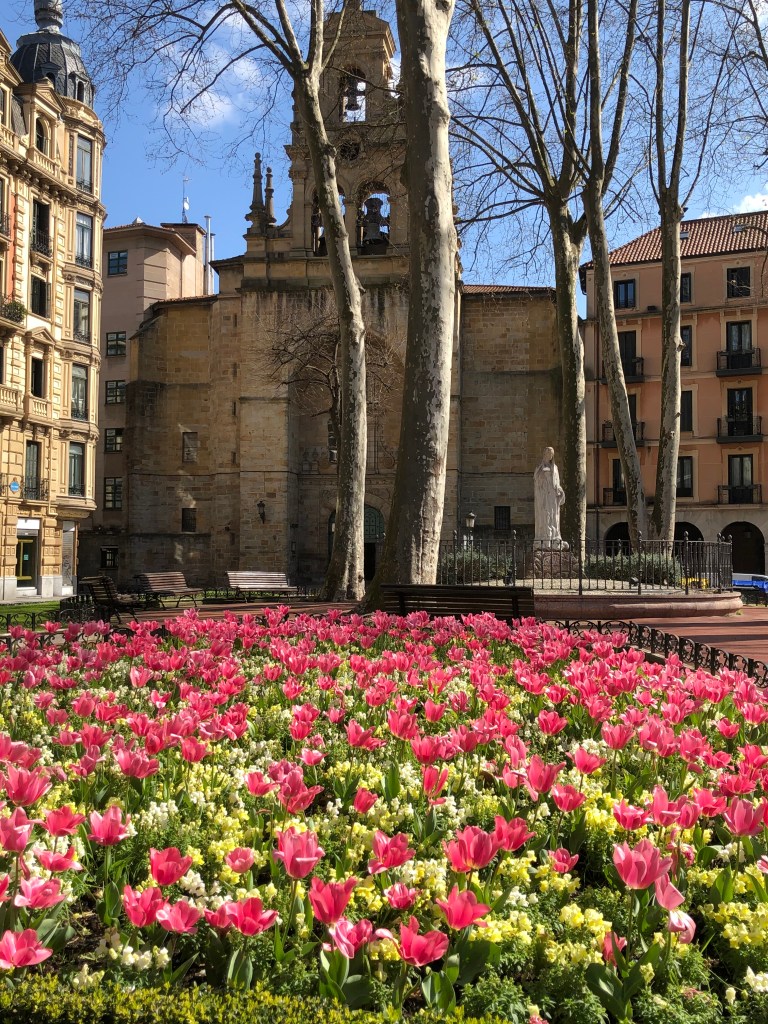
With morning ablutions completed we continued our Bilbao re-acquaintance. The Bilbao’s shopping and commercial districts are agreeably agreeable coming liberally garnished with late 19th and 20th century architecture.

Meandering but gravitating towards the old town we discovered steps. A lot of steps – a concrete and less plant based beanstalk. Once we’d clambered to the summit it started to rain. Heavily. A tree provided cover until this weather malfunction rebooted. The panoramic views across Bilbao and the surrounding hills were (thankfully) agreeably pleasant. Sus loves funiculars. I prefer beer. Bilbao does have one. It was being renovated. In a sudden (and rather too late) flash of insight we realised said stairs were the free, healthy and open air option.

On our previous visit we contrived to completely circumvent the old town (Casco Viejo). No idea why and so, having descended from Mount Bilbao, we headed directly there.

With the exception of the Catedral de Santiago, dating back to the 14th century, Bilbao old town is not actually that old. Dating back to the 19th century some cities would consider it their new town fit only for peasants. Oh the shame. And this older Bilbao quarter was devastated in a 1983 flood necessitating major restoration. And the first street we happened upon was rather run down and rather closed.

Do not be put off. These so called seven streets are a charming place to wander window shopping and shop shopping with sustenance needs thoughtfully met by numerous bars and restaurants.

Craft beer and chocolate

Google discovered Singular (http://singularbar.com/) a cracking craft beer bar with a relaxed vibe and great music. After a thoroughly deserved beer or 2, and equally deserved pintxos (Basque for tapas) or 2, we wandered over to Azkuna Zentroa – Bilbao’s Contemporary Culture Centre. Though devoid of culture or culture types at that particular time, and reminding me a little of an underground carpark, it’s a genuinely impressive space. The centre incorporates early 20th century wine and oil warehouses with the 43 pillars holding the structure up individually decorated. There’s also a swimming pool on the roof with swimmers clearly visible from below – a human aquarium. Prefer fish.

We both adore chocolate, a genuinely life affirming pleasure. Searching for a little sweetness in our lives we stumbled across a local chocolatier and, feeling a need to investigate, popped in. As is our way we began chatting with the 2 charming young ladies behind the counter – one surprisingly English, the other Spanish. They offered us a sample, then another, then another. Sus, by this time was feeling a little guilty. Me less so. All is fair in love, war and chocolate. After spending an enjoyable 20 minutes chatting and sampling we made a purchase or 2, said our goodbyes and left. The chocolate was excellent, the company perhaps more so.

Unfortunately neither remember when we went, where we went or what it was called.

For stupidly expensive but stupidly fabulous chocolate take a peek at Melt (https://www.meltchocolates.com/), a London based chocolatier. Though only a rare treat this is the finest chocolate either has ever eaten.

Our final stop that evening was the Penguin Bar – another craft beer spot which, on arrival, we recognised as a previous haunt. Yet more taps of beery loveliness to choose from. Back home brewery/tap rooms offer samples to the uninitiated and beer snobs alike. In Spain trying means buying. Or certainly did in the Penguin Bar. You live and learn.

Bustling Bilbao, bus station, bus journey

The following morning we checked out and moseyed on down to the bus station. Which had moved and improved since our last visit. Tickets bought we had a couple of hours free before our hour and a half bus ride to San Sebastian – trains are a pain and do not take the strain on this particular Basque A to B.

The latest incarnation of the bus station is perfectly pleasant though not a place either wished to devote 2 hours of our lives. Thankfully, habitually travelling light enabled us, even with luggage, to explore Bilbao’s close by Alameda de Recalde district (City Centre). This bustling neighbourhood, though not architecturally grand (Croydon rather than Venice), comes with a wide and tree lined main thoroughfare, local shops, cafes and bars. We liked it.

We sat in the main square for perhaps half an hour watching a world, seemingly consisting almost entirely of the older generation and often with carers, wander by. Slowly. At 55 I was just a babe in arms. Surreal, uplifting even, one was very much aware of one’s own mortality.

I loathe littering and litterers – ignorance and an utter disrespect for the environment and those inhabiting it. It’s not as if bins and, better still, recycling are complex concepts to grasp. Anyway – and who doesn’t enjoy a righteous rant to make themselves feel a worthier human – the assortment of roads, towns and villages between Bilbao and San Sabastian were probably the cleanest I’ve witnessed anywhere. The journey was only let down by one stretch of the river (which we followed most of the way) that had acquired an unfortunate plastic habit – the unlucky recipient of same plastic holidaying downstream.

San Sebastian

Digs, pintxos, new town, old town

Our self catering digs, a 5 minute walk from the bus station, was from a time architecture took an extended holiday. A large 70/80s vintage block of flats only town planners of the day could love. And, preferring a semi in the ‘burbs, certainly never lived in. The interior, or at least the fragment owned by Atotxa Rooms, was an antidote to our ‘70s town planner chum – modern, clean with shower, air conditioning and TV all functioning splendidly. Alas, not always a given.

Our ever helpful hosts explained where we were, where everything else was and how to get to everything else. Atotxa Rooms is situated on the wrong side of the Urumea River for most of the loveliness, including the old town, San Sebastian has to offer. Dishearten not, all that charm is walkable within 15 minutes. And having to cross the Urumea everyday is never a chore, only a delight.

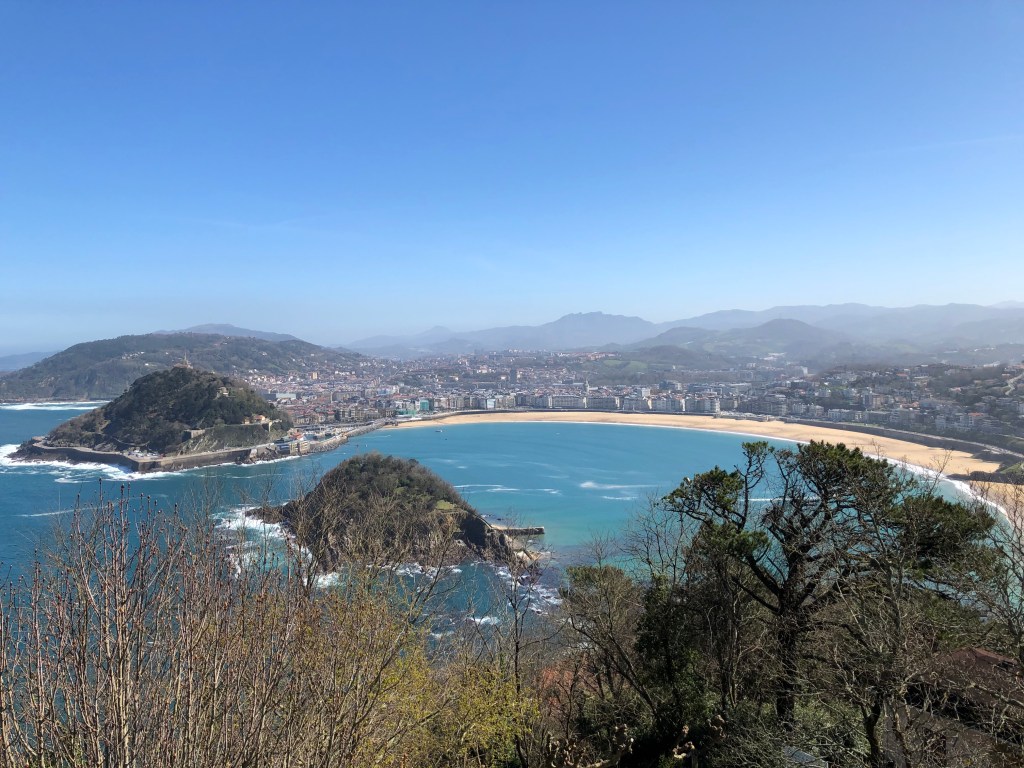
Fortune favours San Sebastian. There’s an attractive Centro, a 19th century old town and the Bay of Biscay. And, perhaps a tad selfishly, San Sebastian has the Atlantic Ocean on its doorstep along with one of the most beautiful beaches – La Concha – of any town or city visited. Though said beach does have an unfortunate habit of mostly disappearing at high tide.

We had a quick recap of Centro (new town) before an indulgent recap of old town. Centro, though with shops familiar to consummate consumers everywhere, is splendidly likable with handsome architecture, immaculate streets and easy strolling. Though not entirely immune the old town has avoided the worst ravages of tourist tinsel and corporate indifference. The streets are narrower, the architecture prettier and resident eateries some of the choicest on offer. The vibe is bustling, the feeling is local.  

The Spanish have tapas. The Basques have pintxos. Though similar to the untrained eye (mine) these little bundles of joy are differentiated by regional variances common throughout Spain. Pintxos are available in the vast majority of bars largely doubling up as cafes. You get down with the locals, whilst enjoying that well deserved break, by standing up with the locals. For those needing to park a posterior many establishments do offer seating.

And, with one exception we lived on these little beauties. I love the little buggers though Sus is less keen. As a vegetarian – occasionally tempted by our water loving ancestors (she’s partial to fish and chips) – her options were somewhat limited. Often to Spanish omelette. Undoubtedly delicious (cooked recently at home) if a tad tedious when the only alternative.

Early evening was upon us. Gandarias (https://www.restaurantegandarias.com/es/), recommended by those nice people at Atotxa Rooms, is a well known cafe, bar and restaurant. It’s an ideal spot, located in a typically beautiful old town building, perfect for pintxos and wine bashing. We duly indulged. Standing obviously. The food was genuinely delicious, the wine decent if not fabulous.

We polished off pintxos at numerous café/bars while in Bilbao and San Sabastian and, nearly without exception, those bundles of deliciousness were indeed that. Gandarias and Sua San were 2 favourites with a third coming later.

It had been a long and enjoyable day. We strolled some more, ate some more, drank a little more before wandering back to our hotel. No complaints.

Rivers end, the Atlantic, 3 beaches and inconvenient tides

We started the following day with a healthy breakfast before hitting the not so mean streets of San Sebastian. San Sebastian has a charming riverside walk bringing one (if one is going the correct way obviously) to the end of days for the Urumea as she empties into the Atlantic.

The Urumea is not tidal. However, swells generated out at sea find their way back up the Urumea (sounds vaguely painful) causing dramatic changes in water levels. When the locals notice a larger swell there’s a headlong rush to the river by men and women dressed in tight fitting rubber and carrying what looks like ironing boards. The Urumea has become a surfer’s paradise, not a mildly disturbing local custom.

I was born and morphed into an adult in Sheffield, in the North of England. Though some (parents) may contend the ‘adult’ bit. Sus did her morphing in California.  She grew up by the ocean, I didn’t. We both have a deep love of the sea. Tides slowly exposing land and equally slowly stealing it back has forever fascinated me. It’s a phenomenon I find utterly mesmerising, primeval, a living thing. And to think this magic has occurred for millions of years fills both with genuine wonder.

Anyway, after spending several minutes marvelling at this watery love-in, we headed towards La Concha beach. The beach is accessible via the town though we, like many others, chose the peninsula. The sun was shining, we had beautiful vistas over the Atlantic, it could have been worse.

Within half an hour, and after passing the small port and harbour, we strolled onto La Concha beach. This stunning beach very much reminded us of the equally stunning Bondi beach. Though Bondi beach keeps its dignity during high tide Bondi town is nowhere near as attractive as San Sebastian town.

La Concha is 1.5 kilometres of come hither goldenness and our arrival conveniently coincided with low tide. Because of that troublesome and afore mentioned high tide, the golden stuff stays wet between tides, making strolling a doddle. Those clever Basques think of everything.

And let’s not forget Santa Clara Island artistically placed in the middle of the bay. Talk about overkill. This little gem, part of a larger island chain, is 400 metres across and, with jagged cliffs, a green interior and encircled by water. Picture postcard does it a disservice.

Though uninhabited summer brings the tourist masses – temptations include a beach (again disappearing inconveniently at high tide), pleasant strolls and, naturally, a bar and restaurant. There’s also a small port and uninhabited lighthouse.

With floating platforms at opportune moments one can easily swim across to the island from the beaches. Or, for those wishing to preserve holiday haircuts, a regular boat service is also available.

After strolling pleasantly for 20 minutes or so (wishing we’d discreetly worn swimming costumes), we came upon a rocky promontory – submerged during high tide. An easy clamber and one finds oneself on Ondarreta Beach, which for all purposes, is an extension of La Concha Beach. At about 600 metres long it’s somewhat shorter and, because of the angle of the sun, less suitable for sunbathing aficionados and those wishing to imitate cooked beetroot. Neither is our cup of sand. It’s quieter and equal in beauty of its more illustrious neighbour.

On leaving the beach you enter an attractive residential neighbourhood which, certainly for Sus, has one of San Sebastian’s most attractive attractions. A funicular.  The young chap taking our money was friendly, the 20 something operating this Victorian engineering masterpiece less so – perhaps contemplating that his life hadn’t quite lived up to his once youthful dreams. Or suffering from a hangover.

Views, views, views. And a funicular

The funicular rumbles and creaks its way up a predictably steep incline valiantly attaining the summit in a mere minute or 2. It’s genuinely great fun and a must if burdened with children. Once safely on flat land the visitor is confronted by a small and quite dreadful amusement park squarely aimed at young children. Mercifully, this being out of silly season, the park was closed. It proved the only touch of tackiness encountered in Bilbao or San Sebastian. Saying that, kids will quite rightly love it.

However, and worthy of their very own paragraph, were the views. Wow. Seriously, wow. San Sebastian, its 3 beaches, the Bay of Biscay, Santa Clara Island plus the Atlantic are all laid before lucky you. It brought to mind one of those beautiful, scale models. And, yep there’s more. Glance away from the always mesmerising wet stuff and you’re rewarded with green hills and mountains surrounding San Sebastian. Gorgeous.

Reluctantly leaving those various vistas we jumped on the funicular before leisurely (tiredness does that) walking through San Sebastian back to the hotel. After a spruce and reboot, and sticking to our riverbank, we determined to explore the local neighbourhood (Egia) and the adjacent neighbourhood (Gros) – the latter located alongside San Sabastian’s third beach, Zurriola.

Pick of the pintxos, Gros, a space for art

Fodder first. Bergara in Gros (https://pinchosbergara.es/). Which meant majoring on Gros and minoring on Egia – we’d show a little more love to Egia the following day. Bergara is not particularly traditional, overly bright and a little out of the way for those based across the river. Don’t be fooled. The slightly sparking white wine, using a grape local to the area, perhaps the best drink – my wine snob went missing when queried to the varietal – and the pintxos quite possibly my favourite. Sus would probably choose Gandarias as her top tip. Neither will disappoint.

Suitably fortified our exploration of Gros proper could begin. The area bordering Egia, and furthest from the beach, is not unlike Bilbao’s Alameda de Recalde district (scroll up about 1650 words) though a little less prosperous. Nevertheless, perfectly pleasant and where the local population (or part of it) go about their daily lives – without tourists somehow occupying the first 5 places of any queue.

Curiously (or maybe not), as you progress towards the sea and San Sebastian’s third beach (Zurriola), Gros becomes edgier, and let’s be honest, more interesting. Graffiti is common; litter more commonplace (I know, I know) and the populace more diverse. The older architecture is distinct with the shops and bars typically more idiosyncratic. There’s also a large square bustling happily with community – this slice of Gros has long passed up and coming and now considered hip and trendy. We slotted – self consciously – right in.

Strangely graffiti, though often silly and juvenile, offends considerably less than litter. And graffiti can be glorious, an art form very much deserving a place in art history. Who doesn’t love a bit of Banksy or marvelled at a colourful masterpiece brightening up a drab wall. Litter can never be glorious, only rubbish.

You emerge onto the waterfront to be confronted with a main though not especially busy road. If one chooses to navigate said road Zurriola beach is conveniently arranged before you. Peering out over Zurriola beach and the Atlantic Ocean is the Kursaal, a modern modernist structure, trebling up as a concert hall, art gallery and event host. There was a free art show. We popped in. It was enjoyable.

Beach number 3, surfing, more craft beer

Zurri beach – as it’s known by those of lesser years than myself – is 800 metres of sandy comeliness and, usefully, less impacted by high tides. Befitting the area it’s notably younger, hipper and edgier than either La Concha or Ondarreta beaches. Zurriola beach charms larger waves much favoured by surfer types. Who were numerous even on a damp, cool and breezy evening.

Peering out over the main road, beach and surfers is Kanabikana Craft Beer Shop (http://kainabikaina.com/). It’s a little strange. There are 3-4 small high tables without stools or anywhere else to plonk a posterior. Obviously a recent addition to Gros and equally obviously geared for take outs – the taps being set up to pour into assorted receptacles brought in by expectant punters. There’s also a decent selection of cans to run away with.

The proprietor appeared somewhat surprised when we suggested sitting (standing) inside to drink our chosen malted barley beverages – he warmed up over the course of our 2 visits. Amusingly, he needed to tap beer into a plastic bottle before pouring into glasses. A legality or practical problem we were never to discover. Nevertheless the views were always interesting and the beer from the 18 taps – certainly the few sampled – top quality. If you love beer go. If you don’t, don’t.

Egia, old town, a wine dearth and a solution

The following day was Egia day. Or at least the first couple of hours were. Egia is largely residential with a selection of local shops and bars. The community rises up from the river to, as is so often the case, loftier and posher residences. Of which a lucky few have far-reaching views back over San Sebastian. Egia is not especially exciting or especially architecturally fabulous and, located on the wrong side of the river, not a tourist tick box exercise. Nevertheless Egia made for an interesting excursion into tourist free local life.

We returned to old town and searched in vain for a wine emporium of excellence. One looked promising – an uninterested (‘we don’t do tasters’) and phone obsessed shop assistant ruined our wine sipping dreams. A second wasn’t open and a third had long ceased to exist. In a region famed for wine it came as a bit of a shock, that aside from the now defunct Bodega Urbana and possibly Bergara, the wine drunk in both Bilbao and San Sebastian was disappointing. If any of you know of a hidden gem in either Bilbao or San Sebastian then please do pass it on.

There is a solution. It’s the small town of Haro an hour’s bus ride from Bilbao. The scenery between Bilbao and Haro and the town itself are pleasant enough though motivation for such an outing are cunningly concealed on the town’s outskirts – a good 20 minutes’ walk from the centre. Haro is set at the heart of the Rioja wine region. Better still, the outskirts don’t consist of run down trading estates, but pretty bodegas representing many of the region’s best wine houses – including Muga (love Muga) and Cune. You can literally sway from one to another sampling their wares at very reasonable prices. Less Bermondsey beer mile more Basque bodega wine barrio.

We’d visited Haro on that previous jaunt to Bilbao. And don’t be suckered into taking an overpriced bodegas tour. It’s a simple do it yourself excursion and a marvelous way to spend a sunny afternoon. If you enjoy good wine of course. If wine is not your cup of fermented grapes this excursion will not be a highlight.

Having despaired of ever finding a worthy wine establishment  – which was friendly, open or in existence – we grabbed a couple of cheeky pintxos before making for Gros generally and Kanabikana Craft Beer Shop specifically. It was still strange. Beer was still superb.

Architecturally attractive, with 3 beautiful beaches and surrounded by lush green hills San Sebastian is an awfully appealing place to find oneself for a day or 2. Undoubtedly and deservedly a tourist hotspot, and driven by the same, San Sebastian is both vibrant but remains remarkably livable. We certainly could.

Bilbao

Wonderful markets, wonderful food

The following morning an early bus took us back to Bilbao, a successful negotiation of the underground to our hotel. We were kindly allowed to check in and, once cleansed, headed to the old town.

And discovered the wonderful La Ribera market; supposedly the largest covered market in Europe. La Ribera, constructed in 1929, is very much a product of its time boasting elegant proportions and large, beautifully stained glass windows. Across the market’s 2 floors are numerous fishmongers and butchers. If your preference tends towards products once less alive cheese, vegetable and fruit stalls plus a bakery will happily take one’s money. The second floor has an area set aside to sample the produce in the shapely form of pintxos. Wine and beer are also thoughtfully available. Even the toilets were spotless. 

We were severely tempted. And proceeded to be severely tempted for about 15 minutes while deciding, not untypically, where to eat. Hunger and a slight feeling of embarrassment forced a decision. Sus decreed a non pintxo related meal – this being our last day in Northern Spain.

Google directed us to a vaguely downmarket – but transitioning upmarket – Bilbao neighbourhood a few minutes’ walk from both the old town and attractive Atxuri train station. The latter was built in 1912 and definitely worth a quick gawp. Our destination was Sokarrat (http://sokarrat.eltenedor.rest/en_GB/), a local and well thought of neighbourhood restaurant.

We wandered tentatively in. We called tentatively out – of life there was none. The chef, genie like, magically appeared and ushered us to a table. Not especially difficult – we were his only customers. A waitress appeared, again a little genie like, with a menu and wine list. The desert menu, rather charmingly was a handwritten scrawl. We each had a small starter, the seafood paella and desert. There was also a bottle of Lanzarote wine involved. At one point, the same chef, he was probably the owner too, came out to enquire about his culinary creations.

Sokarrat is not posh – more a hip café befitting the area with locals popping in and out (and back in) for a beer, coffee or a glass of wine. Diners are seated on mismatched furniture with the large open kitchen – and slightly scary looking chefs – clearly visible. Do not be fooled. The food was delicious, the wine excellent – the best we’d had in either Bilbao or San Sebastian. The staff were a delight and Sokarrat is rather splendid value. We would not hesitate in returning.

We left Sokarrat late afternoon and wandered, including a short hotel refresh, aimlessly for a couple of hours or so. Said aimlessness brought both to a decidedly edgy neighbourhood, an Aldi for snacks and Singular for a 2 half cheeky recharge. Returning to the hotel we indulged in a snack bashing session before retiring gracefully for the evening.

A strange day, kindness of strangers

Breakfast was weird. A group of perhaps 10 Mexicans, plus staff, were our only company. COVID-19 had reached Northern Spain. Spain would shortly be in lockdown.

Humankind is fucking up the planet; Nature may well be taking her revenge. And, I along with Sus, are part of the problem. We recycle, use recyclable products and avoid plastic wherever possible. However we love to travel. Often requiring planes.

In the UK, as presumably elsewhere, we’ve had the warmest Spring since quite possibly the Ice Age. Only to be told – quite rightly – not to go out for more than an hour. Nature may also be having a laugh.

The rest of the day was weird. Our flight home wasn’t until late that same evening and so, once checked out, we pottered over to Duesto, the neighbourhood we’d stayed our first time in the city. Duesto is a bustling mingling of locals and university students, liveable with easy access to Bilbao, and rather to our liking. In fact the Guggenheim is just a short stroll and is where, enjoying a coffee, you next find us. Oddly the museum was closed, their café open.  A mixed message response to COVID-19. Boris has since become the master of such messages.

With the exception of Duesto Bilbao had felt unnaturally calm – little appeared open, people were scarce, traffic was light. This was Saturday.

Returning to pick up our bags we spied a lovely local bar considerately open. The pintxos looked tempting, a glass of wine more so. After partaking in a glass we collected our luggage and ambled to the airport bus stop. Again, as is our way, we chatted with 2 delightful university students teaching English abroad – one was English, the other German and spoke better English than I do. With their schools closed both were desperate to get home.

The bus duly arrived. There was a problem. Because of COVID-19 the driver, grumpily if understandably, would only allow passengers to board via the rear doors. He wasn’t accepting cash; only the requisite travel card. This we didn’t have. Joy.

Not only did our new found student chums pay for us using their travel cards neither would except a cash reimbursement. The kindness of strangers never ceases to amaze and humble us.

We like Bilbao. A lot. It’s not a beautiful city just an agreeable one. As with Rome Bilbao is one of those rare places we both feel very much at home. Throw in San Sebastian and it’s a region we could happily live.

The journey to the airport, the flight back, even the trek from Gatwick to West London were all uneventful and straightforward.

Home.

Lockdown.

The Cotswolds

The Cotswolds are a range of gently rolling hills in the south of England; the largest Area of Outstanding Natural Beauty in England and Wales; sprinkled liberally with quintessentially English market towns and villages built from honey-coloured stone.

We realised quite recently the delights of this green and pleasant land lie only an hour and a half drive (M40 in a good mood) from Ealing. Splendid. This revelation has led to 2 recent jaunts, one last May and one in January 2020.

May 2019

After a tolerable hour-ish drive on the M40 we fancied a nibble to eat. Sus had found, with a little help from that clever internet, Daylesford Organic Farm (https://www.daylesford.com/). This Gloucestershire mothership has given birth to another 4 outposts in London and included a shop, restaurants, butcher, baker, alas no candlestick maker, fishmonger, grocer and homeware. Much of the produce is grown, reared or hatched on their organic farm. It’s expensive, busy and perhaps a little too commercial but worth a wander and a gander. And our pizzas were excellent.

We drove to our B&B, freshened and made our way to Cirencester. Which appeared closed. Nevertheless, Cirencester is an attractive market town with Roman remains, medieval morsels, 18th century Cotswolds stone buildings and the ubiquitous Victorian architecture. Fortified with a healthy takeout of chips we wandered agreeably for an hour before returning to our B&B.

After a splendid and obviously healthy full English we waddled our way to Stow on the Wold. Another extremely attractive market town Stow boasts many 16th century limestone houses (one even dates back to c1450); a beautiful 11th century church pimped up in the 15th century; a Victorian hall; numerous cafes, pretty pubs and restaurants galore. Originally a wool town Stow on the Wold is genuinely a beautiful place and would make an excellent base.

Next up, the wonderfully named, and perfectly safe, Upper Slaughter and Lower Slaughter. Though sounding like a B horror movie and an equally dreadful sequence the name actually relates to location. Both are blessed with 16th and 17th Cotswold Limestone dwellings, Upper Slaughter acquired a Manor House dating back to the 15th century, Lower Slaughter a 19th century water mill. Both happily share the River Eye and are less than half an hour stroll apart. Both are gorgeous.

And, as luck would have it, Jane Austin’s Emma was being filmed at the time of our visit. Thanks guys. The incongruence between 21st technology and early 19th century costumes was genuinely surreal. Americans were dribbling with excitement, the English stood around looking smug. The reverse is true when the English find themselves gazing into the depths of the Grand Canyon.

We pottered off but only after watching a scene being filmed that really will be on a screen near you quite shortly.

Burton-on-the-Water was teeming with tourists – quite possibly millions of them. We drove through and headed to Cheltenham. After ambling around the sometimes pretty, sometime not city centre we headed back to the car – quite deliberately discarded a minute’s walk from the wonderful Favourite Beer (http://www.favouritebeers.com/). They have perhaps 10 beers on tap and hundreds of cans and bottles to either quaff in or quaff out. Sus drove home.

For reasons unknown I chose this as the finale of our first Cotswolds adventure. And threw away the notes Sus makes on such trips. It wasn’t. We had 2 day left, including the event this trip had been built around.

Whoops. Let’s play a memory game.

Another morning, another delicious and healthy full English. Snowshill Manor and Gardens was our intended venue to burn off, for me anyway, all that fatty loveliness.

Snowshill Manor is a beautiful Tudor manor house bought by a chap called Charles Wade, thanks to an inheritance from his parents, shortly after the Second World War. Charles, an avid collector, revamped the Manor to house his ever growing collection and transformed the farmyard into an Arts and Crafts garden. He lived in the small Priest’s House opposite. It was that or a barn conversion.

His eclectic collection (much admired by the lovvies of the day) includes a magical model village, a room full of bygone bicycles, and weirdly, one of the finest collections of Samurai costumes outside of Japan. 

There is nothing not to like. The Manor, collection and gardens blend superbly to create both a fascinating and beautiful place to be. The National Trust might own half the country but they do it so very well.

And it’s here dear readers where memory and Google fail me. Neither can recall anything of that evening…….

…….segueing seamlessly into the next morning. We drove to a Holiday Inn on the outskirts of Maidenhead for this particular jaunt’s raison d’etre (an expression crafted by the French, destroyed by the English). 

Excited? We were.

We checked in, freshened up and taxied to Bray, a small, pleasant suburban village on the Thames. This bijou Berkshire community boasts, as near neighbours, the Fat Duck and Waterside Inn. The former is the domain of Heston Blumenthal, the latter of Alain Roux. Both are restaurants, both are 3 star Michelin restaurants.

Sus, though certainly not looking so, was to be 50 that June. The Fat Duck was the lucky recipient for this undoubted celebration.

The taxi dropped us outside a 16th century building. We looked around – there was a pub but no neon sign pointing the way to this temple to gastronomy. Thankfully, within a few seconds of our landing in Bray, a door opened, a waitress emerged and a 4 and a half hour journey began. I was genuinely nervous, Sus considerably less so.

And please be assured, what follows will not be an in depth dissection of what we slurped, burped and gulped. With accompanying selfies.  I‘d be bored.

The restaurant was surprisingly small (40 covers only) with tables well spaced. We had the taster menu with matched wines – 16 courses (yep 16), some being small plates, others literally just a mouthful, most inbetween. The incredibly inventive menu is based around Heston’s seaside memories and, for one delectable fish course, includes headphones with sounds of the sea. Astonishingly it really did make a difference. Never saw that coming. I’m presuming the fish didn’t either.

It was stupendously expensive. You could probably purchase a McDonald’s franchise for the same cost. The seaside narrative is occasionally stretched and the food, though of superb quality, very occasionally misfires. However, the waiters and waitresses were fabulous, the wine wonderful and the food, when it does work, was without doubt some of the finest either has ever, ever eaten. One particular small plate was the tastiest I’ve perhaps eaten anywhere, anytime. And we’ve been lucky enough to dine in many a fine establishment.

Taken in its entirety that 4 and a half hours is one of the many highlights of our 10 plus years together.

Would we go again? Fuck yeah.

January 2020

Eight months later, another birthday. Partly in celebration of my 55th birthday, we were back. It was cold.

We based ourselves in the Bear of Rodborough Hotel on the outskirts of Stroud. Two particularly unfortunate bears, having been shot and stuffed, stood as silent sentinels menacing reception. The hotel is a rambling 17th century coaching inn and, though perched on a busy intersection, proved a delightful and quirky place to stay. There’s a lovely bar, real fires, decent bar food and a full English as splendid I’ve bothered in sometime. My mornings are generally reserved for cereal or porridge.

Stroud is yet another market town. The Cotswold’s seem to have a knack of producing such places. Stroud was very much closed. And very much cold. Stroud, once an important wool town, boasts 17th, 18 and 19th architecture, still has a large and successful market and an active local community. Though not postcard pretty Stroud is certainly an attractive spot. When open.

The next morning, and following an obligatory and healthy full English (something non meaty for Sus), we drove to Lacock Abbey. The abbey was founded by one of the most formidable and powerful women of the Middle Ages – Ela Countess of Salisbury. The cloisters, somewhat surprisingly, were incorporated into a Tudor country house in the 15th century. The canny courtier, who purchased the abbey shortly after the Dissolution of the monasteries, presumably picked up a bargain. We should thank him; the cloisters are a rare example of medieval monastic architecture. Cheers Bill (Sir William Sharington).

John Ivory Talbot inherited Lacock in the 17th century and went about pimping up the olde yea place in the totally on trend Gothick style. In the 19th century William Henry Fox Talbot inherited this impressive pile and, depending on your nationality, may or may not have invented modern photography. It might have been a French bloke. However it does explain the rather incongruous appearance of an excellent photography museum in the grounds of a building dating back 800 years. 

In 1944, a surprised recipient of the Lacock estate sensibly entrusted its future upkeep to the National Trust. Of which we’re members.

Parts of the house were undergoing conservation and not open to the public. This is a common practice during the winter months, as we learnt from the guided Conservation Tour we booked on arrival. It may sound a tad drab but was a fascinating insight into the ongoing battle between nature and old buildings. There’s surely a Sky original series in there somewhere. Thinking hobbit but more insect focussed. 

We bravely braved immodest weather to explore Lacock village the setting for many a film and TV series. Most of the village houses date to the 18th century or earlier, there’s a 14th century tithe barn, a medieval church, an inn dating to the 15th century and an 18th-century village school still in use today.

You could easily spend a day wandering around Lacock abbey, town and estate – all are quite beautiful. A half day is the least Lacock and you deserve.  

Our day ended on a trading estate on the outskirts of Cheltenham. Somewhat disappointing architecturally after Lacock. There were mitigating circumstances. This particular trading estate was home to the delightful DEYA brewery and tap room. As Sus heroically volunteered to drive I enjoyed only a couple of halves before we headed back to the hotel. Thoughtfully the lovely chaps and chapesses at DEYA sold their delicious brews in cans. We purchased several.

And shared a couple before struggling to finish a decent and very substantial seafood platter. With an equally decent gin and tonic. It had been a long day.

After another delicious and wholesome full English we said goodbye to the hotel and our 2 bear chums. Our next stop was a literally freezing salvage yard (too cold to get wallet out) before meeting daddy Tony and Bev (second wife) in Stow on the Wold. Dad, a regular visitor, loves the Cotswolds and it’s actually simpler to meet them both here then it is their Derbyshire home. After enjoying a pleasant hour catching up in one of the numerous coffee and cake establishments we headed back to London.

I may not always agree with dad – his worldview, being 80 plus and living in Derbyshire, veers right of my own – but his love of this area is totally understandable. The Cotswolds genuinely are a beautiful part of the world. We’ll be back.