CHEDDER GORGE

CHEDDAR GORGE

Arrival

On Monday 2 November we departed West London for Somerset and Cheddar Gorge for another of our cheeky 4 night staycations. The country was again locking down, this time on Thursday 5 November. We had booked until Friday 6 November.

London, as I write a few days before Christmas, is toying with tier 4. I was blissfully unaware there was a tier 4. My, living in a Herefordshire field brother, gleefully pointed it out.

Somerset is inconveniently distant from West London taking us 2 hours plus – without major holdups – to reach our self catering accommodation of choice, Middlewick Farm. For those living in countries vastly vaster then my own 2 hours might only entail a stroll to the garden shed and back. However, for many of my fellow islanders, a 2 hour plus drive generates a certain degree of excitement.  

Middlewick Farm (https://www.middlewickholidaycottages.co.uk/) is able to cater for upto 50 touristy types in a mix of cottages, glamping pods (why?) and even a Shephard’s Hut (seriously, why?). Our one bedroom cottage, the civilised option, was one of several converted from farm buildings.

There are a number of walks directly from the farm and a swimming pool, sauna and farm shop all on site.

As we were transferring an inordinate amount of belongings from car to cottage Jonathan, one of the owners, dropped by. A lovely chap, he nonchalantly announced staying until Friday was not a problem. Fabulous. 

If you stray Somerset way Middlewick Farm will make a splendid base. We loved it.

Wells

After a non-fried, self catered breakfast the following morning we drove to the cathedral city of Wells.

Wells, unimaginatively named after wells it was founded around, is only the size of a small market town. Nevertheless as an ancient diocese with that all important cathedral Wells graduated to city status. Nicely played.

The town centre embraces all the usual chain suspects though is perfectly pleasant with its mixture of architectural styles.

Most visitors, I sincerely hope, don’t arrive for the mediocre shopping but rather the historical historic cathedral, Bishop’s House and Vicar’s Lane. Those 3, though not the shopping, are all listed. Built between 1175 and 1490 Wells cathedral is a masterpiece. By following the ‘Pilgrim’s Path’ modern day pilgrims and tourist alike are able to explore this magnificent beast of a building. The famous and stunningly beautiful scissor arch, rather helpfully, keeps important bits of the cathedral vertical. Still doing its job after 700 hundred years said arch shames many modern buildings. Outside the west portal has, what many believe, to be the greatest collection of mediaeval statuary – of once self important religious types – in Europe.

Wells Cathedral and Salisbury Cathedral claim to have the world’s oldest working clocks with both dating back to the late 14th century. Unfortunately for Wells Salisbury’s timepiece (allegedly) predates Well’s timepiece by a mere 5 years. How annoying. Fortunately for Wells their timepiece is original, Salisbury’s having been partly restored in the 1950s. Every quarter of an hour the Wells clock much loved jousters do their thing. It amused me to think one pitiful knight has had his ass handed to him for the over 600 years. ‘Fuck this, my turn to win’ is surely overdue.

As with most religious arguments this particular one is set to rumble on. At least civil war is unlikely.

Whichever church you happen to be visiting please do make time for these wonderful timepieces. I love all things mechanical and these clocks are marvellous examples of mediaeval, mechanical ingenuity.

A quick coffee in the cathedral coffee shop – guessing not mediaeval – before braving the cold and damp weather. The Bishop’s Palace, thankfully for those Bishops amongst you, sits close to the cathedral. The palace dates to the 13th century with numerous additions throughout the centuries including our oft vandalising Victorian chums. Surrounded, as it is, by a moat and high walls, to my eye, it’s architecturally more pleasing than the cathedral. One does have to wonder why any bishop would need such a grand home. The church prioritising status over its flock perhaps?

Whatever I, or anyone else believes, these buildings are tribute to the wonderfully talented craftsman, architects and others who built them. These fabulous manmade structures need to be treasured and celebrated for their architecture and huge historical significance.

Time and historical masterpiece fatigue necessitated skipping the interior of the Palace. We consoled ourselves with a wander around the picturesque moat and watched swans, a tad comically, preen and wash. Or so we assumed with all their splashing and head ducking. They may merely have been letting off steam – appearing one’s best for your general public could do that.

Encircling the cathedral green are a number of beautiful historical buildings and, a little further afield, the mediaeval St Cuthbert’s Church and Vicar’s Close. Vicar’s Close dates back to the mid 15th century with mod cons such as chimneys and gardens thought essential added in later centuries. Vicar’s Close, originally constructed for the men’s choir, is claimed to be the oldest purely residential street with original buildings surviving intact in Europe. And it’s absolutely fucking gorgeous.   

The Close (a soap opera beckons) probably was my favourite listed gem of Wells. People, the same as me and you, have resided in that street for nearly 600 hundred years. That’s 600 hundred years folks. And for the vast majority of those 600 hundred years they lived their lives without a smart phone. Mind blowing.

A Tor, a Town and Pagans

The weather was interesting as we headed towards Glastonbury Tor. After driving up a wide path masquerading as a road we parked outside a random collection of houses. This presumably is a parking hell hole during non COVID-19/peak season.

There was a path of sorts which we followed until I got bored and decided the shortest and steepest route was my pathway to success. It proved more scrambling struggle than elegant ascent. Sus sensibly walked the paved and stepped path that followed the contour of the Tor. Longer undoubtedly, wiser definitely.

The Tor, perhaps surprisingly, is natural and was once, before modern drainage, an island. The terracing on the hillside is Neolithic, the tower a tad newer dating back to the 14th century. It’s the only surviving remnant of a church quarried for stone.

The summit was, on a blustery and damp day, unexpectedly busy. Being the highest point for miles around, and visible from the same, the vistas are indeed stupendous.

Glastonbury Tor has been the focus of religious, pagan and spiritual devotions since humankind discovered this remarkable oversized grass hummock. I’m originally from Yorkshire in the north of England where spirituality comes someway after football, rugby league and pork pies. And even with the opportune appearance of an exquisite rainbow the whole spiritual thing passed me by. Nevertheless it’s not difficult to grasp why people are drawn to this ancient site. May it continue to be so.

Glastonbury is a strange place and you may spot a 21st century hippy trying to recreate a time long since vanished. The high street shops are mostly peddling the same tourist tat (with a mystic twist) recreating the feeling of past times past. It’s all a tad naff.

Which is a shame as Glastonbury is architecturally attractive with genuinely old pubs – the George Hotel and Pilgrim’s Inn and the Mitre both hark back to mediaeval times. There’s also a ruined abbey where reality and myth collide (ouch). The abbey is thought to be the cradle of English Christianity and the supposed burial place of King Arthur and Guinevere.

Back to base, the farm shop, a swim and bed.

The Seaside, the story of 2 Cheddars

The following morning a trip to the seaside. Burnham-on-Sea. Unfortunately, as with many seaside resorts, the town is little rundown though with obvious and welcome signs of regeneration. The high street is resplendent with cafes, charity shops and beauty salons. It’s not a place to linger even with a sprinkling of finer establishments and decent cafes.

The beach, in total contrast, is quite fabulous. Our visit coincided with low tide exposing vast expanses of sand. It’s clean, well maintained and must be a joy for locals and tourists alike during warmer days.

Next a drive to Cheddar. If Burnham-on-Sea town centre was a disappointment Cheddar was plain weird if pretty enough. It resembles a large hamlet rather than a small village with only a large pub, café and butchers open for our visit. I suspect the large pub, café and butchers were the only establishments ever open in Cheddar.

Where was the gorgey bit? Where was the cheesy bit? Where were the cafes? Why was Google lying to us?

We nipped into the café for a coffee and, in Sus’s case, a panini. While having a wee I noticed a poster quoting JC – Jesus Christ not Jeremy Clarkson. In a secular country becoming more so each year this Christian café was a proper oddity. It was, strangely, more overtly religious than the café in the cathedral. Funny old world.

The splendid butcher sold me a delicious, large steak and kidney pie (my favourite). That pie did me for 3 meals.

Predictably, a trip to a local brewery was next – Cheddar Ales. When considerably younger I drank many a traditional, hand pulled cask ale. The taste was variable, the quality often dubious. I always remember reasoning, as part of my heritage, I should enjoy them. I never did and switched to lager in my 20s. However, many traditional English breweries had a range of bottled beer which can still be found in supermarkets to this day. I enjoyed, and still do, this motley collection of bottled beers. Arguably these golden oldies were craft beer before craft beer was craft beer.

Cheddar ales was steeped in this tradition and, after chatting with one of the owners, purchased a 6 pack. And very quaffable they were too.

A short drive from Cheddar we discovered the Cheddar Gorge bit of Cheddar explaining our earlier disillusionment. Apologies to Google. Cheddar.20 is squashed charmingly into the lower end of the gorge with café’s and shops galore. We had our pick of parking spots, presumably impossible in pandemic free summers, before wandering through pretty streets menaced by the steep sided gorge. The river Cheddar Yeo ambles contentedly on through adding to an already picturesque scene.

Though not normally lovers of cupcakes, on the outskirts of Cheddar, we spied a local baker selling the very same (https://www.thecheddarcakery.com). We purchased, we ate, we liked.

Tillamook Cheese Company is to be found in Oregon. We both adore cheese and, whilst visiting that beautiful state, dropped in for a sampling fest. The staff were lovely, samples plentiful, the cheese mediocre. The Cheddar Cheese Gorge Company proved disappointedly similar. Though an improvement on Tillamook’s offering there’s finer fare to be unearthed in your local deli or even supermarket. Stick to those cupcakes.

Lyddie – Lydford Leigh III, Eighth Earl of Wessex to give him his full title – is our 11 year old Mini Cooper. Sus named the little chap, not me. Lydford comes from the registration plate, Leigh is my surname. The rest is an utter mystery.

We love our Mini, Lyddie loves corners. Excels at them in fact. Much to Sus’s chagrin, Cheddar Gorge became his own personal race track. Sus squealed a lot. As occasionally did the tyres. The gorge is considerably lengthier than I remember or Sus thought. It’s also stunningly beautiful. This being a late Autumnal afternoon with humans scarce, the gorge had a primeval quality. A loss of 4G signal, until clear of the gorge, only added to the Jurassic Park impression. At least we could have taken pictures of any dinosaurs spotted. Apparently dinosaurs are camera shy.

We headed back to base, ate and relaxed in front of the tele. Rock and roll.

A Walk, Fibs and a Red Herring

We woke up to lockdown Thursday, swam and showered all before breakfast. Predictably lockdown encouraged the best in the weather and, so returning to Cheddar Gorge, we parked and chose the ‘Gorge Walk’. Classed as moderate this ramble required a reasonable hour and 40 minutes. So many fibs.

We scrambled, sometimes literally, through a wood towards the summit though rewarded with picturesque panoramas.
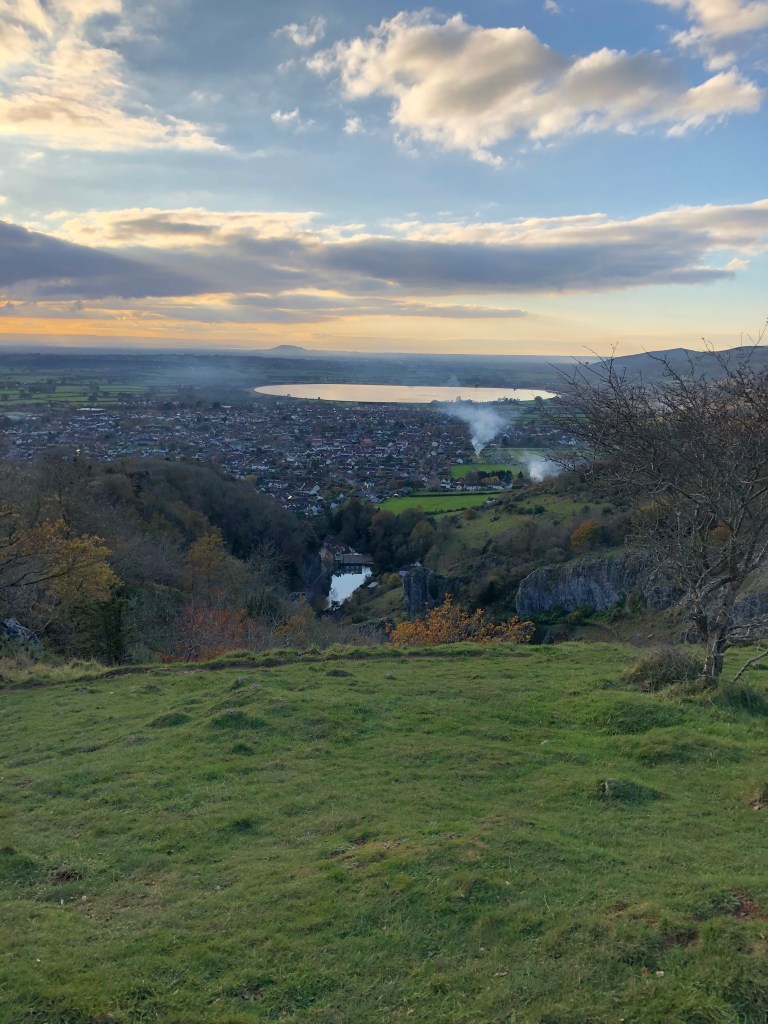
On the, often slippery, sporadically muddy, descent we spotted a wild goat. The size of a large dog, with bonus horns, we decided against engaging in conversation around what to consider in a good goat’s cheese, and hurried on past.

After about an hour and half our descent brought us to a road, parked cars and self-congratulations. The road and cars proved, in classic Agatha Christie style, a red herring. All signs pointed to another steep climb worryingly resembling a (merely damp thankfully) stream bed.

Cue further ungainly clambering and scrambling. At the summit fellow human beings had magically materialised and continued to magically materialise from whence we never discovered. The vistas were again fabulous as were spectacular views down the gorge.

We spent a few minutes admiring the views before descending towards Cheddar coming out, after a final 241 steep steps aptly named Jacobs Ladder, opposite the car. Result.

The walk/hike/expedition had taken us a little over 3 hours. We may have missed a big sign saying ‘this way idiots’ though, not being idiots, neither believe this to be true. And we now understand the reason for those cars smugly parked at the bottom of the second climb.

Even red herrings and my moaning can’t disguise how much we both enjoyed that walk. The weather behaved and the views and scenery were worthy of the behaving weather. However, this is not a walk to take elderly relatives or those who may have eaten too many pies. A reasonable fitness level will be needed as will some tasty snacks. And their definition of difficult may well incorporate Everest base camp.

We were knackered. In a very good way. And like those cars, perhaps a little bit smug. We drove back to Middlewick farm (self driving cars can’t come soon enough), ate and relaxed.

The following morning we drove home.

Somerset, Cheddar Gorge and even Glastonbury (especially the Tor) are staycation staples and easy to recommend. Cheddar Gorge is indeed spectacular and I’ve a sneaking suspicion Somerset has significantly more to offer.

And finally, a heartfelt thanks for taking the time and effort to read these electronic scribblings. I do hope you’ve enjoyed a wonderful Christmas with, where possible friends and family, and wish all a happy and healthy 2021.

Tony

December 2020

ITALY (again)

Rome

Initially we’d planned to fly directly from Amman to Rome. Instead we flew back to London, had a day washing clothes and drinking decent beer, before heading to Rome the following morning. It proved both simpler and cheaper.

Our flight was stupid o’clock in the morning and before public transport was alive – happily the taxi to Heathrow and the flight to Rome were uneventful. We danced through customs and, with Sus armed with a coffee, caught the train into Rome. There was a change which we handled magnificently. Until, as we emerged from a tunnel, I pointed out there appeared to be a lot of green bits and not a lot of concrete bits. Rome, it seemed, had moved. We were going the wrong way.

For a stomach falling/cold sweat inducing few minutes we feared the train might be headed to the coast before stopping. A coast is always welcome though a tad inconvenient with our hotel to be found in Rome. Mercifully stop it did and we were able to arrive in Rome with pride just about intact. That little detour had taken us 2 hours.

It was raining in Rome. We trudged through our latest ‘hood finding it attractive if a tad damp. Our self catering apartment was on the third floor of a charming 19th century building. The street door was open, the door to the apartments of which one was ours, was not. We rang the doorbell until an Irish lad staying in one of the other apartments kindly let us in. And told us where the keys were. We were missing a text explaining the process. The apartment was lovely, as was our apologetic custodian.

It was still raining, we were hungry. Be.Re. sold craft beer and Trapizzino – a fusion of pizza, pie and tapas. Sounds awful, tastes delicious. We sat outside (undercover), drinking craft beer, scoffing Trapizzinos and watching Rome wander past. Perfect.

The rain had stopped and, somewhat reluctantly, we got of our mildly sozzled backsides to explore. We wandered into St Peter’s Square with the looming Vatican and amusingly dressed Swiss Guards. By the river was the imposing Castel Sant’Angelo. Built originally to house Hadrian’s Tomb Castel Sant’Angelo was later converted into a fortress, a papal residence, a prison and an execution ground. We didn’t go in, we will next time.

I love motors and motorbikes. To my absolute delight a procession of perhaps 50-60 mostly vintage Ferraris chuntered past. I slobbered embarrassingly, sus admired serenely.

Then the rain started up. And then became heavier. And then became torrential. We bravely waited it out under a shop awning. Walking back, we discovered a high street a few minutes walk from our digs. Excitingly there was also a small supermarket – we popped in and bought some goodies.

We’d enjoyed that first half day in Rome. It got better.

We ate breakfast at a local bakery and, getting down with the locals, stood up. Departing our neighbourhood we zig zagged, partly by Sus’s internal satnav and partly by the less organic Google Maps, towards the river Tiber. We meandered past the striking though not old Supreme Court, strolled across the Tiber and wandered into the rather grand Piazza Navona. Built on a Roman Stadium the piazza now boasts Baroque and Renaissance architecture still maintaining the original Stadium’s contours. Fountains, churches and tourist multitudes feature. It’s quite beautiful. Even some of the tourists.

Another stroll found us in front of the gorgeous and stunningly preserved Roman Pantheon. It’s free to enter, we did and it’s fab.

Next a giant obelisk (easy tiger) – the Column of Marcus Aurelius. The Romans, it transpires, had a bit of a thing for obelisks – there are several scattered randomly across the city presumably leaving many an empty hole in Egypt.

We kept walking arriving at the tourist teeming Trevi Fountain. Sus threw in a coin and made a wish, I didn’t preferring the relative solitude of a few feet away. Onto and up the Spanish Steps, taking a few moments to admire the view.

The Vittoriano is a colossal mountain of white marble that towers over Piazza Venezia. Constructed in the early 20th century it now houses the Tomb of the Unknown Soldier. It’s a tad ostentatious with as many locals hating it as loving it. Detractors will point out this marble monstrosity overshadows the Forum. We both quite liked it.

The following hour or so was spent wandering, at street level, around the utterly magnificent afore mentioned Forum. We walked under the Arch of Constantinople, around the Coliseum and through the ancient theatre. Spellbinding. Genuinely spellbinding.

A random zig and a random zag, through several attractive neighbourhoods, conveyed both back to our hotel. Freshened up, and after a couple of cheeky halves at Beer Time, we went in search of sustenance, specifically an Osteria we’d previously spotted within easy reach of the hotel. Unfortunately we’d misplaced it.

Happily, we soon discovered another Osteria – Ragno D’Oro (http://www.ragnodoro.org/). Ragno D’Oro was very busy primarily, or so it appeared at first (and second) glance, with Americans. This is a sure sign that 5 people had rated it 5 stars on Trip Advisor – not always a reliable indication of quality. Thankfully the food, house wine and service were all splendid.

It had been a long, long day. I don’t remember many, whilst travelling, we’ve enjoyed more.

Naples

Following a breakfast of bananas and cake (a generous doggy bag from Ragno D’Oro) we headed to the train station and Naples. The journey was a tad over 2 hours. And yes we did go the right way. It’s considerably more expensive taking the quicker train (1 hour 20 minutes). Your credit card will squeal in pain.

Naples does not have the greatest reputation and initial impressions certainly did nothing to dispel this. From the ultra-modern, nearly finished, train station we walked through an edgy, graffiti covered and trash filled neighbourhood. Our hotel, on the border, was friendly and clean. The maintenance chap warned us to be vigilant. Marvellous.

The old city (Spaccanapoli being the main drag) comes with steep, narrow and crowded streets, shops seemingly intent on selling tourist trap crap and restaurants specialising in fast food. However, the old city happens to be a UNESCO World heritage site boasting wonderful 16th, 17th and 18th century architecture. It might be tourist teeming, graffiti garnished and trash trashed but it does exude a certain exuberance and charm.

We probably spent a couple of hours exploring the old town finding a cathedral, a steep street crammed with shops selling exactly the same awfulness and, in the name of balance, a lovely little place selling organic gelato. We briefly wandered into, via one of the original town gates, the new town. Which was still old.

The clumsily titled Oak Wine and Craft Beer, Oak to its chums (https://oaknapoli.com/), was located on a side road just inside the old town. And presumably still is. It was a friendly spot; we popped in a couple of times and sat outside watching a tiny slice of Naples slither past. Italy has a burgeoning craft beer scene (as so many countries do) so it’s not difficult to drink the local brews. However, there were a surprising number of well known British craft brewers represented in the beer havens we visited.

Back at the hotel our en-suite poo palace wasn’t working properly and never was to. The owner, showing no great desire to fix our rogue loo, offered the somewhat public toilet in the breakfast room. Both our digestive systems immediately seized up. Though not ideal, there was a bathroom just outside our room, which became our haven for all matters digestive.

Surprisingly the shower was excellent. As was the breakfast. And on leaving the owner, to compensate, paid our city tax. Fair enough.

Pompeii

The following morning we caught a packed train to Pompeii, our chief reason for visiting Naples. Excited travelers can pay at the actual site entrance or use the ticket kiosk in Pompeii station. We chose the latter, and for 2 extra Euros each, we were able to avoid the queue at the entrance. A very, very splendid thing as the queue was massive. In peak season the queue doubtless starts in Rome.

Cobbled streets are beautiful, incredibly hard waring and a right pain to walk down. Evidently our Roman chums had yet to buy into the concept of accessibility. We lurched down the main cobbled drag peering into dwellings akin to peering into peoples’ houses when lights have been left on and curtains left open. And hoping no-one peers back. That would have been particularly disturbing in Pompeii. At the time of its lava bath Pompeii was a thriving, bustling and economically wealthy town. In the quieter streets, you’re still left with an impression of Pompeii and its people 2,000 years ago.

As one nears the coliseum tourists are able to intrude into, and not just gape into, one particular dwelling. Do so. The luxury would not look out of place today.

The coliseum, for such a relatively small town, is designed to impress. And so it does. There is a small museum/large display close by that houses some beautiful painted plasters rescued from the main sight. Our usual zig zagging guided us (kind of) through the town proper. And into the imposingly large main square with its 2 substantial temples to Apollo, columns and preserved bodies. The latter a haunting spectacle even with the crowds.

Initially, we were a tad underwhelmed by Pompeii. The blame lies firmly with Rome and Jordan. It’s only now, a month since our return, I’ve realised and understood what an incredible place Pompeii is – was.

Once safely back ensconced in Naples we headed to Chiaia. Toledo names both the nearest metro station and the principal, pedestrianised shopping thoroughfare. This affluent seaside neighbourhood is made up of rather grand 16th and 17th century architecture – highlights include the gorgeous Galleria Umberto and imposing government edifices. Chiaia is home to upmarket stores and boutiques, a large park where one can watch the cruise ships struggle to avoid each other and posh restaurants and bars. It was a genuine surprise and in utter contrast to the old town. Never fret, the real Naples was never far away.

A little behind this conspicuous consumption is the Quartieri Spagnoli neighbourhood often called the real Naples. Created in the 16th century to house the Spanish Garrison, Quartieri Spagnoli is a blend of narrow, sometimes steep streets and, though visited by many a tourist, very much residential with numerous local restaurants, bars and stores – not dissimilar to the old town but cleaner with a greater local, almost community, feel. Some reviews tell wide eyed tourists not to go. It’s nasty, unsafe and not worth the effort. Bollocks. Give Quartieri Spagnoli a whirl, be vigilant as you would be in any other city, and you’ll be pleasantly surprised.

Despite its name, and located on the water, is the striking Castel Nuovo. Originally constructed in the 13th century, enhanced in the 15th century and tinkered with throughout its long life, the Castel Nuovo truly is a magnificent beast. The castle is still in gainful employment to this day hosting cultural events and housing the Municipal Museum. Unfortunately time and hunger had both overtaken us and we were not able to fully explore.

The Osteria Carmena (http://www.osteriadacarmela.it/) was our chosen foddering hole that evening. The proprietor kindly squeezed us in, those arriving minutes later weren’t so lucky. We felt special. The food and wine were both excellent.

A 45 minute walk returned both to our hotel and non-functioning toilet. Bed seemed to be the best option. Naples is not Rome. Or Venice. Or Florence. Naples is very much Naples standing a little apart from these uber tourist cities. It is dirty, perhaps a little menacing and undoubtedly edgy. Please ignore the doomsayers, get off your cruise ship and give this fascinating place a twirl. You won’t be disappointed. We certainly weren’t.  

After another lovely breakfast and equally lovely shower we headed back to Rome arriving early afternoon. We’d wanted to stay in those same self catering apartments but, a tad unsporting, all were booked. We checked into (just) our latest home in the upmarket Flaminio neighbourhood close to the Piazza Del Popolo before, once again, meandering meanderings.

We spent a happy hour discovering Villa Borghese Gardens – the Villa Borghese Gardens are now an expansive park – before continuing our Rome explorations including our lovely latest ‘hood. Literally around the corner from our hotel was, yep, yet another beer place. Sus was only mildly suspicious. Art Beer was a bottle shop (no taps), cosy with a fantastic range of splendid beery loveliness. Relaxing in foreign climes, imbibing beer, watching the world go by knowing it was less 5 minutes back to our hotel, made me very happy. Cue smug selfie. Our only gripe – the bartender appeared more interested in the, albeit attractive, young lady in the crèche opposite.

Once freshened up we strolled perhaps 3 doors down from the apartment to our restaurant of choice. The food was again excellent, Sus’s favourite though my choice was still Ragnor D’Oro. The wine was perhaps the best we sipped. The restaurant was again full of Americans – being European (just, at time of writing) one might accuse Americans, unfairly (Jazz, Blues anyone?), of a lack of culture. Whatever you might believe the buggers certainly know where the best grub is.

We slept into 9am the next morning. We’d forgotten check out was 10am. It all ended happily and, because our flight home wasn’t until late, we spent several hours wandering wanderlessly. Highlights included discovering the remains of 4 stunning temples (Largo di Torre Argentina) handily placed for all to see in the middle of a large road junction; the stupidly ornate 17th century Palazzo Muti Papazzurri; the beautiful Basilica di Santa Maria in Trastevere; the non-working Fontana dell’Acqua Paola compensated by fabulous views back over Rome.

Sus, who had by now become a little obsessed with obelisks, ushered us to the dramatic Circo Massimo to admire the oldest one of its kind in town. Alas, Sus had only read half the article she’d unearthed on Google. The second half of said article helpfully pointed out this particular obelisk had been relocated.

Regretfully the airport and flight beckoned. We popped back to the apartment, stretched, weed and picked up our bags. We were back in our West London flat before 11pm.

Italy happens to be blessed with an annoying number of beautiful cities. Rome is without doubt, our favourite. It’s both a working city and beautiful city something none of the others combine as well or at all.

We loved the place. Paris or Rome? Rome without hesitation.