
Lisbon and Porto are inconveniently built on hills. Lots of them. We recently visited both in the same week. And spent an inordinate amount of effort trudging up and then back down said hills. Strangely, cyclists were not a common sight.
For those preferring mechanised transport both cities thoughtfully offer metros, trams and buses.
LISBON
A little light history
Lisbon was originally settled by the Phoenicians back in 1200 BC, followed by the Romans who established it as a municipium called Olissipo. The Moors later conquered the region in the 8th century AD, leaving a lasting mark on its architecture.
After the Christian Reconquista, Lisbon became the capital of Portugal in 1255. During this period, Gothic architecture flourished, seen in landmarks such as Lisbon Cathedral (Sé de Lisboa) and the Monastery of São Vicente de Fora.
Lisbon played a crucial role during the Age of Exploration in the 15th and 16th centuries. The wealth generated from trade with newly discovered territories contributed to the construction of magnificent structures such as Belém Tower and the Jerónimos Monastery, both UNESCO World Heritage Sites.
In 1755, a devastating earthquake followed by a tsunami and fire destroyed much of Lisbon, including many historic buildings. This earthquake is very much responsible for the Libon we see today. An architect by destructive default.
The Marquis of Pombal led the efforts to rebuild the city, introducing a new architectural style known as Pombaline, characterized by sturdy, earthquake-resistant buildings with simple, symmetrical facades.
Lisbon experienced further growth and modernization during the 19th and 20th centuries. The cityscape became a blend of architectural styles, including neoclassical, Art Nouveau, and Art Deco, reflecting the changing tastes and influences of the time.
In recent decades, Lisbon has seen a resurgence in contemporary architecture, with notable projects such as the Champalimaud Foundation by Charles Correa and the Lisbon Oceanarium by Peter Chermayeff.
We checked into our hotel, inevitably uphill, around 7pm. A short stroll from the hotel was the Santa Justa Lift or Carmo Lift. I wasn’t expecting a lift. Crafted in the late 19th century, entirely from wrought iron, it’s a handsome beast. It connects Chiado (top) to Baxia or downtown (bottom). We didn’t take it.
Nope, we took the free, less busy lift close by. Though it deposits tourists from and into the same area it has the look of something from a 3 star hotel lobby.
Baxia is resplendent with restaurants. All apparently boasting the same fare from menus advertising scaringly florescent food. Bit of a tourist trap. However, and far more interestingly, Baxia is quite lovely – classy plazas joust with classic 18th century Pombaline architecture, a delightful spot to stroll and people watch. Pedestrianisation is a welcome bonus.
Back to the lift, the hotel and bed.
Can we walk the whole of Lisbon in one day, day?
Nope, but it felt like it.
First up, São Jorge Castle. I’m not especially bothered about so called Patron Saints though continually surprised how much St George got about. Bit of a tart that lad.
Another lift efficiently elevates one to Castelo, a tiny neighbourhood surrounding the castle. Do take a wander.
The castle dates back to the Moors though much of what we see today is a restoration following that dreadful earthquake of 1755. Nevertheless, chez St George is worth the 15 Euro entrance fee. Several of the towers are climbable and the walls can be promenaded along. The views back over Lisbon are properly spectacular.
As are the many peacocks strutting their stuff within (and on) the castle walls.
Alfama and Graca and Baxia and Pink Street
Though stretching from a smidgen below the castle to the Rio Tejo most tick boxers will head towards the so called Fisherman’s Village. As did we.
But not initially. Nope, we strolled into Graca the adjoining neighbourhood. Graca was a welcome surprise from tourist Lisbon – albeit deservedly. Graca could be where you live, or I live. Normality exists here. We liked it.
We drank coffee at a wonderfully busy and local cafe before eating the tastiest food of our time in Portugal at Graca 77. Their house red also being the best wine quaffed whilst away. A gem of an eatery.
In need of exercise we then wandered uphill to The Church and Monastery of Graça. It’s a huge and handsome beast dating back hundreds of years though has been extensively restored. Expansive views across Baxia and Barrio Alto are a bonus.
Back to that fishy village.
In the 1755 earthquake many Christian churches were destroyed. Alfama, perhaps a tad ironically, survived virtually intact. It’s Lisbon’s oldest surviving district.
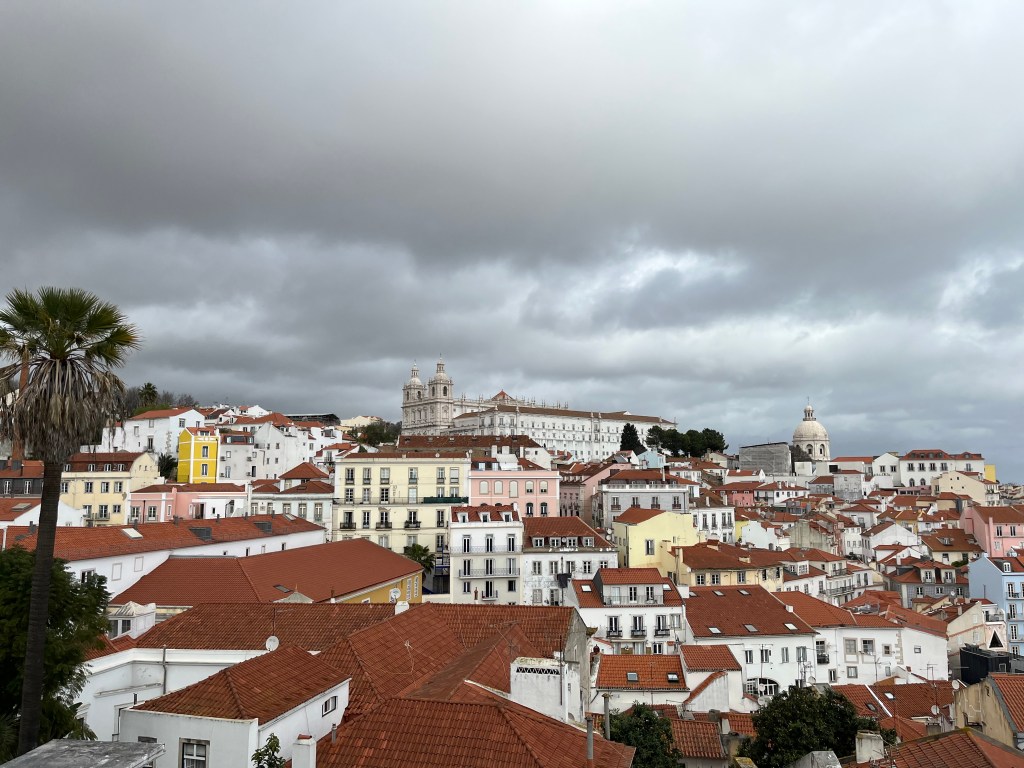
Miradouro das Portas do Sol is a huge terrace, squatting above Alfama, revealing the district in all of its labyrinth loveliness. The streets are stupidly steep, even by the standards of Lisbon, cobbled and narrow. Plazas, churches and alleys make up this characterful area – becoming lost may be the best way of stumbling upon Alfama’s hidden gems.
Historically squatting outside of the castle walls, Alfama was home to home to the poorer and perhaps less fortunate elements of Portuguese society. With Portugal becoming one of the preeminent seafaring nations Alfama soon become home to sailors with a reputation as a tough and deprived district. Essentially that fisherman’s village.
Today Alfama has morphed into an artisan and tourist enclave though some commentators do feel it’s lost much of its traditional vibe. Whatever that was. We felt, after exploring (getting lost) for an hour or so a modicum of old charm had survived the onslaught of gentrification and tourist infestation. Abetting this charm is the total absence of ridiculously rotund and possibly pointless SUVs clogging the streets. No cars of any size do. The streets are just too narrow.
Don’t be fooled though. There are tacky tourist shops and restaurants with those scaringly bright menus aplenty amongst more interesting finds.
Alfama’s populace may has gone upmarket, the architecture hasn’t. It’s worth at least a couple of hours of anyone’s time.
Strolling along the River Tagus we encountered Praça do Comércio, the daddy of Lisbon’s squares. Highlights include Rua Augusta Arch – completed in 1873 celebrating the rebuilding of Lisbon post earthquake – and and Equestrian Statue of Joseph I, the unlucky king on the big chair during the earthquake.
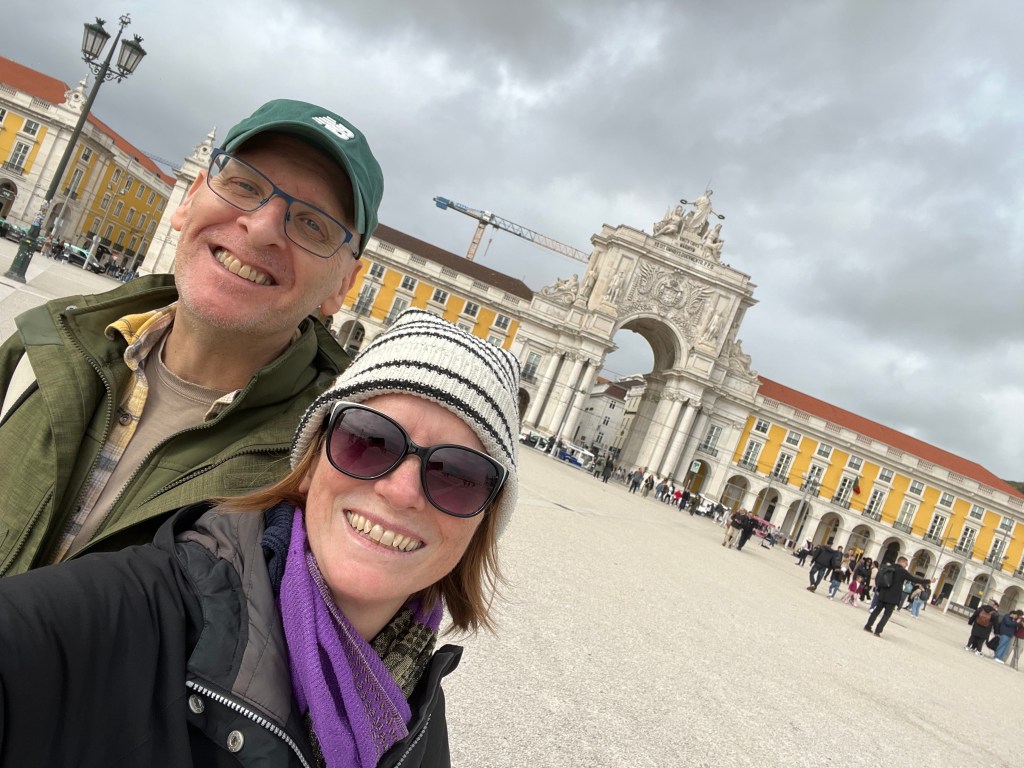
The square back onto Baxia and so rude not to wander back in before meandering our way to Pink Street. A strange little street. Not especially pink and with a bar worshipping all things Liverpool FC. I support Sheffield United (my birth city) so feel unable to criticise. Other bars offer alternative viewpoints though all seem to exist to serve as much beer to as many thirsty punters as possible. I heard many an English accent.
Chiado may be a shopping district but it’s an attractive little number. And where, allegedly, the world’s oldest bookshop contentedly lives. We had a looksee and content it very much was. Locals apparently shop here as well as the tourist hoards – it was, a tad surprisingly, one of our favourite Lisbon districts.
Having walked over 12 kilometers our final stop was the most welcome Outro Lado, a wonderfully atmospheric craft beer bar. More in my beer blog at https://wordpress.com/post/tonysbeersnobblog.wordpress.com/617
Belem
May sound like Gotham’s evil twin but is, in reality, a tad more mundane. It’s Lisbon’s westernmost district, where the River Tagus encounters its watery maker, emptying into the Atlantic.
During the Age of Discovery Vasco da Gama left from Belem and Columbus popped in for a cuppa on his way back from a some unfortunate discovered land.
Getting there proved our very own Age of Discovery. It only dawned, when our intended tram clanked past, that our stop was currently on a hiatus. Even the copper, waiting for that same tram, appeared vaguely perturbed.
Back to the hotel. Coffee, google and a wee (2 in my case) helped us plan an alternative route. Metro, topped up our travel cards for 24 hours, train, Belem. Easy. Unfortunately not. To our frustration the 24 hour top up ticket did not take kindly to the train. Another top up ticket, and a short train journey, finally brought us to Belem.
On arrival, and once a short lived but bad tempered squall had passed, we strolled along the waterfront. It’s all rather agreeable. There’s the river, an opposite bank revealing wooded hills and, alongside the river path, the occasional building (new and older) masquerading as restaurants or hotels.
A short detour took us away from the waterfront and bizarrely through a petrol station. Reunited with the waterfront we were plonked in front of the imposing concrete and limestone Discoveries Monument. Rebuilt in 1960 from an older monument it celebrates 15th and 16th century celebs. Men really. Only a single women is represented and she’s someone’s mum. Nevertheless, it is striking. Though shaped like a ship, architecturally, there’s a whiff of 1950s Russian propaganda about it.
Belem Tower is a bit of a looker. Built in 1515 as both beacon and fortress guarding the entrance to Lisbon’s harbour.
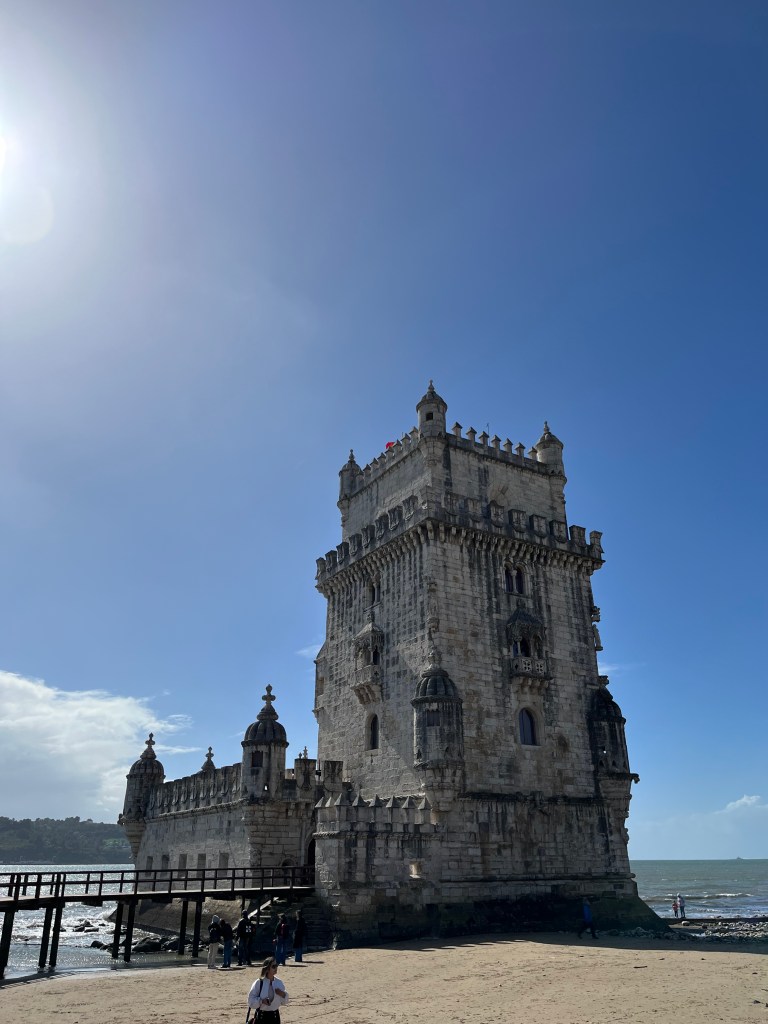
Belem Tower is a stunning piece of Gothic architecture utterly deserving its World Heritage Site status. It’s more Disney than Disney. I loved it.
We reversed our route, moving away from watery wonderland into urban landscape. Belem Palace, built in the 1500s though renovated in the 1800s, is currently the official home of the President of the Republic and pretty in pink. A tad oddly, unlike other royal residences, it lives on a high street. Two ornately dressed guards alerted us to it’s self importance. Nevertheless, it’s a beautiful building even the glimpse we were given.
Next up, more weak bladder than by design, was Belém Cultural Center (CCB). Constructed in the 1990s, it’s an imposing and oddly attractive building – now housing the MAC/CCB Museum and it’s large auditorium, hosts world class performances. The 4 huge living walls especially appealed.
Jerónimos Monastery, a short saunter from the CCB, is a stunning example of 14th century Gothic architecture. No surprise it’s a World Heritage Site and one of Lisbon’s most recognisable attractions. This being a Monday, it was closed to tourists. Perhaps it’s the day of their team meeting.
Established in 1837 Antiga Confeitaria de Belém or Pastéis de Belém is the birthplace of the famous custard tarts. High church to custard desserts. Those Monks, presumably on a Monday, were allegedly responsible for the still secret recipe.
We succumbed. Though an obvious tourist trap said flavoursome fripperies were not extortionately expensive. A small, west London shopping centre hosts a pasteis store as well as Hammersmith tube station.
Nearby is Rua Vieira Portuense with its 16th-century houses. Worth a gander.
MAAT (Museum of Art, Architecture and Technology) is a dramatic modern architecture structure, it’s roof doubling up as a vantage point overlooking the river. The 19th century factory close by, now part of MAAT, is properly gorgeous. If you like that kind of thing. I do.
The weather had become rather bad tempered. A sit down and glass of wine seemed most opportune. And so we did in the museum cafe. A pleasant vibe with river views helped to distract from the overpriced and distinctly average vino.
LX Factory is a complex of industrial buildings – dating back to 1846, underneath the 25th of April Bridge (not my birthday) – has been transformed into a dynamic hub for art, culture, and commerce. Over 50 restaurants, bars and cafes live here and LX Factory is bang on trend and a Lisbon hotspot.
It’s perhaps a little contrived, though likably contrived. Nevertheless, the street art is fab and genuinely inventive.
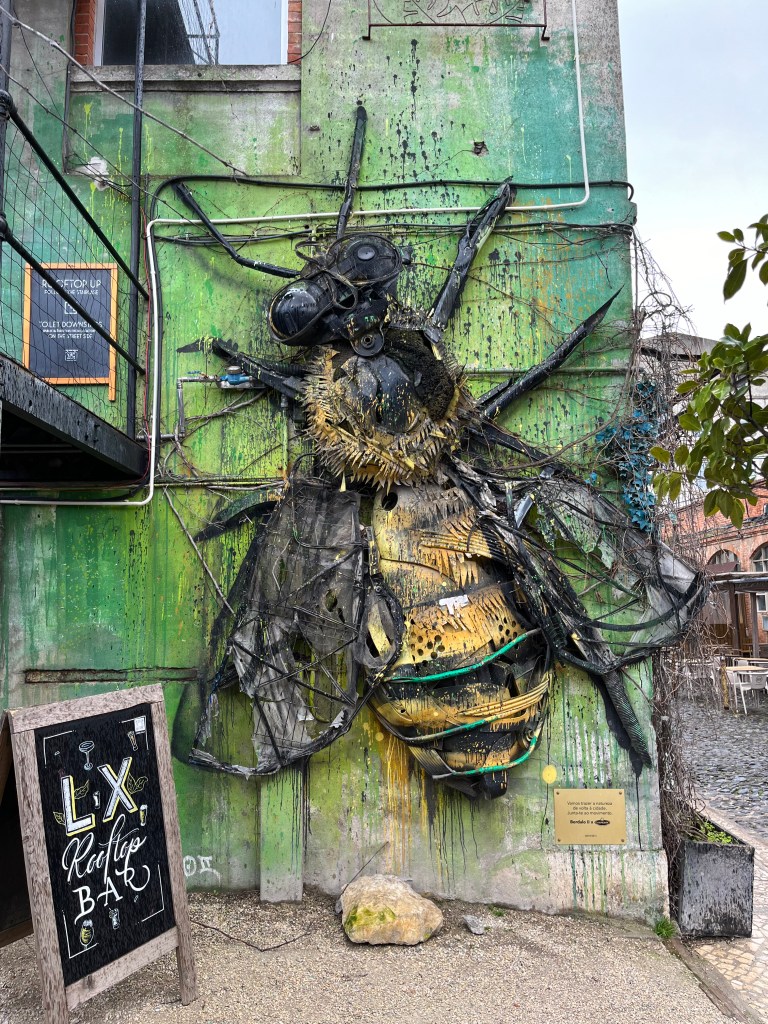
I adore chocolate, always have, always will. Strangely, I’ve never been a hot chocolate devotee. I am now. Sus persuaded me to pause for a hot chocolate whilst in LX Factory. Lush. As young people say.
Belem is a fascinating and hugely significant district with distinct contrasts. We didn’t but Belem merits a day of your hard worked for holiday. We caught glimpses of gardens and museums are aplenty though were unable – and on occasion didn’t wish too – to stop. Hopefully you will.
An 7.5 mile day. We bussed back to central Lisbon.
PORTO
The following morning we checked out, metro to the train station (Santa Apolonia) and jumped – it was a huge step up – onto the Porto train. We (Sus) had bought tickets online the previous evening.
The 3ish hour journey passed comfortably, the scenery was agreeable, the train was pleasant. Highlight was cranes hijacking large metal pylons for luxury living. Fabulous. Though how the highest perches were allocated I’ll never know. Long time residents or new money?
A short trip on a local train brought us into Porto proper. Apple Maps appeared to direct us to our hotel in a somewhat roundabout way. We obviously ignored Apple Maps and went direct. An impossible incline harbouring steps and cobbles quickly showed us the error of our ways. Trust AI.
We checked in, rushed out. Our hotel shared Praça da Batalha with the 18th century Church of Saint Ildefonso and the Royal Theatre of São João. The original theatre dates to 1794 though was rebuilt in 1908 following a fire.
Porto’s town centre or A Baixa roughly encompasses Cordoaria, Praça da Liberdade and São Bento Station – the central station of our arrival and subsequent battle of the cobbles.
Attractive streets (Avenida dos Aliados), squares (Praça da Liberdade), city hall and government buildings vie with locals, tourists and consumerism. Century old trees decorate Cordoaria Gardens providing shelter and sunburnt tourists a place to belatedly lather on suntan lotion. It all feels familiar and rather likable.
Se neighbourhood, one of the oldest and traditional, and especially charming. Porto Cathedral resides in a picturesque square here and dates back to the 12th century. There’s been the odd nip and tuck since though, unlike an aging reality tv star, only embellishes an already beautiful building.
A surviving section of the medieval city wall is also in residence.
A Baixa is not flat. Porto is not flat. Neither is in any sense of the word flat. Sprinkle in a little snow (unlikely), predestination (more likely) and a developer or two and Porto would become a ski resort.
Talking of developers, Porto is undergoing a major refurb. Porto’s tram system is being extended and many older buildings renovated. Cranes and construction dominate the town centre – Porto appears to be a city on the way up.
As to a lesser extent did Lisbon.
We ended up, predictably, at a fine craft beer establishment – Letraria (https://cervejaletra.pt/en/).
And that was that.
A bit of history
Porto began as a Celtic hamlet before the Romans, as they did, popped over transforming the town into a successful trading centre. And renaming it ‘Portus Cale’. Which gives us ‘Porto’ and ‘Portugal’.
It then became a tad messy. In 456, the Visigothic King Theodoric II booted out the Romans, and fairs fair, in 716 the Muslim Moors booted out the Visigoths. In 868 Alfonso III of Asturias reclaimed Porto from the Moors for the other side. The Christians.
Portugal however, as we now understand it, emerged post 1096. Afonso Enríquez, after inevitably bashing other parts of the region, laid the foundation of modern day Portugal. Hoorah.
The 15th and 16th centuries were Portugal’s Golden Age and pinnacle of maritime influence. Porto’s shipbuilding expertise and renowned shipyards helped to drive this exploration frenzy. Famous explorers such as Henry the Navigator discovered new lands, opened up trade routes and generally kicked bottom. Goa in India and the beautiful Parity in Brazil demonstrate the scope of Portugal’s exploration.
Less gloriously, on discovering the African coast, Portugal’s explorers enthusiastically embraced the abhorrent slave trade. Portugal was not alone.
Between 1580 and 1640 Spanish Habsburgs bossed the Iberian Peninsula. Porto was not best pleased and eventually regained independence. Weirdly, this period of Spanish rule, proved a hugely successful period for Porto and its inhabitants. In1756, after shockingly rising against a British monopoly on their famous wines, Porto went through what many believe was a golden age in terms of both commerce and architecture.
Until Napoleon visited in 1807, outstaying this unwelcome intrusion until 1814. In 1820 Porto was at the vanguard of Portugal’s Liberal Revolution demanding a constitutional monarchy. This was achieved in 1822.
During the 20th century Porto and Portugal became a republic (1910), succumbed to a dictatorship before becoming the country we know now.
Like many a larger metropolis Porto is a tasty smorgasbord of historical styles encompassing Baroque, Neoclassical and increasingly modern, cutting edge architecture.
Perhaps ‘rather a lot of history’ would have been a better heading.
A lot of pages day. And Porto’s Ribeira.
Sus keeps a diary of our travel exploits which forms the basis of this blog. Or at least the bits I can read. Many, many pages contributed to this particular day.
Ribeira is the classic picture postcard – iPhone postcard – and a World Heritage Site. It’s Porto’s historic centre and the city’s waterfront. The water in question is the Douro.
The boats in the picture were once used to transport the port.
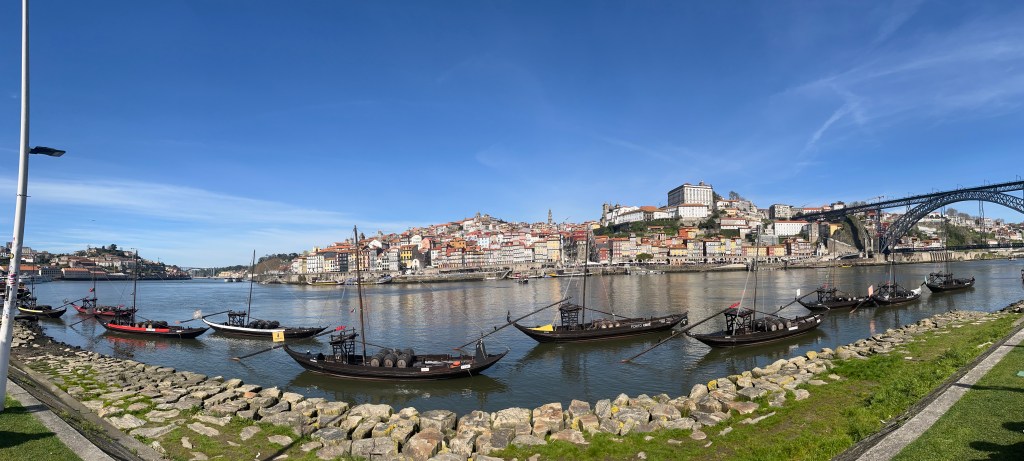
Narrow alleys complete with small squares lead down to the waterfront. The riverfront waterfront is a wonderful pastiche of picturesque and colourful facades. Restaurants and bars vie for tourist Euros.
Who doesn’t love a little bit of Victorian architecture. Or, in the case of the Ponte Dom Luís I Bridge, a lot of Victorian river architecture. Completed in 1886 this metal and concrete monster magically combines handsome good looks with function. Not a bad epitaph.
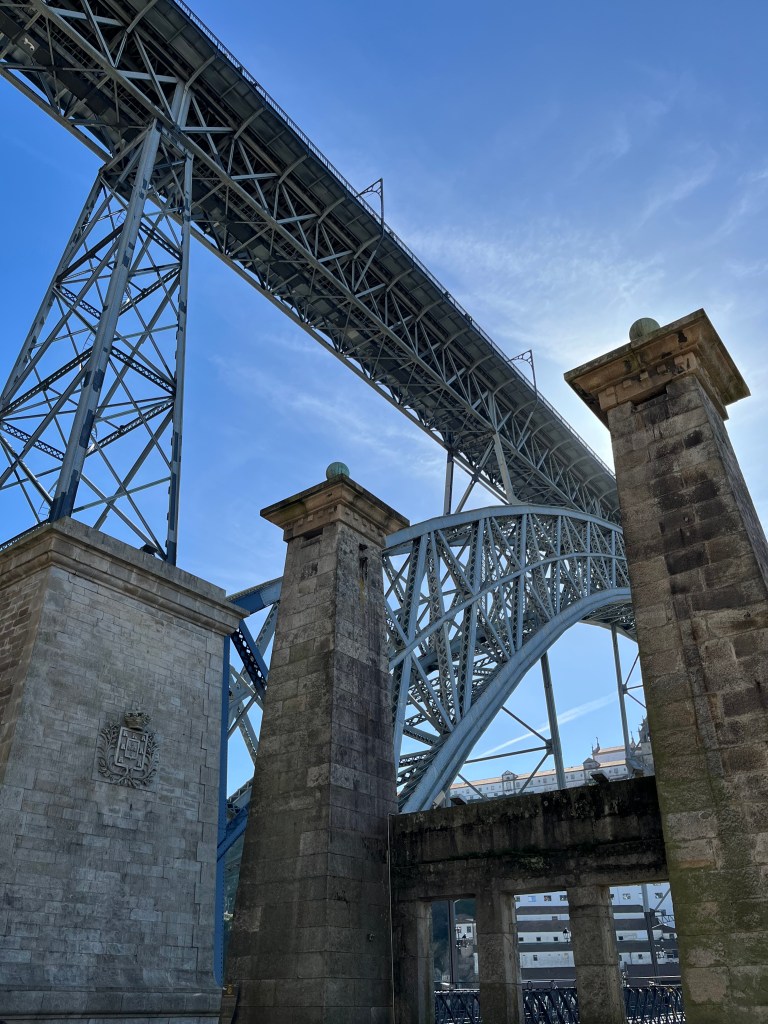
We strolled across. Then up. Again.
To Mosteiro da Serra do Pilar. The monastery, yet another World Heritage Site, harks back to the 16th century. A large square fronting the monastery commands another fabulous viewpoint Porto apparently specialises in.
Wandering back down one encounters the Gaia District featuring gorgeous 19th century warehouses housing the famous wine (port) cellars.
Further warehouses and wine cellars lie behind the Gaia waterfront and give a glimpse of what the area must have been like 200 or so years ago. Wander uphill – this is Porto – and one discovers WOW, Porto’s cultural district. It’s a stunning combination of old renovated warehouses and modern edifices housing museums, restaurants, bars and stores. WOW’s sheer size unfortunately made the absence of humans palpable. Thankfully, as we disappeared, the lunch crowd appeared.
To be honest, we only walked around, went to the loo and considered a coffee. The Chocolate Museum and World of Wine warrant further investigation. The laws of time and space (I watch alot of sci-fi) meant this wasn’t possible.
The Teleférico de Gaia, cable car, gracefully ascends from the waterfront to the Jardim do Morro Metro Station offering pretty peeks of Ribeira and Gaia. It’s a tad expensive, lasting all of 5 minutes and offering only an alternative perspective, not anything new, Nevertheless, a pleasant diversion.
Port is a fortified – usually with brandy – wine. Red grapes are the norm though not exclusively so. Adding brandy shoves up the alcohol level to around 20% also preserving more of the natural sugars from the grapes by stopping the fermentation process. This adds sweetness. Many ports are barrel aged (Ruby and Tawny), Tawney up to an incredible 40 years. We sampled a 60 year old aged sherry at a wedding in Spain a couple of years back. Think what that sherry would have seen. If it hadn’t been stuck in a barrel.
The choice of a top tipple spots are many with port dominating. Now, neither of us are port drinkers, Sus has even less interest than me. Nevertheless, this being Porto, port felt a more appropriate choice than Heineken. I’m a beer snob. If it was Heineken or nothing, nothing would win. And has in the past.
I supped a Tawny, Sus a Ruby and the port, as it turned out, was delicious. And perched on a terrace (Sandeman), in the sun, certainly enhanced our port love in.
I did try a second from further down the port food chain and the difference in quality genuinely surprised me. I suspect cheap supermarket ports are properly nasty.
We wandered back across Ponte Dom Luís I Bridge – incidentally offering wonderful views of its own – and continued exploring the narrow streets that appear to make up much of Porto. Following a brief hotel visitation was wine and fodder at Genuíno. Genuíno, located in another of those interesting districts Porto specialises in, serves both organic wine and food. We tried and enjoyed both though Sus was limited by a small menu. Worth a gander.
Then back to the hotel for a final time. Where they were showing an FA Cup game. Marvelous. An excellent game, lovely staff, mediocre wine.
We’d planned to train it back to Lisbon the following morning. Didn’t happen. We decided to stay in Porto another day. On our brief visitation earlier we booked another night. No upgrade this time.
Stay in Porto Day
The weather was a tad bad tempered the following morning and still raining as we left the hotel. We bravely set forth.
Rua das Flores, dating back to 1521, is a gorgeous street in Porto’s historic centre. And it had stopped raining. Beautiful facades many with charming balconies – a Romeo and Juliet vibe.
The next hour or so we meandered. No set agenda, just choosing streets we didn’t recognise. Or did, halfway down. There’s very little I find more enjoyable, or relaxing.
The Mercado do Bolhão is a large, covered market dating back to 1839 though the current neo classical structure is newer (1914). Perhaps a tad less traditional than it once was locals do mix with the tourist masses. And Mercado do Bolhão still provides a tempting array of fishmongers, butchers, greengrocers and florists across it’s 2 floors. Both bought delicious snacks. We loved it. And would return.
Predictably, as we meandered, craft beer joints magically appeared. Baixa hosts Cerveja Musa on a pretty terrace overlooking the Douro. In stark contrast, Taproom Porto (Dos Diabos) is slotted into a residential street. Both offered friendly natives and good beer. For more details please pop onto https://wordpress.com/post/tonysbeersnobblog.wordpress.com/617.
A return to Mercado do Bolhão, Indiana Jones at the hotel before a final supermarket visit for breakfast goodies.
Lisbon, The Return Of
The following morning a train efficiently returned itself and us to Lisbon. We checked in to our latest home from home before a final exploration of Lisbon.
Tram 28 is tourist temptation – it trundles up and down narrow streets tick boxing many of Lisbon’s famous sights. We initially waiting at a tram stop currently not in use. Deja vu. Walked up to a previous tram stop and waited. And waited. Became bored. Left.
And strolled back up to the lovely Chiado. Attractive streets, pretty squares and a hustle bustle made it a favourite district.
Wandered into Bairro Alto, Lisbon’s party neighbourhood. Bairro Alto has a denser more claustrophobic vibe. It was quiet. Either recovering from the previous night or preparing for that night. Bars are everywhere, party central – and then some – indeed. Attractive though. And steep.
Walking down we passed and popped into another Musa for a cheeky half. Then the huge and crowded Time Out Market. Decent enough though I preferred the feel and food of Porto’s Mercado do Bolhão.
Our final stop was Outro Lado, my third and Sus’s second visit, to what has become a favourite craft beer destination. Anywhere.
Hotel, pack, sleep, wake up, quick breakfast, metro, flight. Home.
Final Thoughts
Our favourite? Porto. We loved the waterfront and the city felt a little less tourist focused, neighbourhoods a tad more distinct.
Nevertheless, Lisbon and Porto are easily recommended. Both charm with beautiful architecture, history and things to do. We could have had a couple more days in each.
Thanks for reading (Tony, April 2024)
 Tony's Travel Blog