
Elegant Helsinki, pretty Tallinn. We visited both at the beginning of July, the former for 2 nights the latter for three. Neither had visited either. Both charmed.
HELSINKI
A Brief History
King Gustav 1 of Sweden founded Helsinki (that must hurt) in 1550. starting life as a small trading town. In 1809 Finland was ceded to Russia with Helsinki becoming the capital in 1812. The city was rebuilt in a neoclassical style to resemble St. Petersburg.
Poor Helsinki. Founded by a foreigner, built in the image of a conqueror. Thankfully, all ends well with Finland finally gaining independence in 1917. Happy days.
Arrival, Initial Shifty
Our Helsinki flight was a manageable and convenient 9.50am. Our airport, Gatwick, was neither. An early start. The Elizabeth Line, Thameslink from Farringdon meant the journey was remarkably civilised. Gatwick becomes a viable, if not preferred, option.
The flight was delayed.
An airport train efficiently, via various non descript suburbs, delivers one to a rather elegant central train station. Constructed in the then new Art Nouveau style, it’s Finland’s most visited building. Trains, and a need to be somewhere else, perhaps give it an edge over the Museum of Contemporary Art.
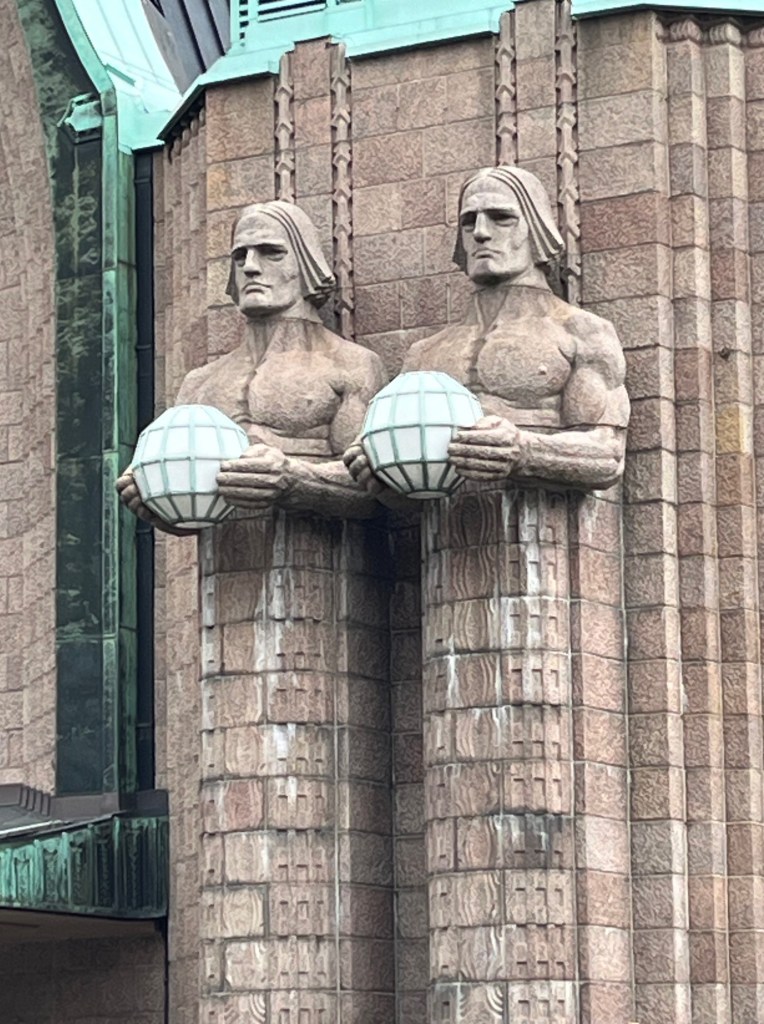
Checked in, rushed out, strolling ensued. Into the elegant Kaartinkaupunki district. Mainly an office neighbourhood and known for fab restaurants, interesting shops and attractive showrooms. Strangely some of Helsinki’s most expensive residential real estate can be found here.
Kaartinkaupunki is also home to the South Harbour (not especially original), Helsinki’s main market square. Which was closed. We were starving. Close by is the Old Market Hall flogging food to hungry punters (not us) since 1889. The same year Sheffield United were founded. I don’t believe there’s a connection.
A number of similarly priced tours leave for similar bits of Helsinki’s archipelago from here.
We discovered a supermarket. Obviously. And perched in a small park eating humus, bread and tomatoes from said supermarket. And chocolate. Never forget, chocolate is a fruit.
That lucky supermarket happened to be located in Katajanokka, a beautiful Art Nouveau district. Intriguing architecture and humus. Can’t go wrong.
Please do explore. Every building is different, the area reminiscent, for me, of a Disney film. One of the better attempts.
Katajanokka is conveniently close to Uspenski Cathedral. The cathedral is thought to be the largest Orthodox temple in Northern and Western Europe. It’s a a handsome beast, a bit Russian, and consecrated in 1868. An attractive red brick edifice topped with shining golden cupolas. On a rock. A Weatherspoons in 5 years.
The cathedral overlooks the watery and charming Katajanokka Peninsula. Gorgeous repurposed warehouse buildings share the view. From Uspenski Cathedral, Helsinki Cathedral. Let battle commence.
Helsinki Cathedral, and chums (University of Helsinki and the National Library of Finland), are all conveniently collated in Senate Square. Each owes its existence to Carl Ludvig Engel, a Neoclassical architect. The Cathedral, with its white facade and green copulas, is especially striking.
We rested on the Cathedral stairs and people watched Helsinki. Trams, tourists and locals all slipped peacefully by.
Sus had chosen our hotel. Less than 5 minutes stumble was Juova Hanahuone, a craft beer haven. How Sus manages this welcome feat neither of us know. I popped in, Sus went back to the hotel.
For more detail of craft beer drinking dens visited on this Baltic excursion please go to my Beer Snob Blog – https://tonysbeersnobblog.wordpress.com/2024/08/12/helsinki-and-tallinn/
A Lake, a Rock Church, a Ferry
More meanderings the following morning. We walked west (towards Laakso) again encountering Art Nouveau and National Romantic Style architecture before discovering Central park.
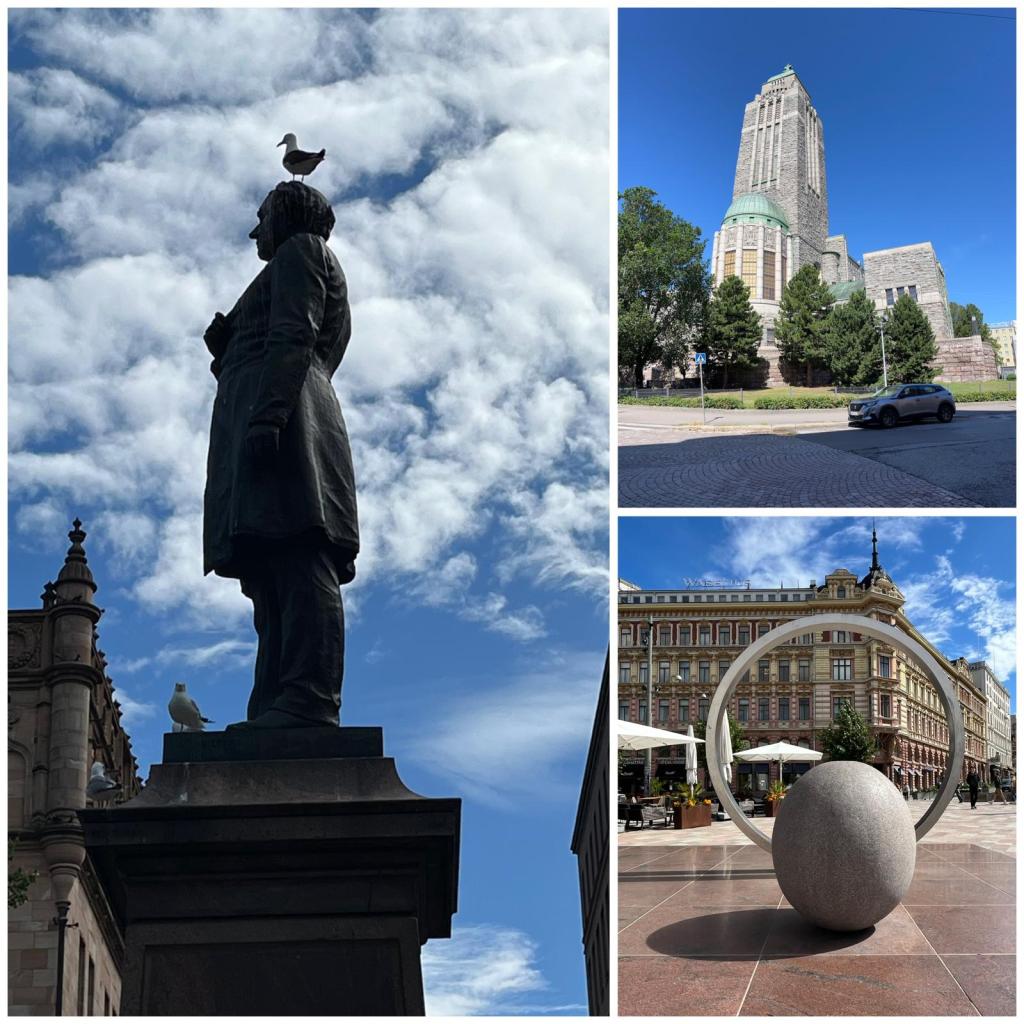
Covering a thousand hectares, running 10 kilometres across the city and harbouring four nature reserves, it’s a tad difficult to miss. A bordering lake splashes politely alongside. It’s a delightful and charming place in which to unwind.
In a moderately nondescript residential suburb sits Temppeliaukion Church. Excavated directly into solid rock (and surrounded by the same), completed in 1969, the roof is with a, the interior walls rugged rock. Excellent acoustics help rugged rock, other music genres are available, sound splendid.
No doubt interesting, and a welcome alternative to churchy churches – we didn’t venture inside – though perhaps a mite underwhelming.
Wandering back we discovered what we’d already discovered, had coffee and cake (obviously) before heading back to our hotel. We had a ferry to catch. Estonia, and more specifically Tallinn, were literally on the horizon.
The number 9 tram, cheaply and painlessly, deposited at the modern ferry terminal. Light, airy, great vistas the terminal proved an easy place to queue for the ferry.
The ferry was a surprise. I expected something akin to the Isle of White (an overrated island neither like) ferry. It wasn’t. There were numerous eating spots, bars and, most surprisingly, cabins. More ship less ferry comparable to a Virgin cruise ship we’d spent a week on the previous year – just less posh. And slick.
We bagged a window seat though, once out on open water, the view was just that. Open water. Lots of it. For a couple of hours. A most welcome addition – we were sat in a bar area – was a young lady with a beautiful voice and guitar. Silenced my history podcast to listen. Very glad I did.
We suspect overnighters once took travelers to St Petersburg. Before a madman believed invading Ukraine to be his destiny.
Tallinn, Brief History
Tallinn, or what became Tallinn, had actually been inhabited for around 5,000 years, before the Danes popped by in 1219, captured the city and built a fortress on Toompea Hill.
By 1285, Tallinn, then known as Reval, became a significant member of the Hanseatic League, a powerful Northern European trading alliance. Next up, the Swedish, who took control in 1561 though, disappointedly one supposes, capitulated to Imperial Russia in 1710.
In 1918, Tallinn became the capital of the newly independent Republic of Estonia. Unfortunately, Soviet and German occupation ruined things a tad before finally regaining independence in 1991.
Architectural Bits
Tallinn’s Old Town is one of the best-preserved medieval cities in Europe. The city walls, with 26 watchtowers, and narrow cobblestone streets create a fairytale-like atmosphere. The Town Hall and St. Olaf’s Church are particular highlights.
Nevertheless, the most important period in Tallinn’s architectural development was between the 13th and 16th centuries. Gothic architecture flourished.Another era, another architecture. Baroque and Neoclassical are next up and include the Kadriorg Palace, built by Peter the Great no less, is a wonderful example of Baroque architecture. Neoclassical buildings, such as merchants’ mansions sprinkle their own architectural magic across the cityscape.
A First Gander
Balti Jaam Market, abutting the station and a few minutes walk from our hotel, is a fascinating food fest. Supposedly, a tad shy of 300 traders across three floors tempt the wary and unwary. There’s a fish, meat, a fresh produce market plus perhaps 20 street food options. Yummy.
Estonian design and crafts dominate, in a non aggressive way, the first floor alongside clothing, household goods and antiques.
A supermarket and sports club offer an alternative.
We loved it.
The Rotermann Quarter, our next stop, was a favourite. It’s a wonderful fusing of old and modern architecture creating a dynamic and fascinating district. We foddered here, at a Michelin Guide restaurant, the following day.
Completed our 2 country, 2 city day in Mikkeller Tallinn Old Town. It does not lie. One really is conveniently and centrally located in Tallinn old town. We bottom rested outside righteously appraising the good people (and they were) of Tallinn. And watched one gang of seagulls bully another smaller gang of seagulls. Apparently our feathered chums have similar insecurities to ourselves.
A Tallinn District Named Toompea
Estonia is a parliamentary republic. Nope, I didn’t know either. And the graceful Stenbock House (1792) is where the government hangs out.
Toompea also boasts the oldest church in Tallin, the Cathedral of Saint Mary the Virgin. Begun in the 13th century, completed in the fourteenth. It seems builders were as unreliable then as they can be now. Tragically much of the interior was destroyed due to fire in the 17th century. Happily it’s since had a remodel.
Rivalling Saint Mary’s gaff is Saint Alexander Nevsky Cathedral. Much newer (1900) this Russian Orthodox building is a striking beast with domes and red and cream brickwork. Constructed opposite the Cathedral of Saint Mary the Virgin and intended to symbolise Russian supremacy in Estonia. Many still think so. A warmongering madman next door probably isn’t helping.
And there’s a castle. Though built in the latter half of the 18th century, its roots (foundations) date back to medieval times. The 45.6 metre long (upwards) Hermann Tower is a poignant symbol of Estonia’s independence.
And Piiskopi viewing platform offers grand vistas (particularly Pelgulinna and Kalamaja districts) over gorgeous Tallinn. A must tick when exploring Toompea.
One suspects, being a hill, encouraged construction of so many significant buildings. Even on and off rain couldn’t diminish this grand and elegant neighbourhood.
We descended from Toompea Hill into the hoi polloi of the main town. Think tourists, not peasants.
St Catherine’s Passage (leave it) is a short, narrow and atmospheric alley conjuring a little of what life might have been centuries ago. One side is lined with predominantly 15th-17th century buildings.
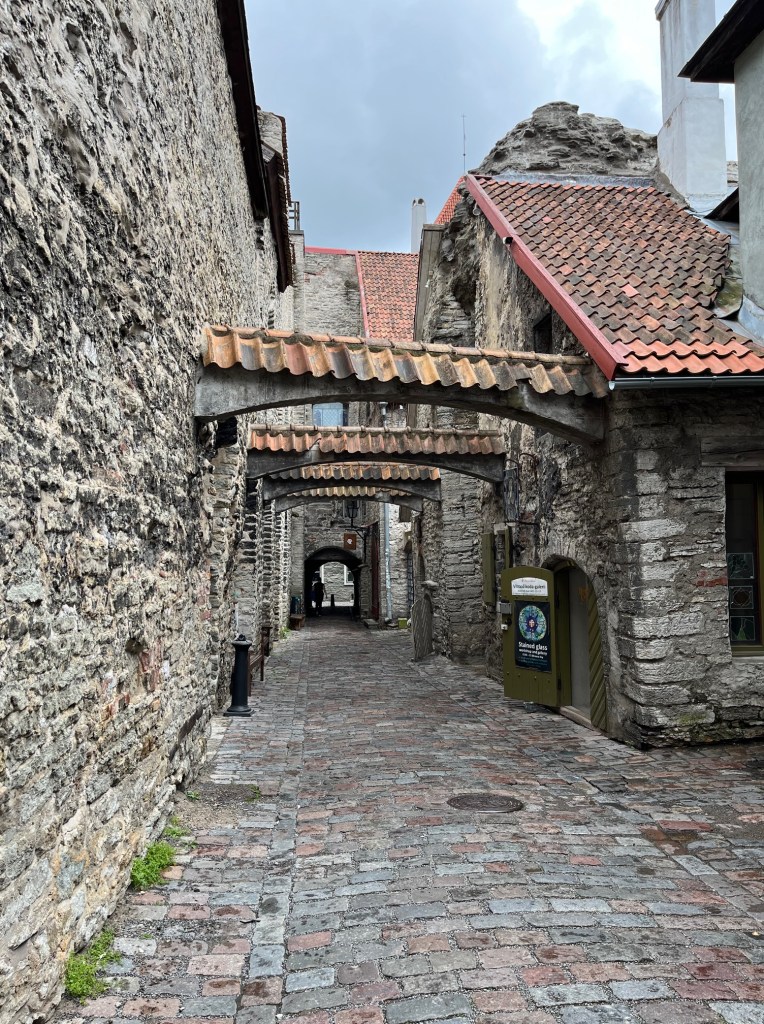
At the end of the passage is St Catherine’s Church purported to be the largest medieval church in Northern Europe. Still standing. It’s a sprightly 700 years old.
On a street housing 3 of the oldest dwellings in Tallinn a middle aged chap stood by an open door beckoning passerby’s in. Not in a creepy way I hasten to add. We succumbed, feeling a tad sorry for him. It was a 13th century church – yep, another one – that had gone through several nationalities and Christian denominations before transforming, arguably more usefully, into a hospital. Then a quarters for Russian athletes before reverting back to a church in 1992.
An odd experience all round. But an enjoyable one.
Hungry and tired we headed back to the Rotermann Quarter and that Michelin Guided restaurant (R14) we’d spotted the previous day. We ate, drank wine, relaxed.
Then more wine at the beautiful Vixen Vinoteek. Beautiful interior, quaffable wine fittingly ended a long day.
Weird Town Day
Paldiski is on the Pakri Peninsula (Estonia’s northwestern coast) and, during the Soviet era, was a closed town housing a not so secret nuclear submarine base.
Though no longer in use as such, the original train station building is genuinely pretty – reminding me, ironically, of small town America.
The walk from the train station to the town centre was, even with people heading the same way, a tad eerie. On the seaward side an attractive church brightens the unrelenting drabness of the landward side. Block after block of unattractive housing blocks, similar to the ones below, dominate the town. Presumably constructed by the Russians to house the bases’ workers.
There’s no litter, no graffiti and no people. Or very few. As I said, eerie. And the majority of those we did see were older. Much older. Possibly harking back to the good old days. Those that can, disappear to somewhere else.
The town centre really isn’t. There’s a large modern supermarket, a very local cafe (excellent coffee and cheesecake) and a couple of smaller shops.
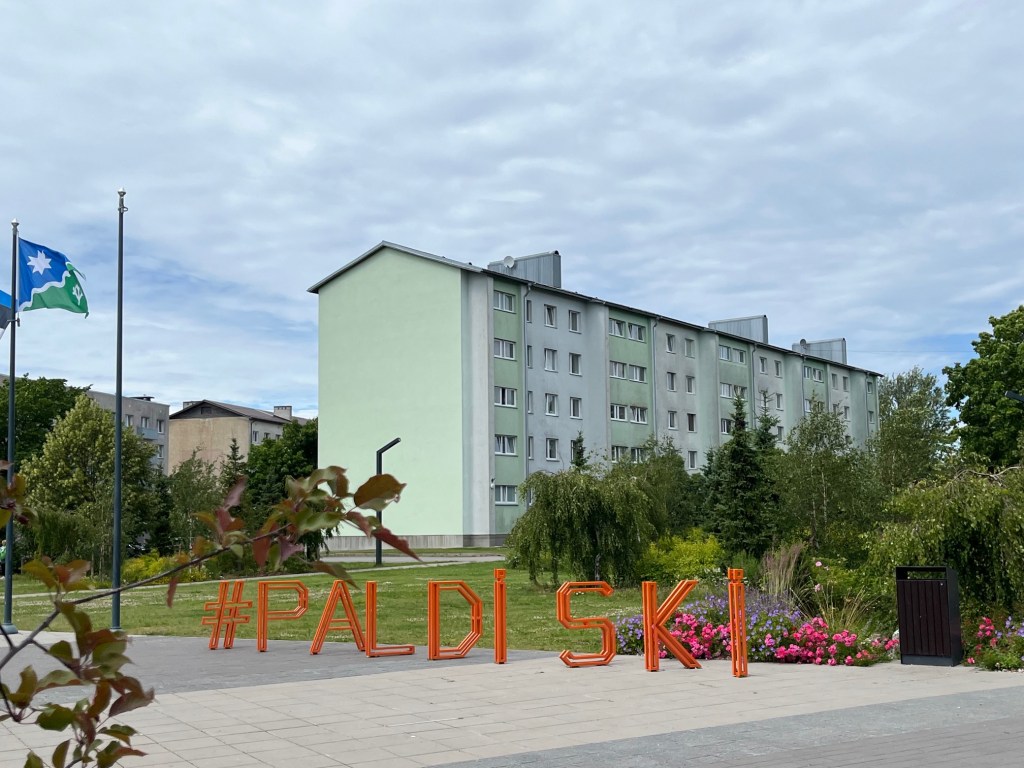
Initially we believed the main town centre must be close by. It wasn’t. And, as far as we’re aware, isn’t. This is your lot.
If you leave the urban sprawl – in fairness, Paldiski doesn’t appear especially large – along the main road into open countryside, take a left into what might have been a service road, will bring the curious to water. The Baltic. Perhaps a 25 minute stroll in total. Demolished buildings, presumably once Russian, decorate one side of the service road.
A small stony beach welcomes all. Alongside construction works are developing something new from something old. And again, with exception of vistas across the Baltic and the attractive landscape, very little else to note.
We walked back. And only saw to boys on bikes and one chap who nodded. In a bemused way.
Paldiski certainly ranks as one of the weirdest towns and/or side trips ever taken. Paldiski offers a glimpse of life back in the Soviet era. And for some, that life may still exist. Fascinating and perturbing in equal measures.
Worth a gander if time permits. And, for those with a little more time, attractive clifftop walks are easily doable.
After training back (journey about an hour) we scoffed at afore mentioned Balti Jaam Market. A 25 minutes walk, through attractive neighbourhoods plus park, kindly deposited us in front of the gorgeous Põhjala Brewery & Tap Room located in the historical Noblessner shipyard area in North Tallinn. A sauna is available for hire during tap room opening hours. Not a common feature on Bermondsey Beer Mile.
We drank beer, sat on the balcony, watched the world go by. Lovely.
Helsinki here we come. Again.
We caught a mid morning ferry back to Finland and Helsinki, reversing the journey we’d made a couple of days previously.
Once ensconced, we left the hotel for the rather splendid Esplanade Park. At one end of the park is Kappeli, built in 1867 and one of the most historic restaurants in Helsinki. Had a look see, very pretty, didn’t eat there.
On the recommendation of 2 ‘can we help’ wandering tourist guides we set off a wandering. Kamppi is known as the heart of the Finnish music scene, and less encouragingly, a large shopping centre. Pretty Punavuori boasts an abundance of design and fashion boutiques, restaurants and bars. And people. It’s Helsinki’s most densely inhabited district.
Somewhere between the 2 neighbourhoods stands the 1903 Hietalahti Market, originally constructed as a Russian stables, now houses restaurants and cafes. Interestingly, in the early noughties it was a short lived organic products hall. It sits, rather prettily, in the large Hietalahti Market Square (chicken and egg thing going on there) which houses a flea market in better weather months.
There was a short diversion to the water before, as is our want, zig-zagging our way back towards the hotel. Pausing for a light ale at the delightful Tommyknocker Craft Beer Bar. Followed with an excellent meal at a Georgian restaurant, not an unusual sight in Helsinki.
Our trip finished almost where it started – Juova Hanahuone. A fitting end.
Final Thoughts
Unusually, I don’t have a favourite. Helsinki is modern, elegant and prosperous. Tallinn beautiful, progressive and atmospheric. Both will delight. Work commitments constrained our length of stay. More time was needed in both to fully appreciate both. I don’t even like my job.
Many thanks for reading, Tony Leigh (August 2024)
 Tony's Travel Blog