
Tokyo, and Japan more generally, are destinations both have yearned to visit for some time.
Initially, Seoul, had also been on the menu. Hong Kong originally a cheeky little appetiser betwixt the two.
However, time restrictions meant Seoul was dispatched. Hong Kong was not only reprieved but our stay extended. A tale of 2 cities.
Seoul, and South Korea, for another day.
It proved cheaper to fly via Hong Kong to Tokyo. Our stopover on our return would provide the opportunity, over 4 nights, to explore the city.
Heathrow to Hong Kong was seamless. ‘Hail Mary’ helped wind away a decent chunk of the eleven and a half flight.
We landed around 2pm Hong Kong time. Our connecting flight to Tokyo was departing a couple of hours later. Nope, it wasn’t.
Unfortunately, we confirmed – we’d had an inkling before actually leaving Ealing Broadway – that our flight was delayed until 2.30 am. I write this at around midnight in Hong Kong airport.
Frustratingly, no compensation was forthcoming. A typhoon – not ideal flying conditions – was to blame.
Not something you see often at Heathrow. Yet.
What to do. Sitting around an airport, even one with free WiFi, charging points galore and a decent and reasonably priced food court, would be excruciating.
Chatted to a couple of helpful tourist information types who suggested a few hours in Hong Kong. A sneak preview in lieu of our return in a week’s time.
As with the hugely overpriced and near redundant (for most) Heathrow Express, thanks to Lizzie Line, a similar service is pushed in HK.
It’s considerably cheaper (£26 day return for both), takes around 25 minutes, pausing in Kowloon prior to termination at HK Central.
A metro and bus deliver a similar service, albeit cheaper and in a more lethargic manner.
If so inclined, a large shopping mall, part of the station complex, tempts those with air conditioning. Once fully immersed said shopping mall could be anywhere in the world.
We did give into temptation and meander its corridors either side of our wander into the mean streets of HK.
We strolled to Victoria Harbour, a matter of minutes, marvelling at both the bay and the densely packed high rise residential and business buildings. The effect, though this may have been sleep deprivation, a little reminiscent of a huge mouth (bay) with jagged teeth (high rises).
Sus makes a friend.
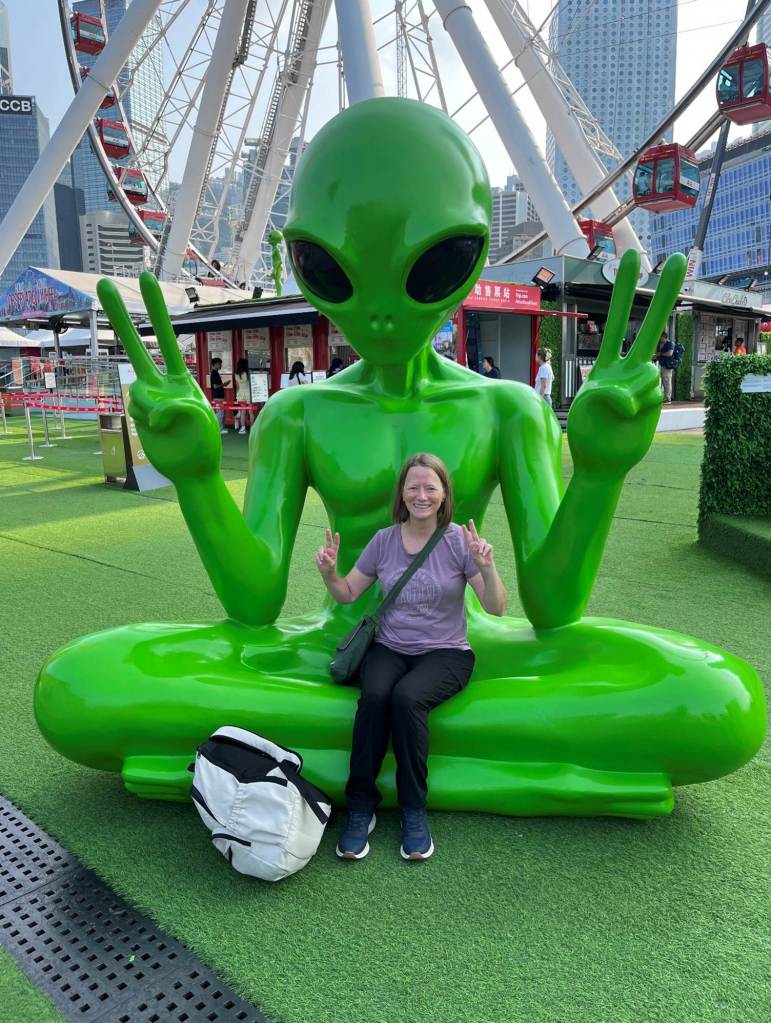
Architecturally there’s little to become excited about but, as a vista, quite striking.
Next a wander behind Central station (we would return on our eh, return). Again, high rises dominate, with a splash of traditional establishments battling with modern upstarts such as Apple and Samsung.
Popped into an M&S. A tad surreal. Products echoed those of Ealing M&S. Just more expensive. A lot more expensive.
Landed back at the airport around 8pm. Wandered, queued, collected, ate food (a modern hunter gatherer me), wrote this.
Tokyo. Finally.
Our connecting flight to Tokyo finally departed as advertised. At 2.30am. Packed too. There’s nothing like 2am airport camaraderie.
Flight painless, entry process bureaucratic silliness. If not especially time consuming.
The self driving wheelchairs, possibly trying to escape, were a genuine delight.
Taxi, pre booked by Sus, waiting even after a near 10 hour delay. Impressive. Scenery industrial, both light and heavy with surprisingly copious, in places, of trash. Checked in, showered, slept. Tiredness conquered curiosity.
Nearly 3 hours later, and still battling tiredness, left hotel for a meander to the waterfront. When asked this might be achieved confused politeness from staff.
Armed with knowledge of sorts we somewhat underachieved. And then gave up. Supposedly possible though given the impression very little to see once discovered.
Returned to hotel and caught free hotel shuttle to JR Maihama Station. Resort hotels offer a regular – ours was every 20 minutes – free shuttle bus between the two. JH Maihama Station speedily connects to Tokyo Central Station (aka Tokyo Station), the hub from which most Tokyo days commence.
We attempted to purchase a prepaid Suica Card allowing tap in/out access to Tokyo’s transport system. The Suica card is also accepted at many restaurants and shops.
We failed. It had been one of those days.
However, thanks to a kindly security guard, we realised our failure was down to lack of cash. The machine only took cash. One for tomorrow.
Otherwise, similar to London’s Oyster. Only with a broader remit. And once mastered, proved a convenient way to access Tokyo’s transit system. Look out for the black ticket machines located at most stations. Topping in up is straightforward though, oddly, cash is the preferred option. Not cards.
As with transit systems worldwide Tokyo’s, at first glance, appears to be an appealing image of colourful spaghetti. Thankfully, as with London, usage brings clarity.
Still caught the wrong train.
Thankfully, as with London the network is extensive. If you do dabble in routes not planned, usually straightforward to get back the right track. As it were.
Oh yes, if using escalators (and you will), stand to the left. Not right as we do in London. Either work. And, unlike London, unlikely to be trampled if you have the audacity to block the escalator.
The busy JH Maihama Station also connects to Ikspiari Shopping Mall. Constructed in the Disney style it’s perhaps an antidote to all those copy and paste malls. Same old, same old American chains are omnipresent though local shops and restaurants are plentiful.
We ate at one such local restaurant and rather chuffed we did.
Slept for 9 hours.
Meiji Jingu Shrine, Takeshita Street, Omotesando, Shibuya
This was to be a long day. And it rained most of it.
Though the drenching we feared never appeared. Tokyo rain is politer than London rain.
Unusually, both were underdressed. Sus, in particular, was feeling the chill. And so popped into a Uni Qlo (we were not alone) to purchase appropriate apparel.
Cheaper than their London outlets and tax free for those visitors from abroad. At their best, Uni Qlo clothes, are simply stylish, practical and without an awful logo. Or suggesting wearer had some connection to Stamford’s 1954 Athletic Department.
We were to return later in our stay.
Strolling, damply, along the main path (sando), before the temple proper, one comes across a wall of saki barrels (Kazaridaru) and, in what appears to be a face off, a wall of Burgundy wine barrels, one each side of the path.
Unfortunately, most are empty. Hic.
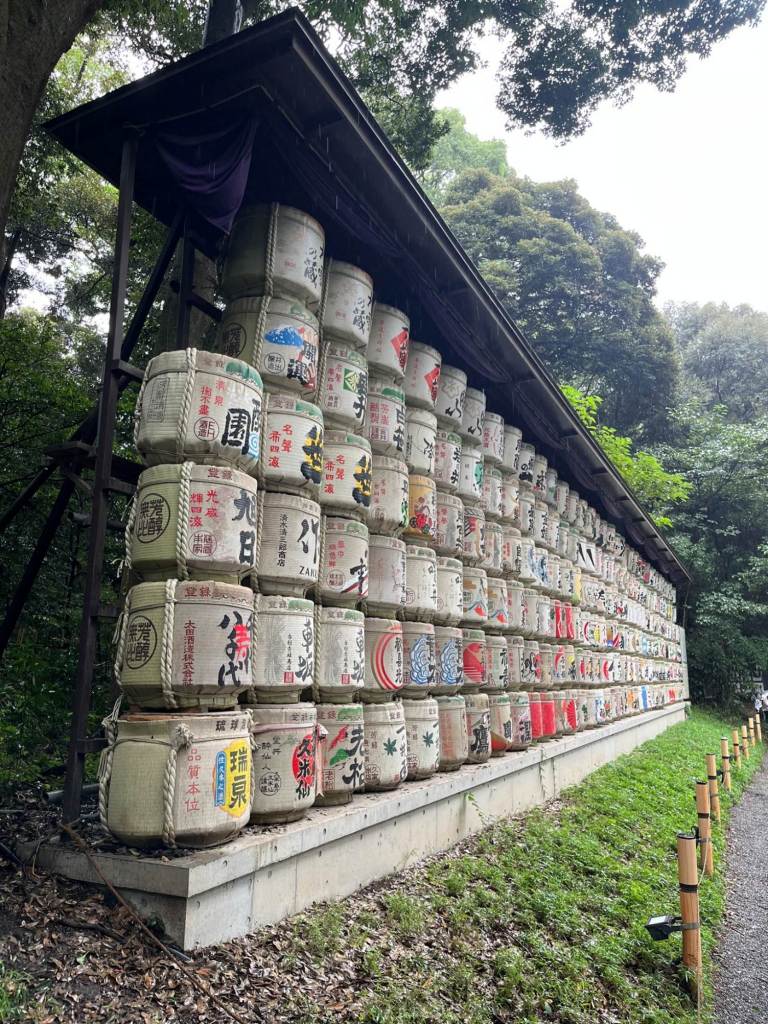
The latter represents the friendship between Japan and France. Supposedly, the Emperor enjoyed a cheeky glass of red with his meals. Fair play.
Said saki barrels are donated annually by nationwide saki breweries, similarly the Burgundy barrels. Saki is not one of my snobberies (basically I don’t know anything though have done tastings) but do appreciate a decent vino. I checked a few of the barrels. Not something you’d pick up for a fiver from Tescos.
A small entrance fee gains entry into the Inner Garden. The weather was not conducive, neither were we.
The Meiji Shrine, dedicated to Emperor Meiji and Empress Shoken, is one of the city’s most revered. Constructed in 1920 (rebuilt after WW2) and set in the beautiful Yoyogi Park. It celebrates the Meiji Restoration (Japan’s first modern emperor), the end of a feudal system and modernisation of Japan’s political, manufacturing and education sectors. Amongst others.
And achieves an air of tranquillity even surrounded by tourist hordes. Did I mention the rain?
Harajuku Station (Yamamoto line) is the conveniently nearby metro.
If youth fashion culture is your cup of ripped jeans than Takeshita Street is the place to be seen. Along what appeared to be most of Tokyo. Absolutely jammed.
Trendy – or so I’m told – boutiques, along with a sprinkling of coffee, bubble tea and assorted shops, line the street. Highlight were a micro pig cafe (utterly adorable creatures) and a shop dedicated to the Grateful Dead. Sus’s favourite band. An easy stroll from the shrine there’s definitely a whiff of London’s Carnaby Street. Or vice versa.
If upmarket shopping is more your cup of Jimmy Choo make haste to Omotesando. Perhaps a kilometre of tree lined, mid to high end establishments. Plus Omotasando Hills mall. It’s an agreeable district to window lust or have a nibble to eat.
And a short walk stroll from Takeshita Street.
Finally into Shibuya, home to that infamous intersection. Amusingly, some Tokyo road crossings feature beeps reminiscent of Imperial Stormtroopers taking pot shots at tourists. We fired back.
The area surrounding Shibuya station is renown as a popular – very popular – shopping and entertainment hub. It’s in the midst of a multi decade redevelopment – apparent – toted for completion in 2032. Many of Japan’s fashion and entertainment trends were born, raised and nourished in Shibuya.
Centre Gai is the pedestrianised and perhaps epicentre of Shibuya with numerous boutiques, huge department stores and game centres.
Once evening takes over bars and restaurants become the main attraction.
If crowds, neon galore and noise are not your cup of relaxation then Shibuya will be painful. A madhouse perhaps, though less so than expected. And remember, Tokyo shopping and restaurants to not exist on one level. A line of neon signs, clambering up many buildings, indicate delights available on upper floors.
Nevertheless, it’s neither dangerous or threatening. It’s a must see if Tokyo bound.
And be warned. Many Tokyo neighbourhoods ban street smoking. Smoking therefore is rare, vaping more so. Dedicated smoking zones are quietly inconspicuous.
Tap and Growler was our Shibuya craft beer destination. Small, very small and not sure any outside space. Lovely staff, 18 taps, couple of fridges. Beer superb. Impressed.
Ended our evening in a vegan Sushi restaurant. Sus loved it, I was less enamoured. Eaten better vegan food elsewhere. Vegan options were surprisingly difficult to find, restaurants – unless only vegan – seem to lack a vegan option. Or, sometimes even vegetarian.
Trekked back to hotel.
Disney Sea, Tokyo
Never been to Disney, never had an inkling to do so. Nevertheless, when in Tokyo…..and Sus wanted to.
I’ve dragged her to enough craft beer bars across the world.
We have Disney Plus if that counts.
Disney Sea Tokyo is smaller than Disney Tokyo and aimed at a marginally older clientele. £45 each – booked before flying out. That includes all rides.
Bayside Station is part of the Disney Resort Monorail providing access (for a small contribution) to Disneyland, Disney Sea, resort hotels (including ours) and JR Maihama.
Jumped on, jumped off. Magically, Disney Sea appeared before us. Attempting to set the scene here.
Disney Sea opens at nine, we entered (efficiently) at eleven. Already busy with 2 to 3 hours wait for popular rides.
Disney does Italy.
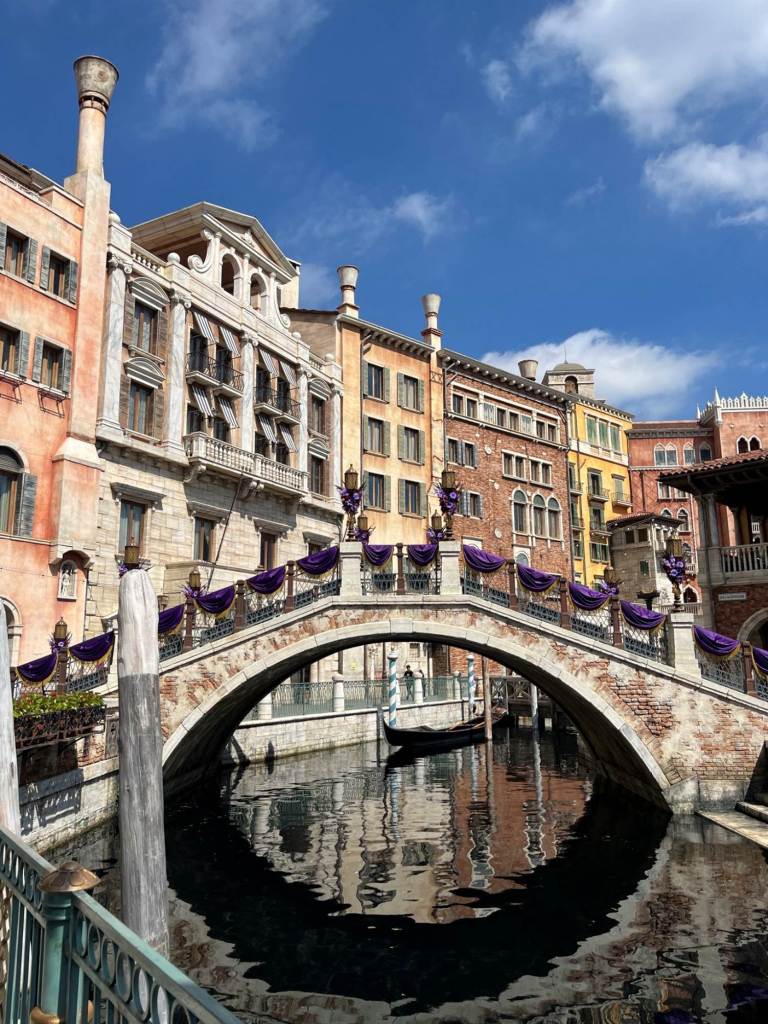
We meandered between numerous zones managing to bag 4 rides – an immersive Nemo experience (surprisingly good), a Jules Verne ride through a seascape (OK) and 2 rollercoasters. One smaller (great fun) and a longer one with a loop (madness).
Disney does Disney.
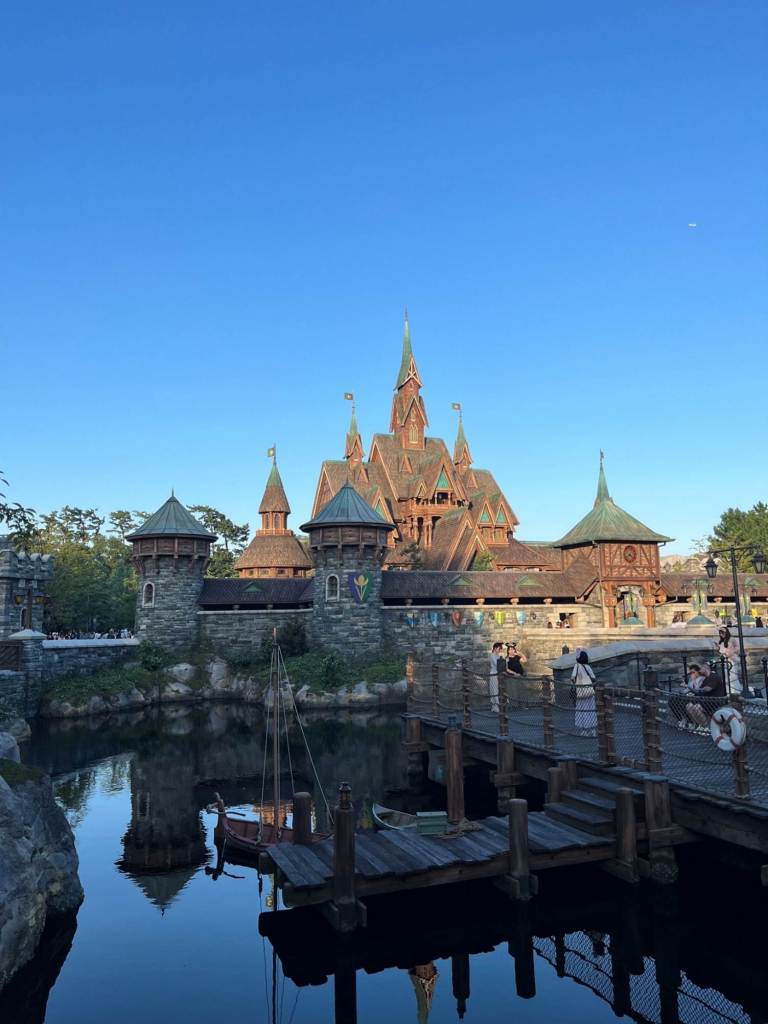
We ate at one of the many, many food options. To my genuine surprise it wasn’t ridiculously expensive and food on positive side of palatable.
So, finally at 61, I experienced my very first Disney. Staff are courteous and helpful, attractions are efficiently policed and that second rollercoaster is a memory that will linger. Is it magical? Not especially. Impressive? Oh absolutely.
And a special mention must go to all those clothed in full costume of, one hopes, their favourite character. Wonderfully creative.
We left the park a little before 7pm, nearly 8 hours after entering.
An enjoyable interlude and new adventure for me. Would I ever return to a Disney Resort? Of course not.
Decided against an immediate return to hotel, JR Maihama first. And Ikspiari Shopping Mall. Foddered at decent pizza place and discovered a serviceable supermarket. Bought next day’s breakfast.
If you are staying within Tokyo’s Disney Resort – more of that later – I suggest giving Ikspiari a look see. Tourist generally arrive via JR Maihama and food is cheaper and similar quality to hotels.
From just another – albeit a pretty one – shopping centre to a bonus we came to rely on. Particularly that supermarket.
Ginza, Imperial Palace, Toranomon Hills
Our normal routine of free hotel transfer to JR Maihama. From there, the world, or at least Tokyo, is our oyster.
Ginza is a rather posh, upmarket shopping area located around Chuo Dori Street. It’s a steady 15 minutes stroll from Tokyo Central Station.
Initially, what we thought was Ginza, wasn’t. It was probably Marunouchi. Nevertheless, serendipity (we’re big fans) kindly deposited us in Ginza proper. High rises (of course, it’s Tokyo) plus all those posh brands you know and some you perhaps need to know.
Many, including Rolex and Louis Voutton, had 2 stores within a relatively short walk of each other. Bit showy.
Ginza doesn’t do restaurants. Ginza does bistros.
Suzuran Street, sat in the midst of this conspicuous, consumer consumption, is an anomaly. Pedestrianised, small shops and restaurants lining each side with tourists mingling with locals.
Neither have any interest in buying over hyped high fashion (Uni Qlo for us) but a fascinating to peek into all things designer. Nevertheless, we did explore the 1930s Wako Honkan Department Store. Incredible food court very reminiscent of Harrods food court..
The Imperial Palace – an easy stroll from Ginza – is constructed on the former site of Edo Castle. Edo Castle dates back to the 15th century, the current Imperial Palace from the 19th century. The latter rebuilt post Second World War.
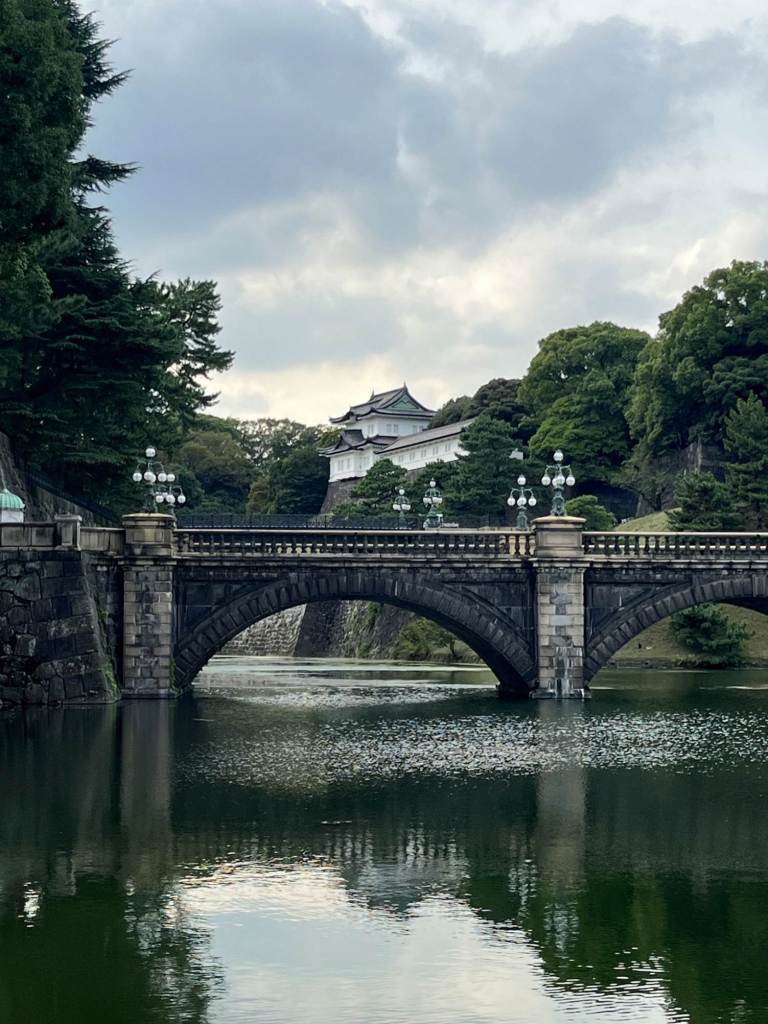
Defensive walls, moats and castle foundations all survive. War, earthquakes and fire did for the rest.
The charismatic Imperial Palace, which isn’t open to the public, is housed within the Kokyo Gaien National Garden. Approximately 2,000 manicured Japanese black pines, seemingly uniformly planted, make for a quite striking backdrop. Enveloped by Tokyo the park affords a welcome intermission from concrete.
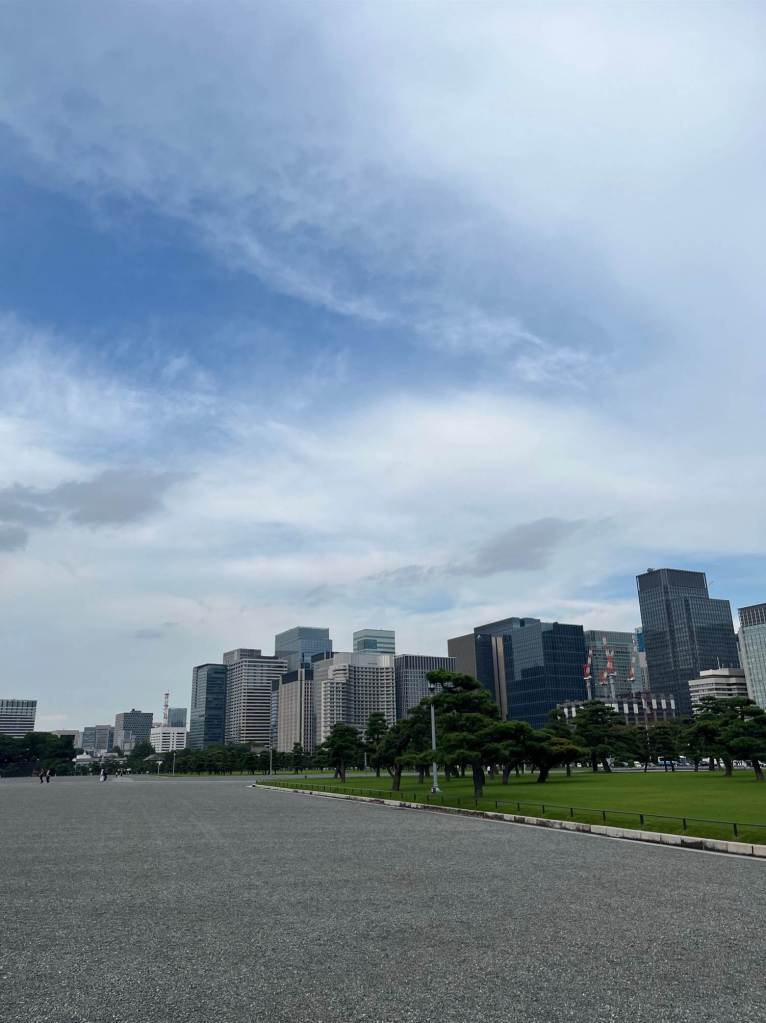
Next up, a half hour walk to Toranomon Hills and Uchu Brewing, via Kasumigaseki district. Government offices dominate. The striking, red brick and former Ministry of Justice building, constructed in 1895, reconstructed post WW2, stands rather prettily amongst its much shinier modern peers.
And into Toranomon Hills dominated by both sleek residential and corporate skyscrapers.
Uchu Brewing have a tiny taproom, a couple of floor from street level. And oddly located on an outdoor thoroughfare of a modernly sleek shopping, business and residential complex. Not a railway arch in sight.
Six taps, 2 fridges, limited standing inside and further upright posturing outside. The latter sheltered from the worst of the elements by another covered walkway connecting 2 residential blocks. No seating. Genuinely a tad surreal. However, and most importantly, the beer is superb.
Smoothie sours and higher alcohol IPAs prevail. No food available but happy, probably delighted, for punters to source food from elsewhere.
Yep, beer. And 1 of your 5 a day.
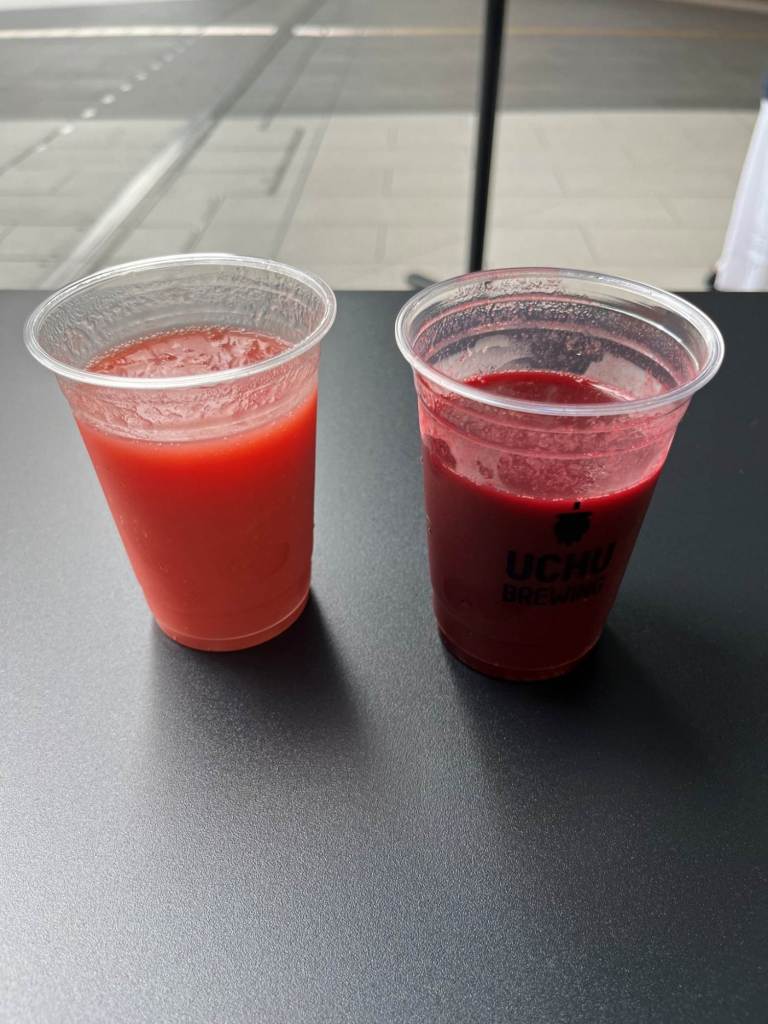
Both loved Ginza, the Imperial Palace and Toranomon Hills. And, naturally, Uchu Brewing. My favourite Tokyo outing? I think so.
Back to the hotel. A little before 10pm.
Asakusa, Sensoji Buddhist Temple, Skytree
Left hotel before 10am and headed to Asakusa and the Sensoji Buddhist Temple.
We actually walked, for around a half hour, from another metro stop neither can recall.
Meandered through residential neighbourhoods before chancing upon Hisago Street. Not dissimilar to the above Suzuran Street. Though Hisago is more backpacking vibe, less ‘where did that Prada go?’.
This exploration meant not entering the temple via the traditional Kaminarimon Gate which spews never ending tourists onto Nakamise, the main shopping street.
From there, you pass through the Hozomon Gate into the complex proper. Sensoji Temple is not alone, neighbours, and one would hope friends, include a pagoda, shrine and those gates.
Parts of the complex date back to the 17th century, others rebuilt in the 20th century. World War Two at it again.
Once templed out explored the afore mentioned and teeming Nakamise. Plus the similarly teeming, neighbouring shopping streets.
Character, undoubtably. Quality unquestionably present. Unfortunately far too many establishments peddling same old, same old tired, tourist tat crap. Whether it be souvenirs, food or drink. All a tad naff. Not our cup of landfill.
However, that temple is undoubtedly worthy of your time. Quite magnificent. And in very much their own way, so are the accompanying streets. Part of the deal. And have been for many, many years.
By now, we were hungry. Let the ramen hunt commence. The Sumida River is only a short stroll and the riverside pathway easily found. Wandered a little way down riverside pathway, half heartedly contemplating a boat ride. Tokyo’s waterside appears under utilised compared with its European peers. Thinking London’s Southbank amongst others.
Skytree on left.
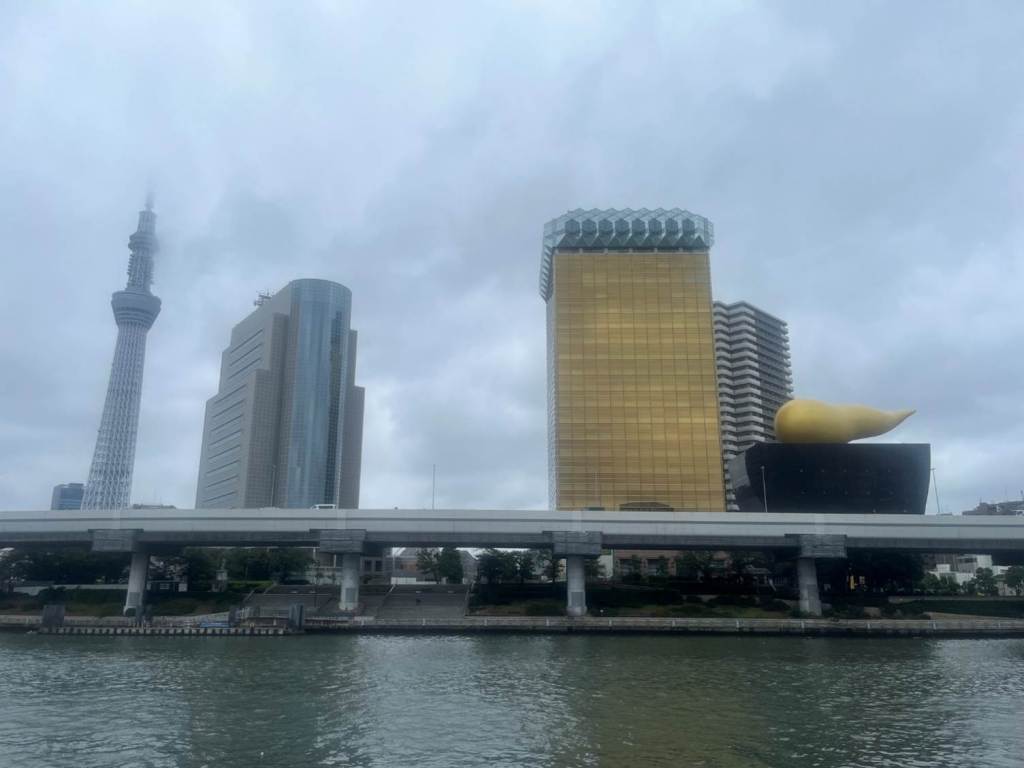
We sauntered past what appeared to be a closed pier before picking a bridge to cross. Naturally, a tourist boat paused, at that closed pier, 10 minutes after we’d strolled on by. Ah well.
Found ramen. Ate ramen. Messily. Local place, cheap and friendly. Perfect.
And, unintentionally, we’d wandered into Tokyo’s Skytree neighbourhood. The Skytree is Japan’s tallest tower incorporating 2 observation decks, a shopping complex and aquarium. A broadcasting communications tower – needing to be taller than surrounding high rise Tokyo – is somewhat striking A genuinely handsome beast. Especially lit up.
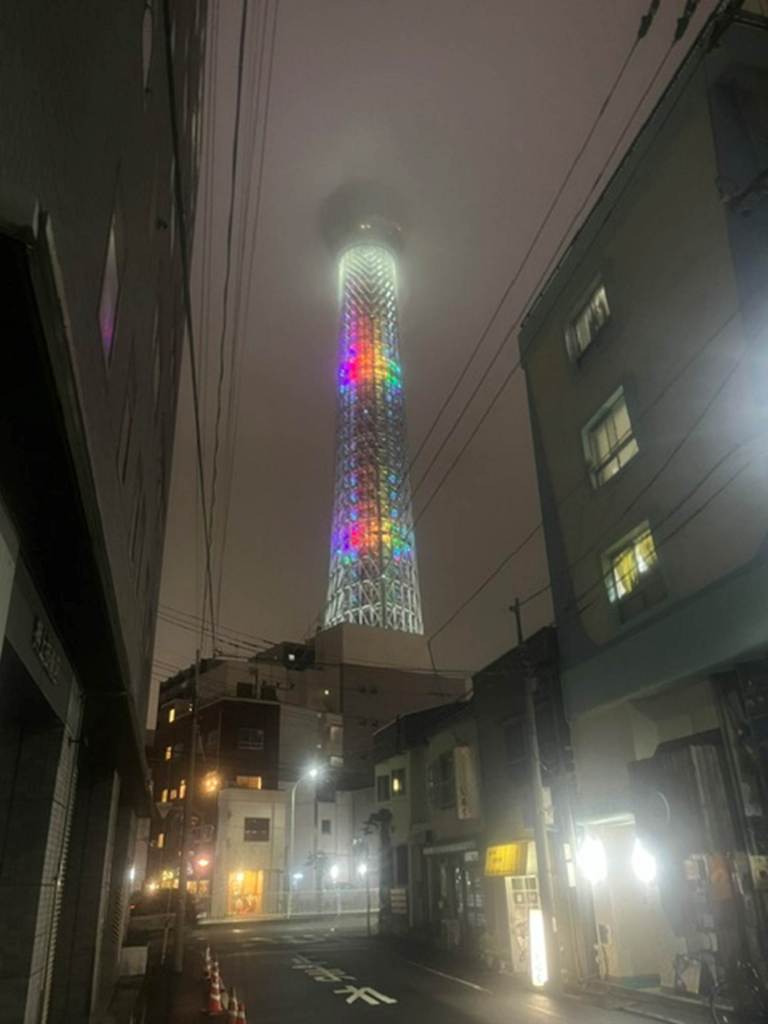
The weather wasn’t kind to those with prepaid tickets. The higher of the 2 observation decks was utterly obscured, the larger and lower deck shrouded in mist. The views are undoubtedly spectacular, and worthy of the £20 (from memory) entrance fee. Just not today.
After briefly wandering around the base, taking advantage of the facilities and free wifi, we went to the pub.
Actually, a small neighbourhood brewery (Bathe Yotsume Brewery), tippled a couple of ales (me) before heading back to hotel.
Shinjuku
Shinjuku station, with multiple railway and subway lines, plus a bus terminal, is considered the world’s busiest transport hub. Numerous restaurants, shops cafes turn Shinjuku into a transit city. I suspect some tourists never leave. All a bit ‘Hotel California’.
Upto 3.5 million passengers use it daily escaping (eventually) via one of its 200 exits. Shinjuku is also one of Tokyo’s major business, shopping and entertainment hubs.
As you emerge from the station neon signs wave at you from every direction and height. After dark it’s almost mesmerising.
A little disappointedly, and perhaps unexpectedly, Tokyo is not litter free. Shibuya and Shinjuku both had their fair share. Other neighbourhoods were spotless. Graffiti, however, rare. Only spotted an occasional scrawl. Homelessness, though not as common – or from what we observed – as other cities (London included) isn’t absent. In Shinjuku, homelessness was increasingly obvious.
Another oddity is Tokyo’s affinity to plastic. Where in the UK alternative packaging is used, in Tokyo, plastic is the pollutant of choice. Weird. Supermarkets a noticeable example.
Anyway, wandered down Omoide Yokocho, known locally as ‘Piss Alley’. I won’t elaborate.
It’s actually 2 or 3 short and narrow streets packed with tiny eateries busy with locals. And ‘bought a tour‘ tourists. To be fair, enticing aromas seep from every establishment. Liked it.
Twenty minutes amble, in the midst of the Skyscraper District (more businesses, shops, eateries) one will find the snappily named Tokyo Metropolitan Government Building. In the main foyer (level 1), look for a small queue, join queue, said queue is a lift transporting one and all to the 45th floor. And an observation deck.
Breathtaking vistas across Tokyo. And it’s free. Predictably, coffee, nibbles and alcohol all available.
Shinjuku Central Park lies behind the Tokyo Metropolitan Government Building. Sus had spotted before our 45 floor ascent. Wandered over. What appeared to be a Vietnamese cultural event was in full swing.
Grabbed a cheap and delicious Vietnamese sandwich and parked in the park. For half an hour.
Returned to Shinjuku station and then a little way beyond. To Golden Gai. Numerous short and narrow streets, lanes almost, hosting over 200 bars and restaurants. All are tiny, many have a cover charge.
We visited mid afternoon so fairly quiet. Suspect utter carnage ensues post darkness. Nevertheless, Golden Gai has a certain charm for those willing to partake.
Image below is from Golden Gai. Tokyo’s electrics, though unquestionably safe, didn’t always appear so.
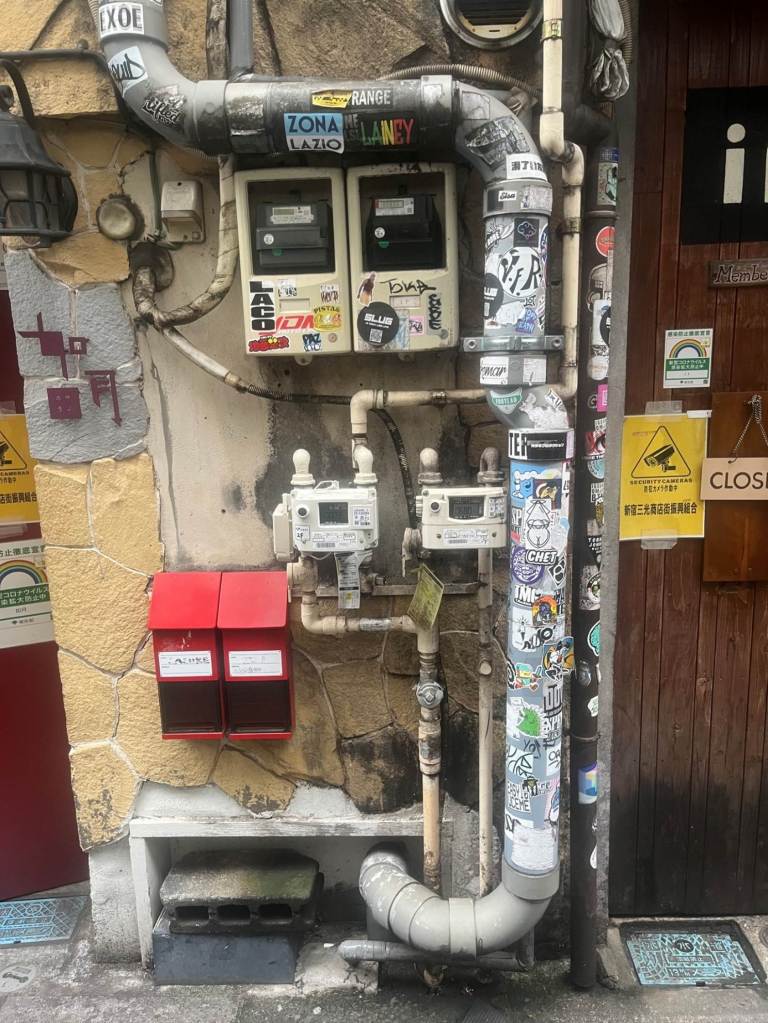
Our final pause, before hotel bound, was Beer Bomb. The good, decent beer, on trend, and appetising food. The bad, a seemingly repeating cover charge and ridiculous ordering system.
Shibamata, Taishakuten Temple, Yamamoto-tei
Last full Tokyo day. Slept late, procrastinated, Shibamata beckoned.
Taishakuten Temple is a few minutes amble, through an attractive low rise neighbourhood, from Shibamata metro. The temple is an elegant, 400 year old temple with intricate and beautiful carvings. Our favourite temple. No crowds, peaceful, pretty.
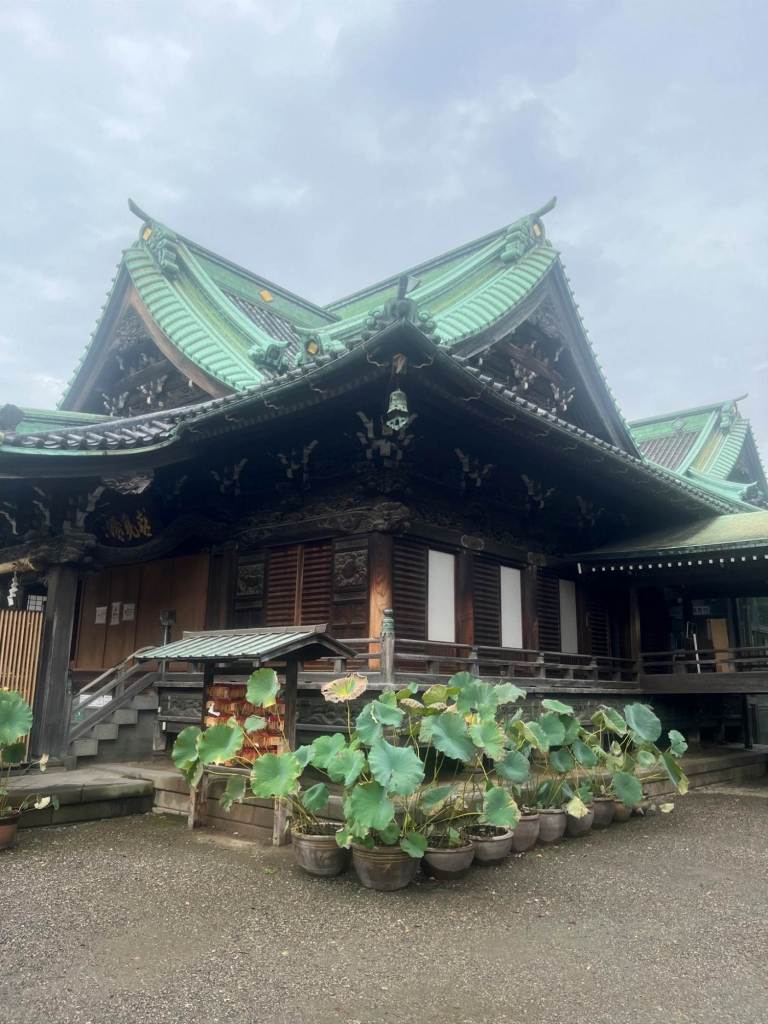
The short, quaint shopping street is worthy of a stroll even though tourist trap shops overshadow their betters. A 10 minute walk from said quaint shopping street is Yamamoto-tei, a hybrid Japanese/ Western merchant house. Charming, the gardens are especially gorgeous.
Wandered to the Edogawa River, strolled briefly through manicured gardens before making for the station.
A charming interlude away from Tokyo’s concrete jungle. Go. We both loved it.
Forty minutes later, and back in Toranomon Hills, we ended our day with beer (Uchu, again) and curry. Very English.
Thoughts
Firstly, location. As mentioned, our hotel was located within the Disney Resort. If Disney your prime objective, recommended. Though suspect whichever hotel chosen, within the resort, offers a similar experience.
If, however, as with ourselves, Disney is only a day diversion, stay elsewhere. Travel into Tokyo is overly convoluted, options outside hotels and resorts non-existent.
Secondly, Tokyo. Both thoroughly enjoyed our time in this city, it certainly never overwhelmed (try India) or frightened. Our week was enough, though four full days should enable most to pick off principal tourist tick box sights. English is widely spoken, the natives invariably lovely.
And those famous Japanese toilets? I’m sold. Heated toilet seats, bottom sprinkler, dryer and sound affects covering any unpleasantries, all common. Free, clean toilets are omnipresent. Including in most stations. I often skipped one opportunity to sprinkle knowing another opportunity to sprinkle was literally around the corner. Living on the edge.
Our excursion to Ginza and the Imperial Palace, plus that final day in Shibamata were highlights. Two days that won’t disappoint. Throw in Shinjuku and/or Shibuya and a museum and there’s your 4 day itinerary.
Nevertheless, unlike close friends of ours, we never fell in love with Tokyo. Easily liveable, but with the exception of the odd temple and occasional modern skyscraper, architecturally Tokyo is a little nondescript. Perhaps lacking a little verve and chaos. It all felt rather controlled.
Nevertheless, Tokyo is a fascinating city and one undoubtably worth visiting. You will not be disappointed.
Hong Kong
Travel day. Contemplated hotel breakfast. Neither especially hungry, that curry was still very much present.
And, only rarely ventured into hotel public areas. Teeming with excitable and screaming children/babies, disgruntled and bored parents. The thought of breakfast amongst that annoying chaos quickly lost any appeal. Popped into the small onsite supermarket instead.
Not our cup of not that happy families.
And from what Sus had read, vegan and vegetarian options were severely limited.
Disney bus, at a surprisingly agreeable cost, delivered us to airport.
Flight painless, landing in Hong Kong around 8.30pm.
A bus, A25, dropped us 10 minutes from hotel in Kowloon. Actually, a tad more as we forgot to press the magic stop button. The A22 (same stand) was another option though deposited us further away.
As soon as one departs the airport humidity engulfs and smothers. Temperatures hovering around 30 degrees bring the joys of inevitable and continued sweating. Air conditioning becomes your new bff.
The air conditioned journey took – to Wampoa station – about 70 minutes. I had great fun with ‘Wampoa’, much to Sus’s chagrin. Mysteriously, on the upper floor, I was unable to stand upright. Low bridges? Small people? No idea. By now it was close on 10pm and the Hong Kong skyscrapers, residential and business alike, were illuminated. I would say for us but suspect they are every night.
Quite Entrancing.
Anyway, checked in, slept.
Peak Tram, Hong Kong Park, Central
Paid for breakfast – to my delight I was eligible for a discount due to my advanced years – before exploring.
Hong Kong is significantly smaller than Tokyo. Tiny even. And with its efficient, air conditioned transit system, simple to navigate. Purchase an Octopus card which operates in a similarly effective way to Tokyo’s Suica card.
We opted for an electronic version downloaded onto our phones. I’m of the opinion that all technology is really magic. Bluetooth? Magic. WiFi? More magic. Technology is just there, always. No clue to what exactly it is or how it works. Magic.
Admiralty was a 10-15 walk, dependent on your interpretation and mood of chosen map app, to the Peak Tram. A funicular railway, operated since 1888. Those original trams have been, mercifully, replaced with modern stock.
Taking less than 10 minutes the funicular is around 4,500 feet long rising about 1,300 feet. Oh, it’s steep.
Two options. Victoria Peak (presumably the original viewing site) or the mildly optimistically named Sky Terrace. We opted for the latter. Cost? Not an inconsiderable £18 each. Or there about.
Sit on the right on the ascent for best instawhatsit shots.
Case in point. Barker Road Station, about half way down. Or up.
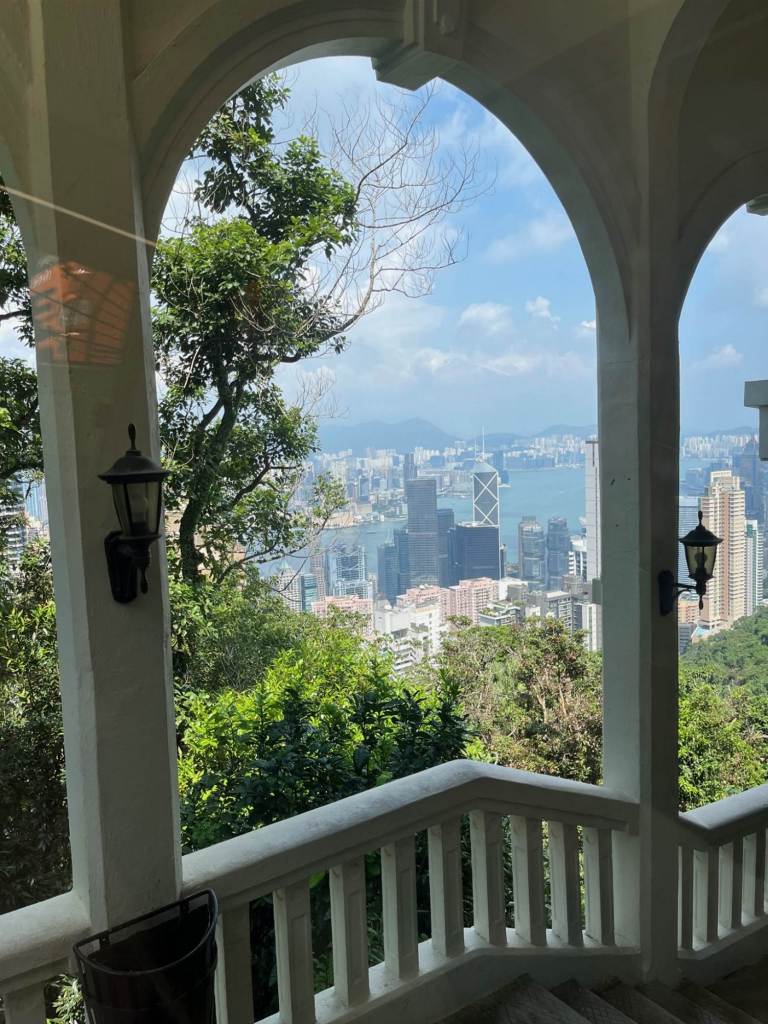
An obligatory shopping mall selling the obligatory crap greets one on arrival at Victoria Peak. Numerous small escalators, via ever present mall, ascend to the Sky Terrace.
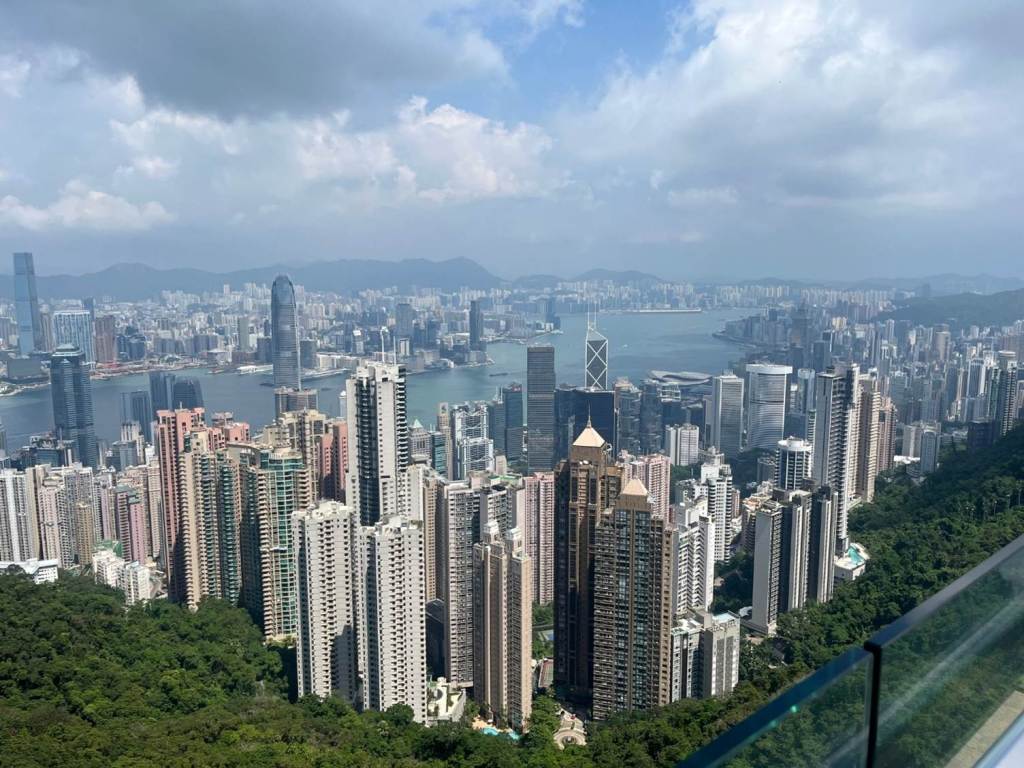
The views, are indeed, spectacular. And aptly demonstrate why Hong Kong is a vertical city. Many of the surrounding hills encasing Hong Kong were, in the main, unspoilt and pleasantly green.
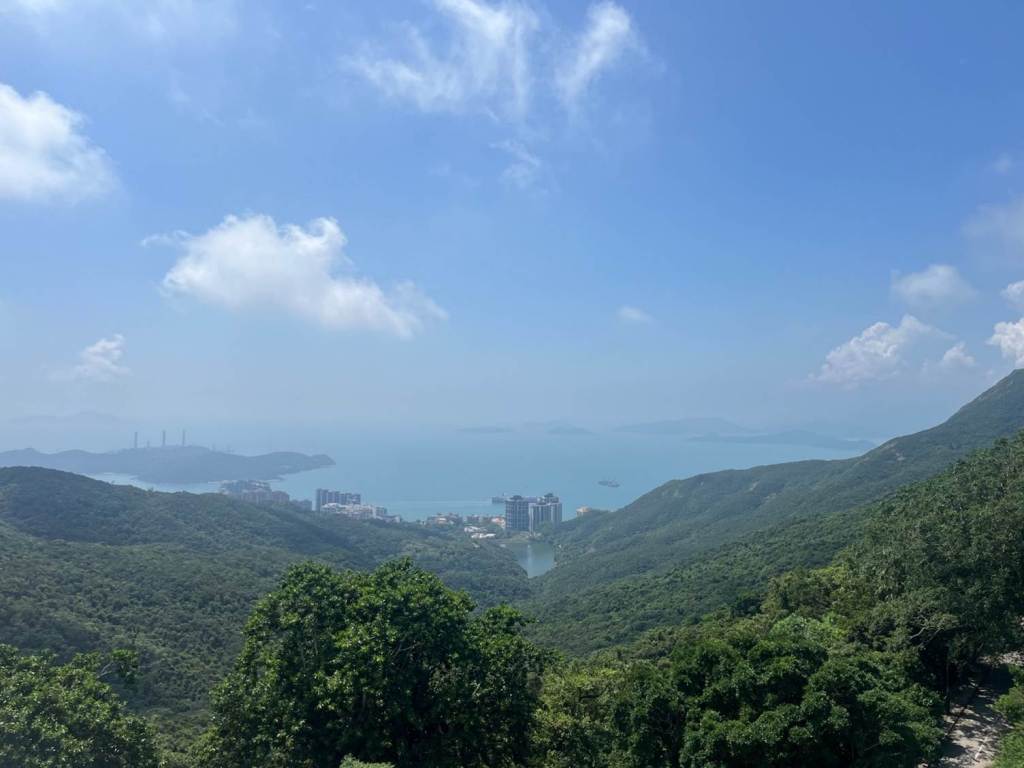
Handily the ticket includes a return descent.
A short stroll from the Peak Tram brings one to the welcome green Oasis of Hong Kong Park. Though with 32 degrees temperatures and oppressive humidity no stroll is short. And Hong Kong is not level. Not at all. Our stair count, for each of those 3 full days, was 20 plus.
It’s a wonderfully, unexpected surprise and includes a small artificial lake, gorgeous planting and a t’ai chi garden. Spied, avoiding the fish, a nervous terrapin.
Perhaps the highlight was a free, walk through an avery. The older I become, the more birds fascinate me. Must be a thing. Spotted many an exotic feathered chum, many utterly disinterested in humans. Don’t blame them.
Exited the park, boarding an old school tram charmingly rumbling and jerking its way to Central. A return, to the Hong Kong district, from our typhoon enforced exploration a week ago.
We sweated our way to Hollywood Road, one of, if not the, oldest street in the city. The street, and its close neighbours, are antique central. Some of the shop windows resemble the British Museum. An expensive gift shop.
Serendipity strikes again. Ambling (and sweating) up Hollywood Road Man Mo Temple (constructed 1847) materialised. Defo worth a gander. The temple still very much part of the community (as it had been in the 19th century and beyond) with locals offering prayers. Good vibes.
Next up, fodder. Central hosts bar and restaurants, of all descriptions, galore. At random really, wandered into a small, probably family owned, Michelin guided spot. Both ordered dumplings and shared a plate of bok choi. Green tea accompanied the meal.
Obviously delicious, I even enjoyed the green tea. Tea isn’t my, eh cup of tea generally. Cost? Less than £20. Bargain.
Finally a couple of cheeky ales at Out of Beer. Another tiny beer emporium with 5 taps and couple of fridges for in or out. Beers outside of China, not surprisingly, ridiculously expensive.
Local brews proved to me a worthy opponent.
Chi Lin Nunnery and Nan Lian Garden
Another breakfast, another discount. Most marvellous.
A short walk from Diamond Hill station (connects to the deceptively large Hollywood Plaza) is Chi Lin Nunnery.
Originally constructed in the 1930s as a retreat for Buddhist Nuns, the nunnery was further developed in the 1990s. Comprising various halls, a library, school and pagoda, Chi Lin claims to be the largest, handmade wooden building without using a single nail. The courtyard features 4 Lilly ponds and a sculptured garden. As with many Buddhist temples Chi Lin conveys a sense of serenity. Helped by the lack of tourist hoards.
And when constructed, imagine skyscrapers were somewhat less plentiful.
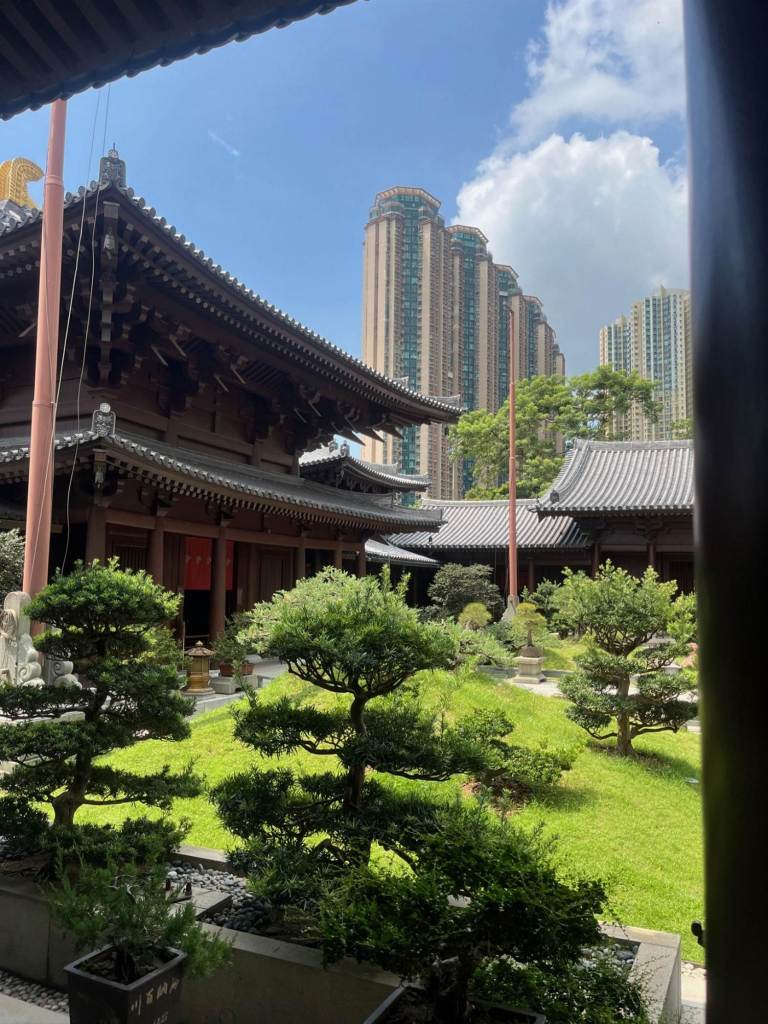
The nunnery, via a bridge, is connected to the gorgeous Nan Lian Garden. Meticulously landscaped following Tang Dynasty design principles. A circular path leads worn out tourist over bridges, past a lake, waterfalls, pavilion and a teahouse. MacDonalds didn’t get that concession.
The nunnery and gardens are free and thoroughly deserving of your time.
Return to hotel, via our bestest new supermarket, for a cool down. And then up to the 20th floor for a rooftop paddle. Views weren’t too shabby either. The residential building adjacent to our hotel had at least another 30 floors. Never felt so inadequate.
Back to room, showered headed to Temple Street Night Market.
Hundreds of small stalls line both sides of the pedestrianised Temple Street flogging souvenirs, clothes, electronics and accessories. For peckish punters the foody bit is located as you manoeuvre from Jordan Street. Though busy, 7pm presumably too early for younger punters, able to quickly stroll through.
Temple Street, and surrounding thoroughfares, are a little less salubrious than Hong Kong’s posher post codes. Older high rise residential blocks dominate, wealth is much less obvious. Nevertheless, all those tourists can’t be wrong. Though hastening through, would have returned if time permitted. It didn’t. This time.
We had a date. With West Kowloon Cultural District. A park. And fireworks.
Apparently, today marked China’s 77th anniversary of the founding of the People’s Republic of China. A surprise to us too. We walked from Temple Street (about 20 minutes) to the West Kowloon Cultural District. A cultural, business and residential district showcasing striking architectural buildings. Waterfront promenades, metro options aplenty.
The district is still very much under construction. If one returned in a year or so, the continued transformation would become obvious. We’d buy off plan.
Wrongly or rightly we decided to quickly trek to the nearby, though not as nearby as we thought, West Kowloon Cultural District Park. With unequalled vistas of Victoria Harbour and those fireworks. Mmmm.
The trek was long. The trek was hot. Fireworks started. Sound, yes. Sightline, no. Fuck. Followed a surge of mildly desperate people. And discovered a splendid, albeit crowded, vantage point.
Lightening behind us, Hong Kong’s illuminated skyscrapers encircling us, water adjacent to us, fireworks battering the night. For 23 minutes. Some scene. Some setting.
Magnificent.
Fireworks finished and struck up a conversation with Tom, a lecturer, teaching in Hong Kong for a semester.
As we conversed a stream of pleasure boats, of differing sizes and presumably costs, steamed by. A flotilla, post fireworks, heading home. Quite a spectacle. Reminding me of first day tourists descending on included breakfast buffet.
Strolled and chatted with Tom before departing in differing directions. Though not before connecting on WhatsApp and Untappd (me).
Grabbed a late supper from supermarket before sleep.
Hong Kong Museum of Art, Tom
Last full day before London bound. Rain forecast, no need to add to step and stair count.
We’d wanted to pop in to Tokyo’s National Museum of Modern Art. It was closed for renovation. Inconvenient. However, Hong Kong Museum of Art (HKMOA) wasn’t. Nestled amongst neighbouring museums, free to enter and dry. Strangly, not located in the West Kowloon Cultural District but Tsim Sha Tsui.
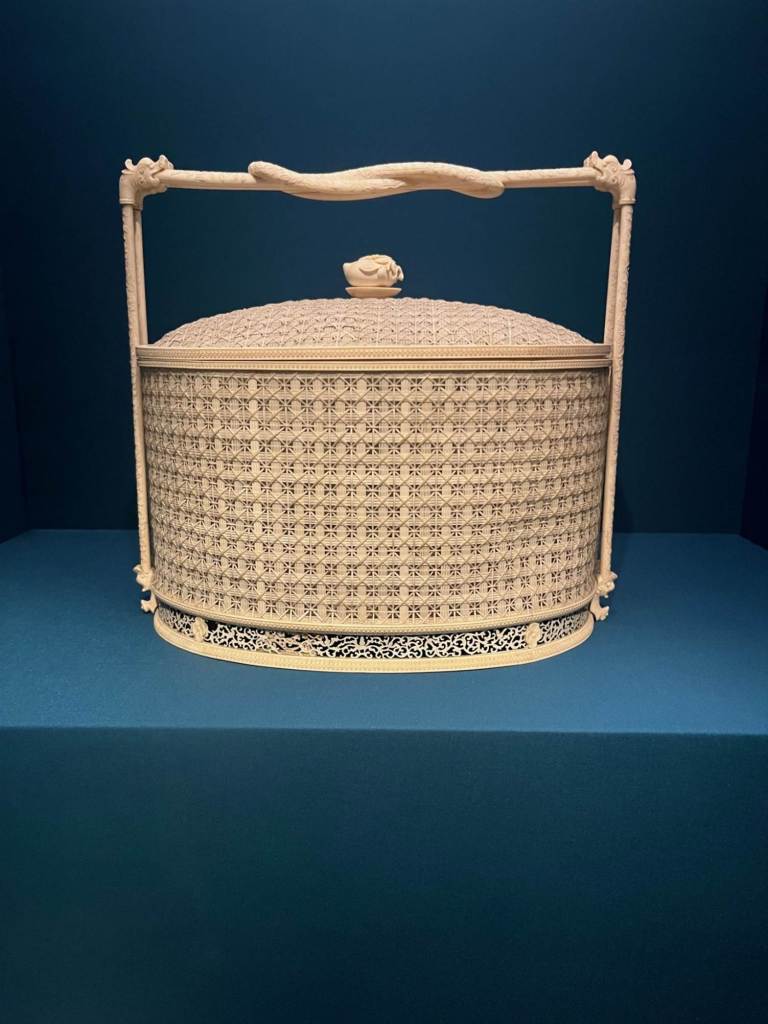
Coffee and cake before meandering around the 2nd and 3rd floors. Calligraphy, painting and art for the European market dominate. Much of what we saw was genuinely exquisite. Highly recommended.
Exquisite. Tragically, ivory.
Metro back to Central, Dim sum at local eatery, beer at Draft Land TST. And Tom. Who’d we arranged to meet.
Twelve taps, again tiny, with a small selection in fridges. Beer at Out of Beer step above, nevertheless wiled away a most agreeable couple of hours.
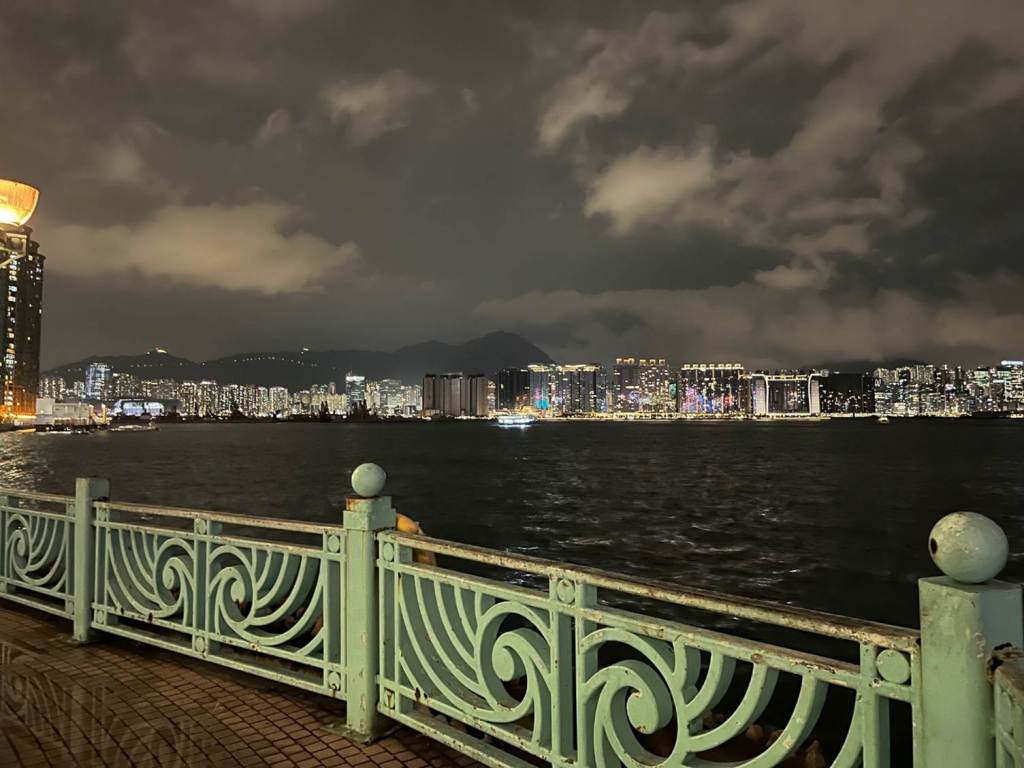
Returned to hotel, toddled behind hotel, took final shots of Hong Kong lit up.
Thoughts
It might be obvious, we loved Hong Kong. Chinese it may be but western it appeared. Though Tom had mentioned friends of his, living in Hong Kong, detecting a tightening of everything since the protests.
Nevertheless, we still loved it. Hong Kong is lively, friendly and exciting. And architecturally more attractive than Tokyo. We’d live there. For 2 years.
London, Home
Showered, packed, checked out. Walked the 5 minutes to the bus depot, straight onto a A25 bus returning us to the airport the same way we’d arrived.
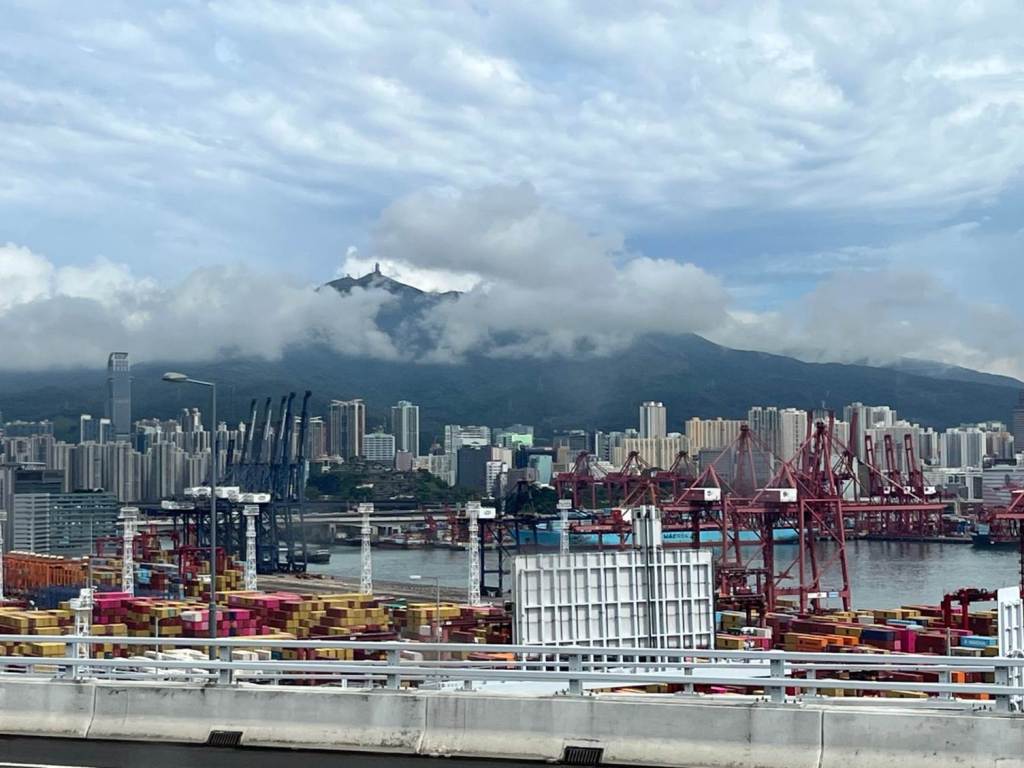
Our flight left for London at around 1.30 local time. And meant the return trip was in daytime. Some of the older residential blocks are perhaps best seen at night. Nevertheless, the huge container port and numerous docks was rather captivating.
Flight of some 14 hours relatively painless, trusty Lizzie Line brought us home.
Final Thoughts
Neither Tokyo or Hong Kong are ethnically diverse. Tourists and ex pats provide that diversity. Arriving in London, jumping on that Lizzie line, only emphasised that impression. Though both, certainly transport and eating out, proved remarkably good value. A surprise to both.
Nonetheless, both cities are incredibly liveable, safe and absorbing. If your ever lucky enough to have the opportunity to live in either, take it.
As always, many thanks for reading, Tony (October 2026).

