
That’s been a decidedly odd few months. And, writing as I do in October, continues to be so.
I’m working from home for the first time in my life and initially discovered separating one from the other annoyingly difficult. This I’ve come to terms with by burying my work laptop in the deepest, darkest corner I can find once my working day is over. In a one bedroom flat this has meant a little creative thinking.
I’m based in our kitchen/diner; Sus is set up in the bedroom. With a recently acquired executive chair no less. Sus, who’s a total guru in all things project management and expertly delivers project management courses, has taken to the home working lark splendidly well and would have no qualms with this way of working becoming her norm.
After rebooking a Seville trip for February 2021 – a re-rebook a distinct possibility – we decided on a September staycation. The New Forest is the new Seville.
Lymington
West London to Lymington took us a remarkably reasonable hour and 45 minutes. Britannia House (www.britannia-house.com/), our B&B, was ideally located 2 minutes from the harbour, 2 minutes from the high street and 20 seconds from the train station.
The posh Victorian bit was one side of the residential street, the less posh bit (part of a small apartment complex) was on the other. We were in the less posh bit, having booked late, though this proved a splendid base for our 4 night stay. And there was off street parking. Beware of centrally located establishments advertising ‘self parking’. Self parking often necessitates driving around your chosen destination desperately searching for that elusive spot less than a 2 mile hike back to your chosen place of rest. And morning fry up. We checked in and chatted with our ever amiable and helpful host Tobi before exploring the very un-mean streets of Lymington.
Lymington is a picturesque Georgian town set on the equally picturesque Lymington River on the equally picturesque Solent. Lucky Lymington. The old town quay was indeed quaint though, surrounded by pubs and independent shops, annoyingly busy. Clutching our packed lunches – anything remotely perishable from our fridge – we moved on. As we were – and still are – playing ‘avoid the human’ game a little more space was needed to enjoy the fruits of my morning labours.
We car and people avoided along a busy road, passed a very private yacht club before discovering a small though lovely park overlooking the marina. No suitable water facing perch was available so lunch was eaten facing a row of pretty houses that unlike us did face the water. After deciding on a favourite (thinned to 2 fortunate contenders) and a very pleasant 15 minute amble – the marina on one side, a large outdoor pool on the other – we came upon an impressive working boat yard. A number of organisations were based there along with a tempting selection of dry docked boats one in particular Sus took a liking to.
More ambling took us through attractive neighbourhoods and returned us to our B&B. Once refreshed we explored the quaint and attractive Georgian high street before a long walk (cue more pleasant neighbourhoods) brought us to a craft beer haven. Actually it wasn’t. However there was just enough to entertain my beer snobbery. And the food was excellent.
Beaulieu – Cars, monasteries and green bits
The following morning, after heroically dispatching the first of 4 splendid fry ups, we drove to Beaulieu and our allotted time slot. Sus is still trying to understand how a word spelt Beaulieu is pronounced ‘Buley’. I explained the whole English destroying the French language thing though she’s still a tad vexed. I felt it counterproductive to argue that as an American her fellow countryman had mangled any number of words and spellings.
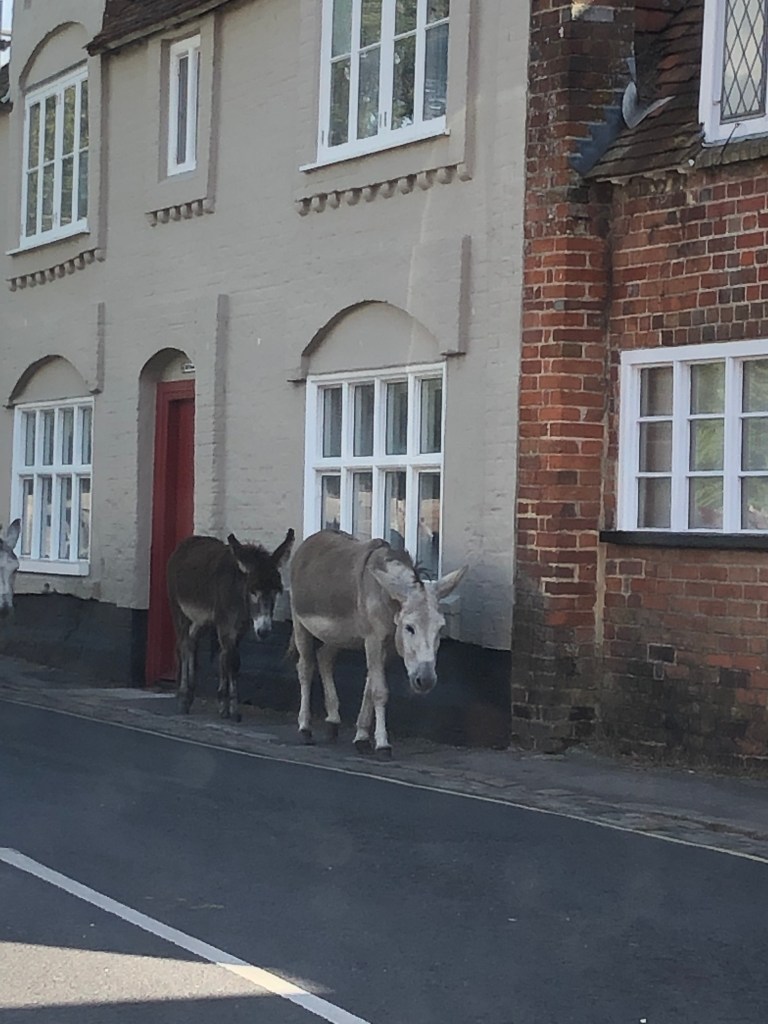
The short drive takes one through a sliver of the National park that is the New Forest. Horses and donkeys amble randomly oblivious to traffic and humans alike. Can’t say I blame them. With thousands of acres to munch on one does wonder why their chosen and presumably choicest green bits have a tendency to cause a traffic jam. Neither of us cared – the horses are beautiful and the donkeys utterly adorable. The latter show a curiosity that means windows are better left closed.
Beaulieu is an 8,000 acre estate housing the National Motor Museum, The Palace House and the ruins of Beaulieu Abbey. There are lots of green bits too.
My car test was passed at 17 and a full bike license collected at 21 – though I’d been riding motorised 2 wheelers since the age of 12. I’m huge petrol head and the National Motor Museum is a mecca for such as I. Sus, who has only a passing interest, indulged me. For 2 hours. There are nearly 300 fabulous cars and motorbikes on show with a fondly remembered favourite around every corner. If you love cars then please do go. If you love someone who loves cars please indulge them.
A petrol head I may be but I’m a petrol head fully embracing the electric car revolution. Electric cars are capable of ludicrously quick acceleration and with ever improving battery technology it is only a matter of time before they ride and handle as well as their petrol cousins. Most importantly electric cars, though not without their own issues, are considerably environmentally kinder to Mother Nature. And the petrol engine will live on in the wonderfully diverse and often eccentric classic car world.
Suffering a tad from combustion engine fatigue we emerged into the outside world, gratefully removed our masks enabling a leftovers chow down. Refreshed we headed to what is left – thank Henry VIII and his libido – of the 800 year old monastery. To our surprise much more survived than either had envisioned. The original monk’s refectory survived, became the parish church and is now a popular wedding venue. The cloister walls remain and, 800 hundred years later, still are an oasis of tranquillity. However, it is only when one explores the pretty gardens that you understand the sheer scale of what was once here. It must have been magnificent.
Palace House, once the gatehouse of the medieval Beaulieu Abbey, was upgraded to the Montagu family home in 1538 and remodeled Victorian style throughout the 1800s. Because of this deeply unpleasant lurgy, queuing was necessary. We both preferred the atmospheric abbey and, though the pub might be beckoning and the kids demanding their iPads, the Palace House is a worthy indulgence.
We wandered back via the lovely Beaulieu River millpond which that lucky Palace House overlooks. The weather had become a little annoying with the vast majority of day trippers deciding on a direct route to shelter. A shame (for them, not us as we were virtually alone) as it’s a pleasant stroll. It’s hard not to notice (unless you’re embedded in your iPhone) the intricate wood carvings fashioned into branches of dead trees across numerous, managed open spaces – parks, National Trust properties, common, heaths. These are fabulous, creative pieces of art and Beaulieu has a few of its own.
Beaulieu is a truly magical day out – and it is a day, plan on it. It’s not only the amount of entertainment on offer it’s the sheer diversity of that entertainment. Beaulieu is not a cheap option, especially for a family, though bringing one’s own lunch will help in mitigating this. And if you did decide to pop back within a year of your visit – and still have your original tickets – entrance is free. Very civilised.
We celebrated with wonderful fish and chips from Elderflower restaurant. Being a take out, and as such understandably not encouraged at our B&B, we ate ensconced in our car overlooking the harbour.
Towns, villages and pedaling
The next morning, once a nourishing fully monty had been dealt with, we journeyed into the New Forest. First up was Brockenhurst – underwhelming with an overwhelming bakery; then came Lyndhurst – larger and prettier; and finally Burley – small, pretty with bike hire. The young chaps at the bike hire were friendly and efficient; we were quickly furnished with our mounts and let loose onto New Forest cycle paths. This was the first time either had been a something with pedals for an embarrassingly long time.
We rode along established cycle paths and ventured off road actually losing any inkling of a path at one point. Though the trails were virtually human free traffic was always audible. Never were we in danger of being eaten by a hungry and grateful mountain lion. We did rest briefly to eat those delicious muffins.
1 tree, 2 bikes, no muffins

I’ve 2 brothers – I’m the eldest – with less than 3 years separating us. We’re close in a middle class, middle aged English kind of way. Both are keen cyclists, middle brother prefers road biking – which I don’t totally get; youngest brother prefers mountain bikes – which I do. I sent a picture of our hired bikes. They sneered. Seems snobbery runs in the family. However, Sus and I were amazed how easily we came to grips with our 2 wheeled chums. We loved the whole experience.
Our day’s drive was wonderfully interspersed with the beautiful New Forest landscape of unenclosed pasture land, heathland, forest and occasional water. Plus those randomly roaming horses and donkeys. That scenery undoubtedly stole the show.
Where’s the chippie?
Back in Lymington we popped into Solent Cellar for a glass of wine. M&S provided dinner.
Conversation, wildlife and pork pies
Breakfast passed pleasantly nattering to our fellow B&Bers. Socially distanced fellow B&Bers. Post socially distanced breakfast we drove to the National Trust Northern Commons confusedly not located in Yorkshire but in the very southern New Forest. To be honest we never properly found it or them. Perhaps they really are in Yorkshire. However we did discover the wonderful Blashford Lakes.
Hampshire and Isle of Wight Wildlife Trust (www.hiwwt.org.uk/) manage over 50 nature reserves – Blashford Lakes is one consisting of 159 hectares of what were once lifeless gravel pits. Woodlands, lakes and grasslands make it a haven for wildlife particularly migrating birds. And again we had the place pretty much to ourselves happily wandering for an hour and since made a small donation.
Next up, pork pies. Award winning pork pies. I’ve had a fondness for pork pies since birth though, appreciating such are not one of life’s healthy pleasures, eat lamentedly few. Nevertheless, an awarding winning and nearby farmshop was shouting my name. I purchased an artery worrying 2 pork pies, one sausage role and a cheese and onion pasty. The pork pies were delicious though the sausage role and cheese and onion pasty were perhaps even better – eaten over a couple of days to prevent a pork induced heart attack.
Ringwood Brewery (www.ringwoodbrewery.co.uk/) was only minutes’ drive away (rude etc). I acquired a 4 pack of their traditional English ales all since proved an excellent alternative to the equally excellent modern session pale ale.
Returning to Lymington via that gorgeous New Forest scenery, and after a brief hiatus to freshen up, we went shopping. Without buying anything. Blubambu (https://www.blubambu.co.uk/) severely tempted both with its stylish furniture crafted from reclaimed wood. Temptation may become reality at their next sale.
An excellent wine flight was provided by The Cellar along with conversation with locals including Stephen Lees a well known artist. Check out his shop opposite, you won’t be disappointed. Waitrose provided dinner.
Last breakfast, checkout, a beach with no name
After our final breakfast Tobi pointed us towards a beach frequented by locals and not necessarily by tourist hoards. We checked out and drove straight there.
Beautiful
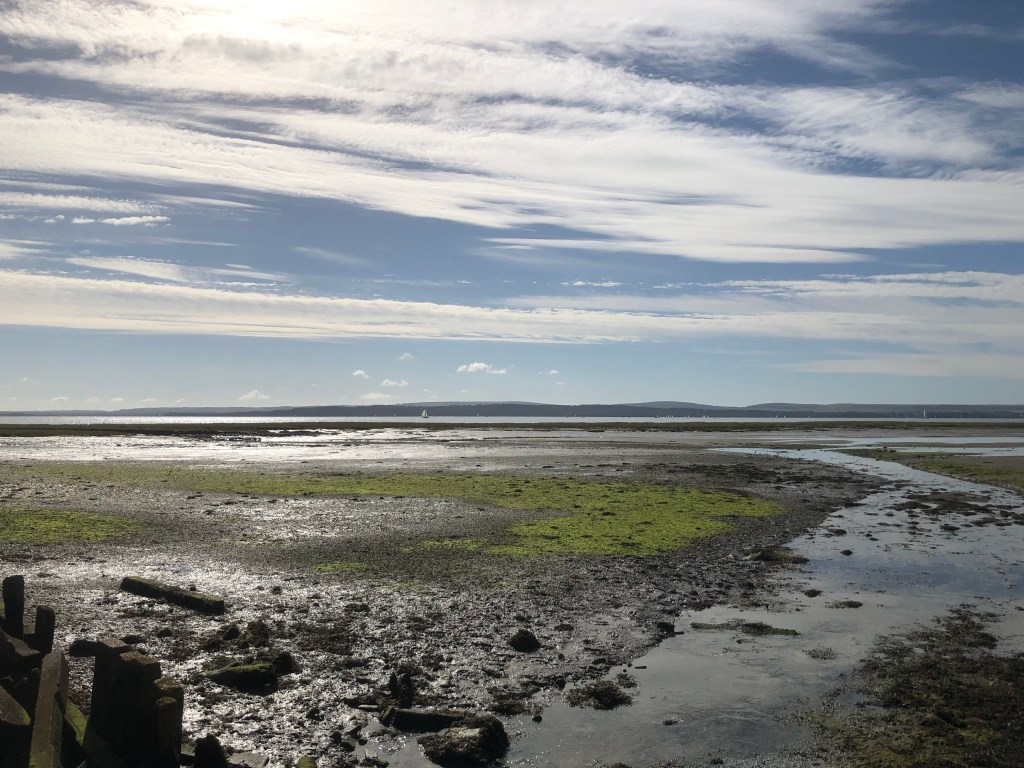
We’ve visited some fabulous beaches over the years including Bondi, San Sabastian and those of Rio de Janeiro – though Rio itself was a huge disappointment. This small estuary beach in the southwest of England is one of our favourites. And it doesn’t even have sand.
The tide was out exposing small green hummocks encircled by water channels and small pools. Mud was prevalent as my shoes can testify. Predominately a pebble beach it backs onto a private wood and large 18th century country estate.
Visible from the beach were the Needles, sailing boats and the Isle of Wight. Having recently visited the latter both felt the island somewhat improved from distance.
Two small SUVs were parked on the beach accompanied by 2 fisherman preparing their rods and tackle. Cows lounged amicably close by. An actor might seem smaller in real life, our four legged milk producing chums don’t. When one of these lumbering beasts wandered your way, possibly because you’d strayed near a calf, you didn’t hang around to ask why they preferred a beach to a field.
We had a stroll, the sun was shining. A perfect ending to our time in the gorgeous New Forest. We both adored the area – for me perhaps even beyond that perennial people’s favourite, the Cotswolds.
Staycations are nothing new, to us or to anyone else. However, the inability to travel to the more exotic has necessitated longer and more frequent trips within one’s own country. Where ever you live in this troubled world you will have discovered or had reinforced the beauty and diversity of your homeland. Familiarity does not always breed contempt but an appreciation of what you might already have. And that’s a huge positive.
The drive back to West London was painless and we were happy to be home. Nevertheless the New Forest made a huge impression on me and we’ll certainly be back.
 Tony's Travel Blog