
Yet again, we left holiday plans to a month before departure. Japan, again not an option, we opted for Africa or the Middle East.
Kenya triumphed.
Trailfinders took the strain, and a considerable amount of our money. We were to fly into Nairobi, safari for about a week before a couple of days on the beach. A little under 2 weeks in total.
NAIROBI
Arrival
Gatwick. Not ideal though late morning flight, compensated. Nine hour flight passed pleasantly film goggling. A mild upgrade assisted. Tad more leg room, no unwanted guest sat between.
With Kenya 2 hours ahead of London, we escaped the airport a smidgen before 11pm. Martin, our TF driver, promptly picked us up, dropping us at the hotel and smoothed our Nairobi hotel check in. And mentioned, Nairobi, in the Masai language, meant ‘cool waters’. Apparently, dependent of who you spoke with, Nairobi has a number of interpretations. Though most appeared to agree ‘water’ was an important element.
Elephants and Beads
After an excellent breakfast Martin, our aforementioned driver, trundled us to KOBA, a non profit organisation, staffed mainly by women. Ceramic beads, crafted mud to bead in-house, and decorative leather accessories.
The charming Sarah showed us the process, then the shop. An entertaining interlude offered the opportunity to demonstrate our dancing skills. Alongside our the ladies working there. Perhaps the ladies were going through the motions, if enthusiastically. Perhaps we were still in London less than 24 hours away. Mortifying.
The shop showcased their wares. And beautiful those wares are if surprisingly expensive.
Elephants followed gems, the Sheldrake Wildlife Trust (https://www.sheldrickwildlifetrust.org/). The sanctuary takes in orphaned elephants before releasing back into the wild – a process spanning an unexpected 5 years. And take a wild guess what is responsible for, in the main part, orphaning elephant. Yep, us. Poaching and territory encroachment being the main culprits.
Encouragingly, we were to later learn poaching is declining. Consumer pressure, and consumer choice, have led to a collapsing market for ivory. Yeh, a win for the humans.
Open only between 11am and noon it was unsurprisingly teeming with visitors. And tour group vehicles. Toyota particularly prominent. Martin slipped through the thronging masses. We sheepishly followed. And secured a prime vantage point.
A small muddy pool, two piles of red dirt, no elephants. Promptly at 11am 13 elephants exited the forest, ambled across a clearing, closed on the pool. Some almost skipping, anticipating treats.
Varying from a few months to 5 years old these magnificent creatures entertained the captivated crowd. And I suspect they knew.
Rangers fed them fortified formulated milk – milking a lady elephant is never going to end well – with greenery strewn for choice munching. A couple of younger elephants would squeal indignantly and chase rangers if believed short changed on the milk. Unbearably cute. Others rolled in the red dirt which helps to protect from sun and insects. They also happen to love it. Another relaxed, blissfully unaware, in the pool using its trunk as a shower head.
To the merriment of onlookers one opportunist male elephant mounted an embarrassingly relaxed lady elephant. Lady elephant, after enduring his enthusiastic if misguided attempts, clambered up and ambled off. Oh dear.
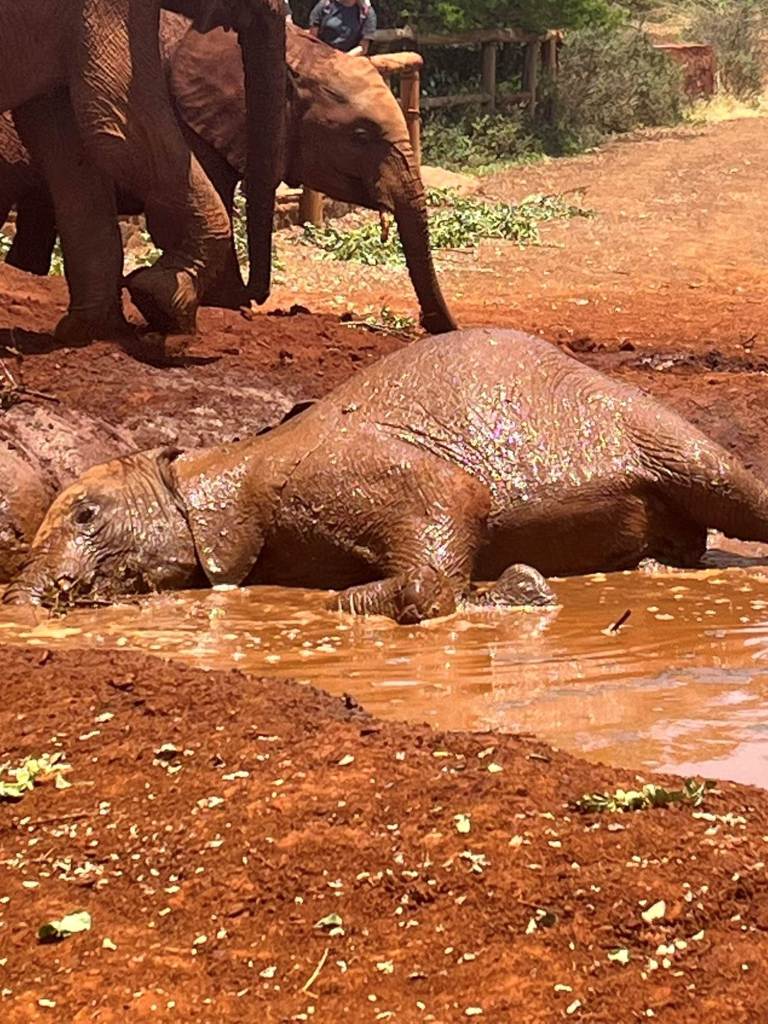
A few even wandered close enough to pet. Which they apparently enjoy. Their skin is rough and hairy. Wrinkles everywhere. A dermatologist’s worst nightmare.
Whilst utterly engrossed with these characterful characters we spotted numerous gazelle, a sole giraffe and a single snuffling warthog (warthogs were to become a favourite) traverse the clearing.
Do go, it’s a fabulous cause and is, as humans, the least we can do.
Martin delivered us to our hotel. Rested, still drained from previous day’s 15 hour travel exertions. A shopping mall stood opposite. We ambled across. Ambled back. Little of interest with the exception of a food court. Where we were politely hassled.
We ate at the hotel, and discovered 3 channels dedicated to football. Oh, what joy. OK, that’s me. Champion’s League footy followed. Before 8 hours of sleep.
Walking Tour Day
Early breakfast – a common occurrence – before an Uber dropped us in Nairobi’s Central Business District (CBD).
The traffic was nasty, pollution was worse. Half the vehicles, justifiably, would be scrapped in the UK. Unfortunately, this would comprise much of any public transport and cargo hauling capacity. Fully electric vehicles were non-existent.
Police controlled roundabouts, lane discipline wasn’t, battle scarred buses menaced. Small capacity Uber motorcycles groped their way through traffic. Drivers wore helmets, passengers didn’t. Spotted one struggling with 3 passengers, another loaded up with veg.
People strolled between the lanes of motionless and not so motionless traffic selling everything from sweets, footballs and clothes. I’m not sure I didn’t see one lady selling insurance. We later learnt some had a cheeky side hustle – selling marijuana to supplement their land fill wares. For medical reasons. Obviously.
A golf course, complete with resident storks, lived alongside this madness. Those ungainly, but magnificent, birds also hogged the trees. They don’t appear capable of flight. Must use ladders. Remarkably, these ungainly giants, are graceful flyers. More remarkably, their touchdowns are tidy, utterly devoid of comical incident.
Nevertheless, chaos it may have appeared, organised chaos it actually was. Remarkably, horns rarely parped, blared or beeped. Road rage, surprisingly scarce.
Welcome to Africa.
Anyway, the walking tour. Our small group were a mixed bunch – Mexican, Japanese, Nigerian, Polish. And us. They proved to be wonderful, informative and fun companions. As was John, our guide, plus his 2 colleagues.
John, was late. We figured an hour, hour and a half tops for the tour. John mentioned 2 hours, though he was a tad vague. It took 3. The CBD hosts government buildings, businesses and the central Catholic Church and Mosque. The church probably does better business than the Mosque. Eighty percent of Nairobians are Christian.
Perhaps ironically, perhaps not, a majority of the older, attractive structures date from British rule. The British gained control toward the latter end of the 19th century with Kenya officially becoming a colony in 1920. Kenya achieved independence from Britain in 1963.
One such colonial building is the elegant library. And a mite odd it is. In need of renovation and housing books, in English, dating from no later than the 1990s. Most hadn’t been checked out since the 80s, others not at all. Wonder why. Nevertheless, WiFi appeared in working order. Students were using the library to study. If not the books. Bizarre.
We nipped into the indoor city market, an elegant early 20th century structure. It’s an odd place. Part tourist trap, with remarkably few punters. Plus a meat and fish market, a few eateries, both aimed squarely at locals. The market, with its high ceiling, might be mistaken for a church long since repurposed. It isn’t and never was.
Beautiful, intimidating hawks assembled on the roof, selecting lunch.
The Kenyatta International Conference Centre (KICC) is one of Nairobi’s most iconic buildings. Plonked up in the 70s and located in one of Nairobi’s city squares. Friends and neighbour include government buildings and the Supreme Court.
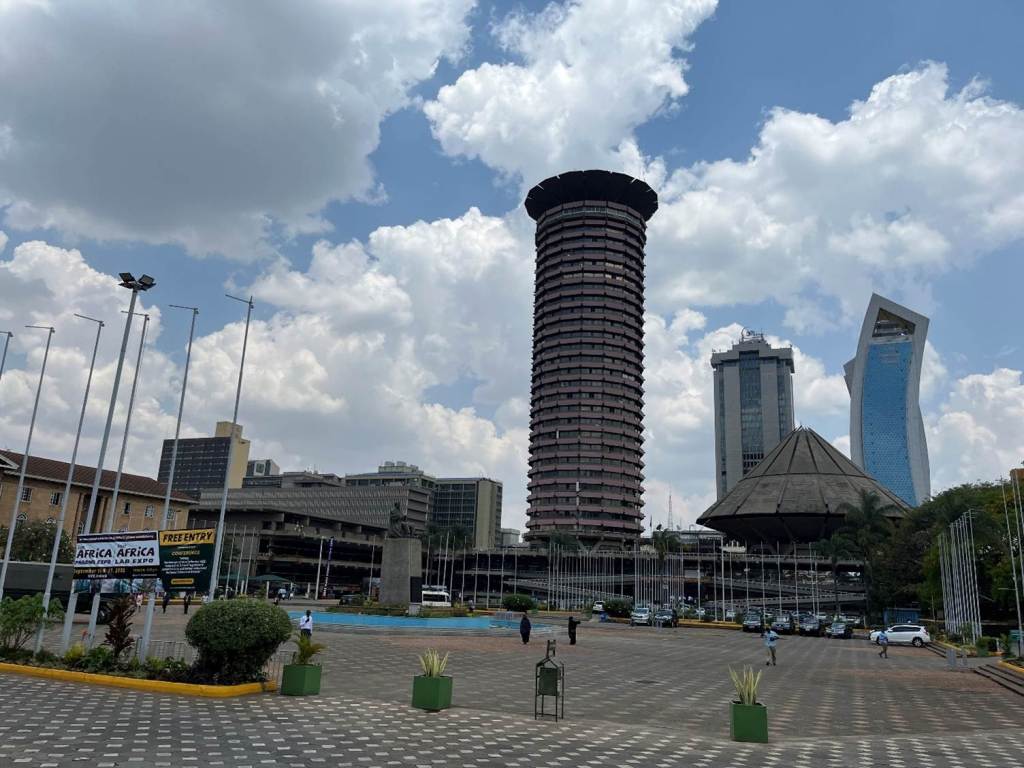
Designated smoking areas exist across the city for the addicted. I don’t recall anyone vaping with smoking rare. Interestingly smoking is not only banned in restaurants, bars and other traditional venues but additionally on Nairobi streets.
A brilliant, informative 3 hours. The group learned from John, John learned from the group. Interestingly, this diverse group shared similarly commonsense politics and liberal leaning beliefs. It was that kind of group. There is hope.
Uber back to the hotel, in half the time it took us to get there. Rush hour is still rush hour the world over.
And before departing Nairobi for a spot of animal worrying, Nairobi National Park – all 225 acres – is worthy of a mention. Dating back to the 1920s, and only a few kilometres from the CBD, it hosts numerous wildlife. Many we would later encounter of safari. We weren’t to visit though glimpsed antelopes and giraffes as driven past. I questioned – briefly and quietly – the need for an expensive safari.
SAFARI
Masai Mara Drive Day
A 7.00am briefing, a 7.30am start meant a 5.30 alarm clock. I was beginning to appreciate the lure of a beach holiday.
Parked outside was a decade old – at least – Toyota Landcruiser. Suspiciously, resembling a Land Rover of similar vintage. Six of us, plus luggage and our driver Edmund, clambered aboard. Old school. The diesel engine had decided against a turbocharger. It showed on the hills. However, off-road, the green beast gobbled everything in its path. These Toyotas were standard tourist company fare. Ubiquitous. Tough and reliable mechanical beasts of burden.
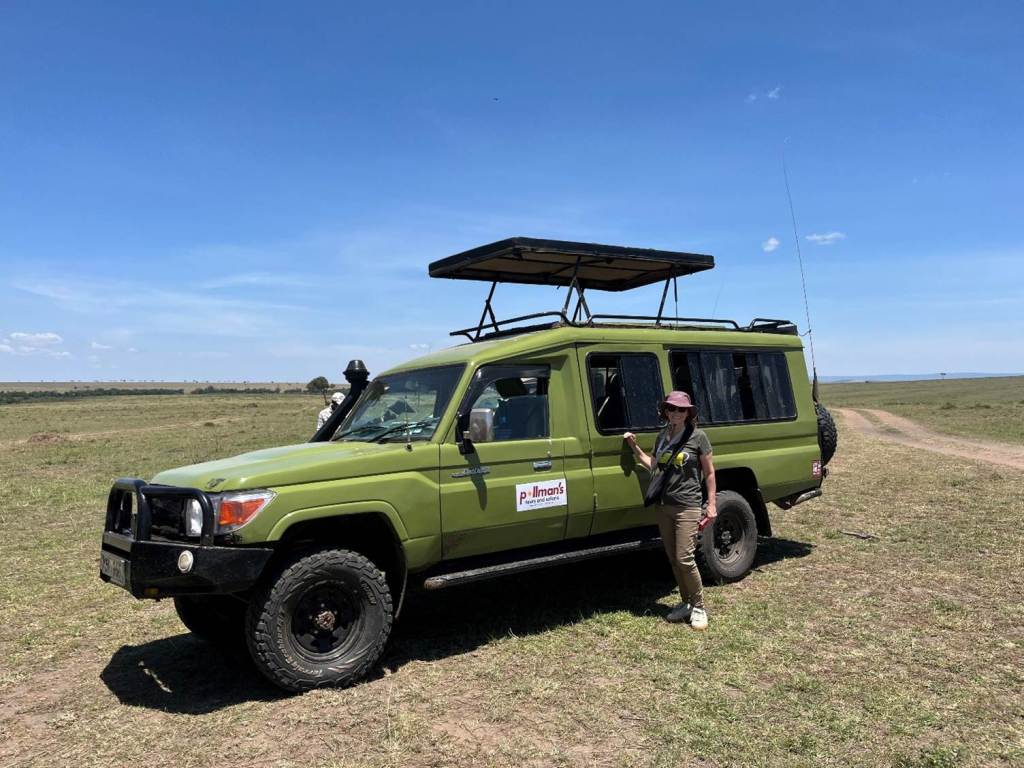
Driving initially on a raised toll road we tootled through Nairobi’s upmarket and expensive business and residential district.
For contrast we next drove by the shantytown. Or slum if being unkind. We only briefly glimpsed the shantytown proper and we’ve experienced worse. The road sprinting past, the road we were on, wasn’t so lucky. Ramshackle dwellings and businesses, many with improbable names, with titanic levels of trash. Piles abandoned, piles burnt, other piles still burning.
Next onto the Rift Valley Highway. Upwards, a short vantage point halt, downwards. Into the rift valley proper. Over 6,000 kilometres long, welcoming 14 counties and formed by clever tectonic plates. Once a wilderness now colonised, if not completely, by humankind. It’s not an improvement. Animals used to roam freely across the landscape. Very few do so now.
Small, scruffy, plastic dominated settlements – shantytowns really – adorn the landscape. Wildlife replaced by plastic. Narok, the largest town and county capital, proved, in the main, a welcome exception. Once freed from shantytowns the landscape recovers.
Humans, trash. Less humans, less trash. No Humans, no trash. It’s not a Kenya thing, it’s an everywhere thing. And, compared with various developing countries visited, Kenya was a definite improvement.
We arrived, after about 6 hours, at the Masai Mara National Reserve. Gate traversed, wildlife miraculously appeared. It’s as if they knew.
Checked into our Masai Mara lodge, lunched and wandered to the hippo enclosure. Nothing. Then a rock yawned. What we believed rocks were beached sunbathing hippos. Too many to count. Smelly creatures. Noisy creatures. Marvellous creatures.
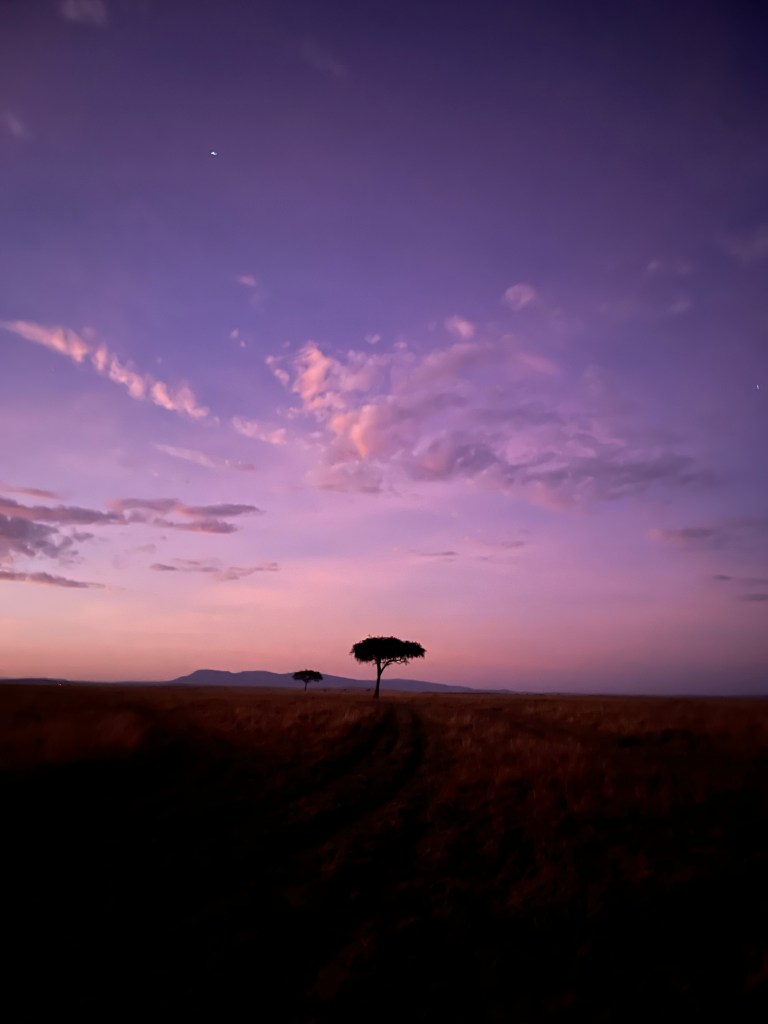
Relaxed before our first game drive. Masai Mara comprises of rolling grasslands, copses of scrubby acacia trees and undulating hills. Could have been Surrey.
The lone tree, an instathingy classic.
Told you.
The reserve is teeming. Over the following 2 hours we saw Zebra (numerous), warthogs (comically cute), elephants (dignified), water buffalo and various flavours of deer and antelope. Thousands of wildebeest (migration season) and 2 lady ostriches competing for one smug male. Lazily loping hyenas were distinctly familiar. Think self-assured dog.
Highlight was a gorgeous lioness with 3 stupidly cute cubs.
The Sand River divides Kenya from Tanzania. And Masai Mara from the considerably larger Serengeti. Some CV. We spotted both wildebeest and zebra traversing the river. So had our lady lioness.
Wildebeest and zebra, when migrating, often hang together. Wildebeest possess keen hearing, zebras keen eyesight. Teaming up make predators easier to discern. Destination reached, each ghosts the other, until return migration.
Our lady lioness, leaving her cubs, went walkabout. Then a lie down. Our driver, plus one other Toyota parked perhaps 10 feet away. Ten humans gawking. She briefly glanced up, twitched an ear and ignored us. As if to say ‘bugger off’ I’m preparing dinner. Once I catch it. No supermarkets in Masai Mara.
Balloons, More Masai Mara, Crocodiles
A 4am alarm call is never welcome. Sus had persuaded me a balloon trip is what was needed. Though both had ballooned before. One of which was together in Egypt.
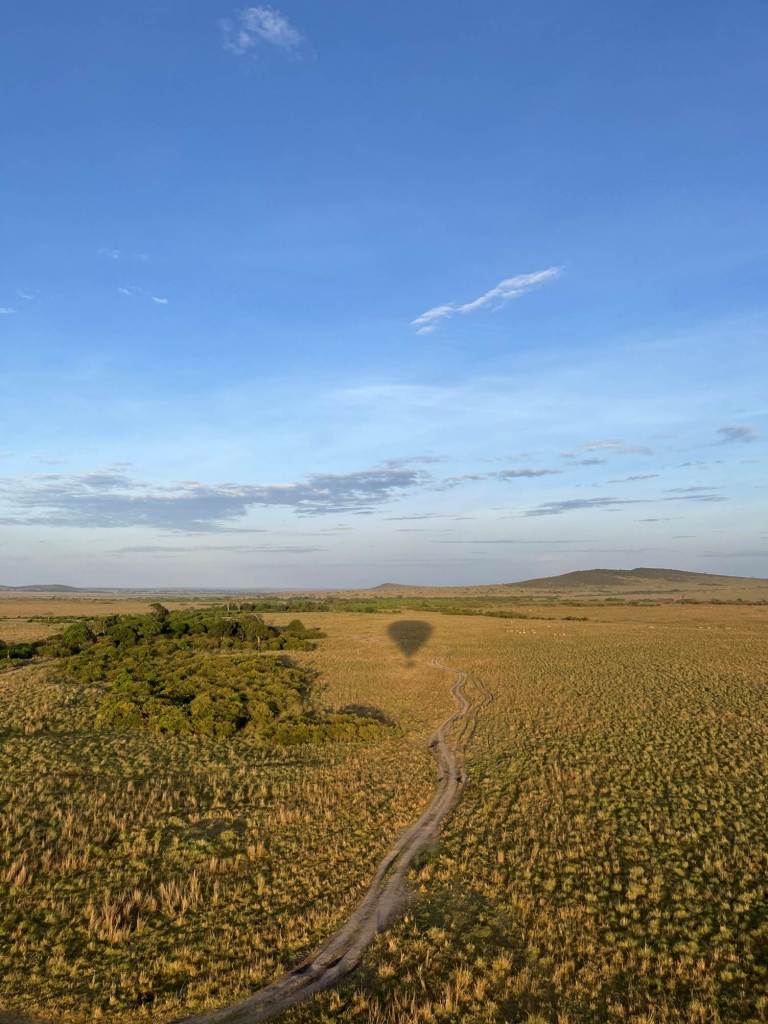
Unlike Egypt the trip was well organised and regulated. An hour soaring, often at no more than 20 -30 feet, above the Masai Mara. Fabulous experience. Nothing new showed but afforded a different perspective of the landscape. Worth considering. Though not cheap.
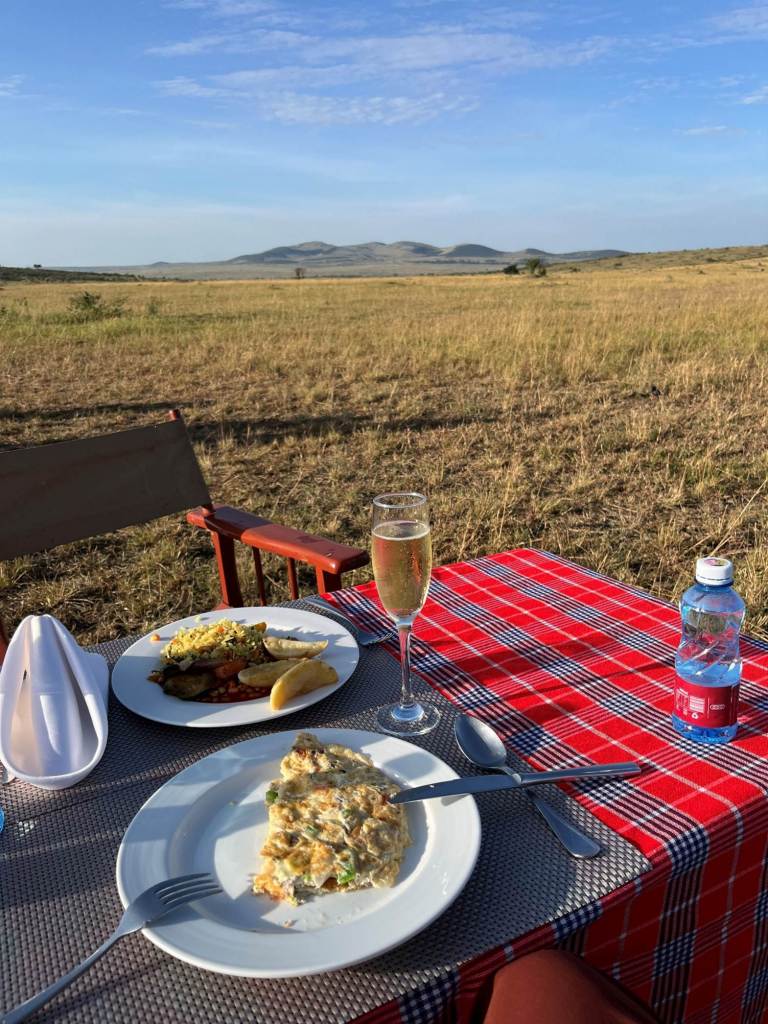
Champagne breakfast next. Setting, Masai Mara. London is many things, breakfast views of loping hyenas and migrating zebra isn’t one. An omelette added normal.
Edmund picked us up around 9am from where breakfast was camped. Until 4pm, including a couple of short pee and fodder breaks, we gamed drove.
We got lucky. Elephants, zebras, numerous deer types, migrating wildebeests herds plus the ever comical warthogs. And they’re equally comical young. Love Warthogs.
Nevertheless, highlights were a cheetah, leopard and 3 lions, one a lazy male, one younger wannabe lazy male.
The drivers communicate with each other, by mobile or stopping to exchange safari gossip. Suddenly you’ll spot a pride of Toyotas congregated around one small area. Our cheetah was discovered by this very safari grapevine. Along with 19 other Toyotas. Our cheetah chum, sat at the base of a tree, seemed utterly unconcerned. Probably mildly vexed. I would be.
He or she went walkabout, possibly hoping for an easy 2 legged lunch, before ambling into the scrub.
Authenticity, Toyota Time, Lake Naivasha
A 5.45am alarm call. And an early visit to a Maasai village. Welcomed, and reluctant participants, of a dance, demonstrated prior to village tour – a scruffy circular mud brick village. More mortification. I’m just not made to dance.
We learnt a little about Masai culture and able to enter one mud brick hut. Nevertheless, the experience, as we’d feared, never felt authentic. Even our initial guide, charming as he was, never truly believed in what was actually articulated.
Ended with a pushy tour and sales pitch of the village souvenir market. Promised the opposite. Fucked me off. I stalked out. Righteous in my anger. And dragged Sus with me. Our guide/salesman ran after us, offering a fair price on our chosen handmade ornament. We accepted. We’d grown fond of our little, stone rhino and the money goes – supposedly – to good causes such as schoolbooks.
Part authenticity, part 21st century, part sales pitch. My time again, wouldn’t bother.
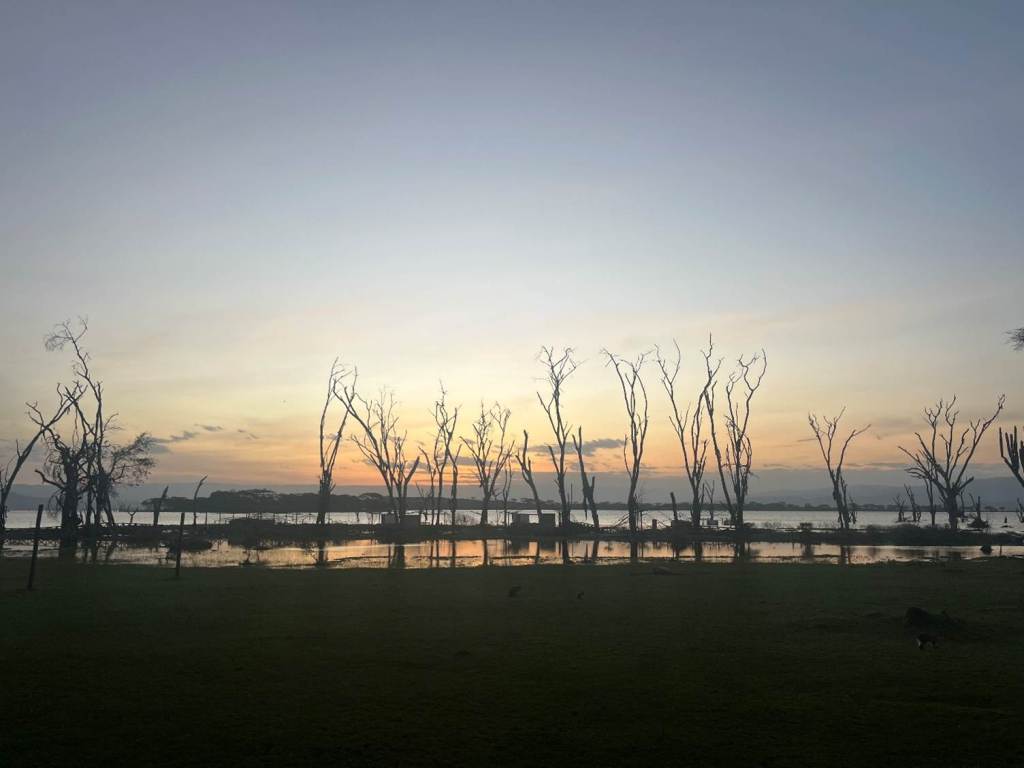
Toyota time. A 5 hour journey to Lake Naivasha. Lake Naivasha is a fresh water lake situated in the ever encompassing Rift Valley. Covering 139km square, with a surrounding swamp of 64km square, this mischievous little lake has been encroaching year on year. Evidenced by the dead or dying fever trees. It’s a tad eerie. Our hotel had lost garden, a jetty and what was probably once a bar to lake creep.
The good natured fever tree still encircles the lake beyond the swamp. Even as their brethren were drowning.
Wildlife is abundant. Hippos, flamingos and 400 bird varieties. Crescent Island host African staples such as giraffes, zebras and waterbucks. Part of our package included an hour’s boat trip. The lake is huge, until the boat trip we hadn’t realised how huge. Crescent Island – with that small sanctuary, blocks the view of one half of the lake.
The hotel gardens, with lakeside views, made a pleasant haven. The Vaulet monkeys made it less so. Cuddly cute, terribly temperamental. Monkeys retrieved/stole anything discarded/unguarded. Their ingenuity, opening bottles of water and sugar packets, is undeniably admirable. Unfortunately, one enterprising individual leaped onto a table of 4 and enthusiastically engaged in a tug of war with a lady holding fruit juice. It lost. And promptly bit the lady.
Sod valour and views. Retired to the veranda where Brighton verses Spurs match was being shown. Cracking game.
As nightfall descends, wildlife ascends. Hippos, zebras and deer all magically appear on the lawn. Ealing Common will never be the same again.
Toyota Time, Amboseli National Park
Left the hotel at 7.30am. A 7 hour drive northeast awaited.
In actuality, it wasn’t especially arduous. Initially, the scenery similar to Masai Mara but gradually usurped by a drier, flatter landscape. Nicely finished with abundant small trees.
Trundling up and out of the rift valley was tedious. Trucks and lorries are Kenya’s life blood, bringing goods in and, via the port at Mombasa, exporting others out. Many struggled up the steep incline, overtake one and another 3 magically appeared. Truck Whacamole.
One particular truck had a chap jogging alongside trying to flog the driver corn. He wasn’t even running. Roadside stalls flogging cooked corn were common.
Same ramshackle, trash filled towns and, as we skirted Nairobi, Africa’s second largest slum. Soweto in Cape Town holds that particular accolade. Edmund mentioned many people choose to live there. It’s outside the control of local government so cheap. No electricity, water or service charges.
Our destination was Amboseli Reserve. The latter part of our drive to the reserve was a most welcome trash free. Lack of human habitation the undoubted reason. It felt part of the reserve without actually being so. Drier conditions delivered dust. Lots of it.
On entering the Amboseli desert confronted us. Miraculously, after all fooled by a water mirage, water did appear. The flat landscape transformed into a watery, green paradise. Palm trees replaced acacia trees with mountains encircling this relatively petite park. Mount Kilimanjaro, selfishly in Tanzania, dominates.
Checked in, quickly ate before our game drive at 4pm. Most game drives happened early morning or late afternoon. Wildlife is at its most obliging. And the lake and marshlands provide for abundant life
The usual peeps. Plus special guests. Flamingos and elegant wading birds. An abandoned hotel complex, testament to a higher water table, adds an eerie element. An enchanting place. That contrast between desert and marshland will live long in the memory.
Tsavo West, Two Pool Day
Left early, safaris not designed for those who enjoy a lie in and leisurely breakfast. We headed east towards Tsavo West National Park. Kilaguna Serena Safari Lodge our host for the evening. Overlooked by the captivating Chyulu Hills. About a 4 hour drive.
Same old, same old. Plastic strewn ramshackle towns, either side of an enchanting African backdrop.
We’d observed, on roads outside of the parks, a number of oddities. Many hotels – at least advertised as such – had a sideline as butchers. A splatterfest twist on Psycho perhaps.
Two telecom organisations (Airtel and Safaricom) dominate any advertising. Many a ramshackle town boasts single story brick constructs painted entirely in the logo of one or the other. Smartphone obsession, online persona, is a worldwide phenomenon.
Many other businesses and dwellings are constructed from corrugated iron and whatever else comes to hand. The small, diverse businesses, are improbably named. Occasionally with religious connotations, more inventively, and amusingly, with an overblown but optimistic monickers.
Churches, of varying dominations, are omnipresent. Some are makeshift, others appear more established.
And the terrain become noticeably drier, paradoxically with a greater concentration of small trees. Flat vistas surrendered to hills and mountains.
Undertaking the final 60 kilometres on an unpaved road wasn’t uncommon. The parks and reserves were predominantly unpaved. However, this 60km stretch, was a proper suspension workout. Pitted, crated with, in some places, innocuous ripple like furrows running across roads. These furrows were nasty, capable of shaking an unwary motor to little pieces. Astonishingly, a small Toyota Corolla passed in the opposite direction. And our front bumper fell off. Or would have if Edmund hadn’t bodged a temporary repair.
Otherwise, our Toyota made light work of it. The humans less so. Shaken and decidedly stirred. The so called ‘African massage’. And, as with Amboseli, this 60km of human blending shared a strong semblance of the park proper. Without actually being so.
After lunch, and much needed downtime, another game drive. A dry landscape of open grassland and unexpected tree frequency. Again usual wildlife chums, a highlight 3 lions chilling after their own late lunch.
Strangely, our lodge, was the main event. The restaurant/bar was a huge, vaulted space open to African vistas. Stunning in its own way. Two large ponds, presumably deliberately located, sat below the wine and beer drinking gawkers. Us included.
Rush hour ensued. Lone male elephants, elephant family groups, elephants en masse splashed, sploshed, played. Arguments were quickly settled, with a gentle push here, a gentle shove there. Why are humans incapable of such compromise.
Groups of elephants would stroll into the night only to return.
It was a mesmerising scene.

Elephants were not alone. Water buffalo, wildebeest, deer and antelopes captivated diners and drinkers alike. And let’s not forget that crowd pleaser, the always comical warthog
One newlywed lost her husband to elephants. Better than the bridesmaid.
Last Day of Safari, Day
An 8am departure. Rejoice. Didn’t know what to do with ourselves. And our final safari drive.
Tsavo West National Park is vast. Really vast. And there’s a Tsavo East National Park. Once one, now siblings divided by a long ago abandoned railway line. Still visible in places.
We drove an hour to escape the clutches of Tsavo West. Spent perhaps 10 minutes escaping only to be drawn back in via another entrance. Posh name, the Taita Hills Wildlife Sanctury.
Our residence for the night was Taita Hills Lodge. On stilts.
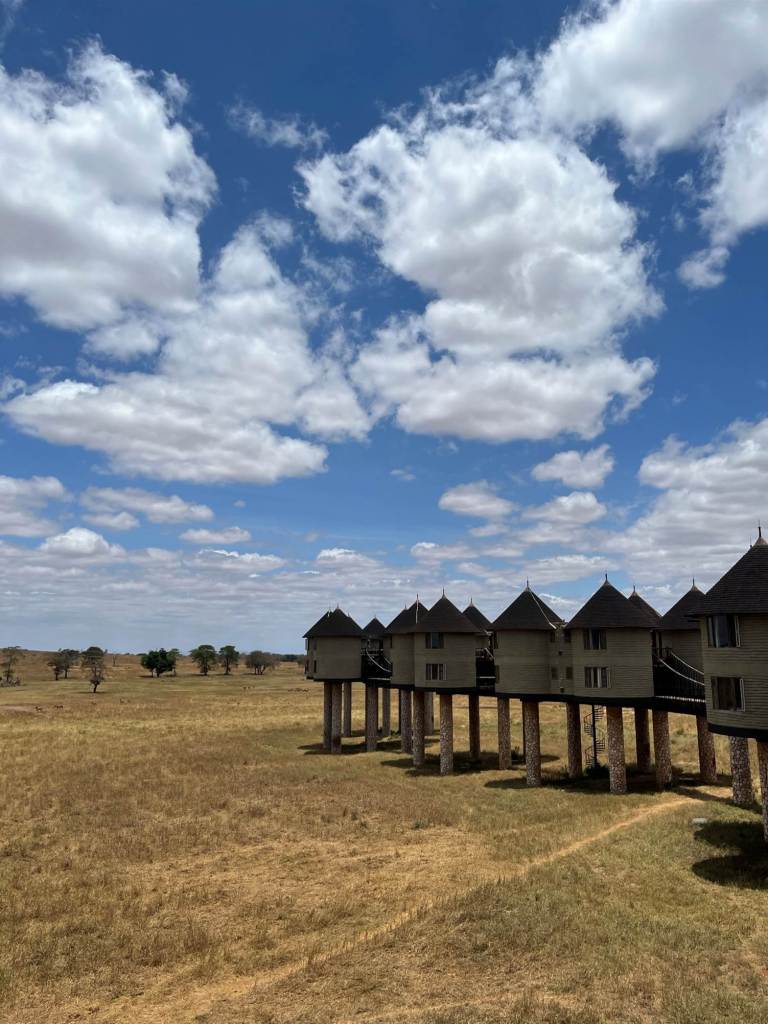
The lowest level, roughly 20 feet above terra firma. Or, the height of one adult elephant. Not that this, in the slightest, hindered gibbons in their quest for food. These implausibly agile apes make cats appear awfully clumsy. Clever, strong and unafraid.
Taita Hills Lodge resembles a medieval German castle. Without all that bashing each other over the head with an unwieldly weapon of choice. Similar scenery as across the road. The Taita Hills, part of the Eastern Arc Mountains, were ever present in the distance and near distance.
Wonderful vistas and, as with Kilaguna, manmade pools strategically located. A small crescent pool dwelt directly in front of our pseudo castle. Elephants loved it. Slurping a few feet from smitten tourists. One casualty were small fish. Poor buggers slurped up, slurped out. Often onto dry land. Not ideal. Casualties were high.
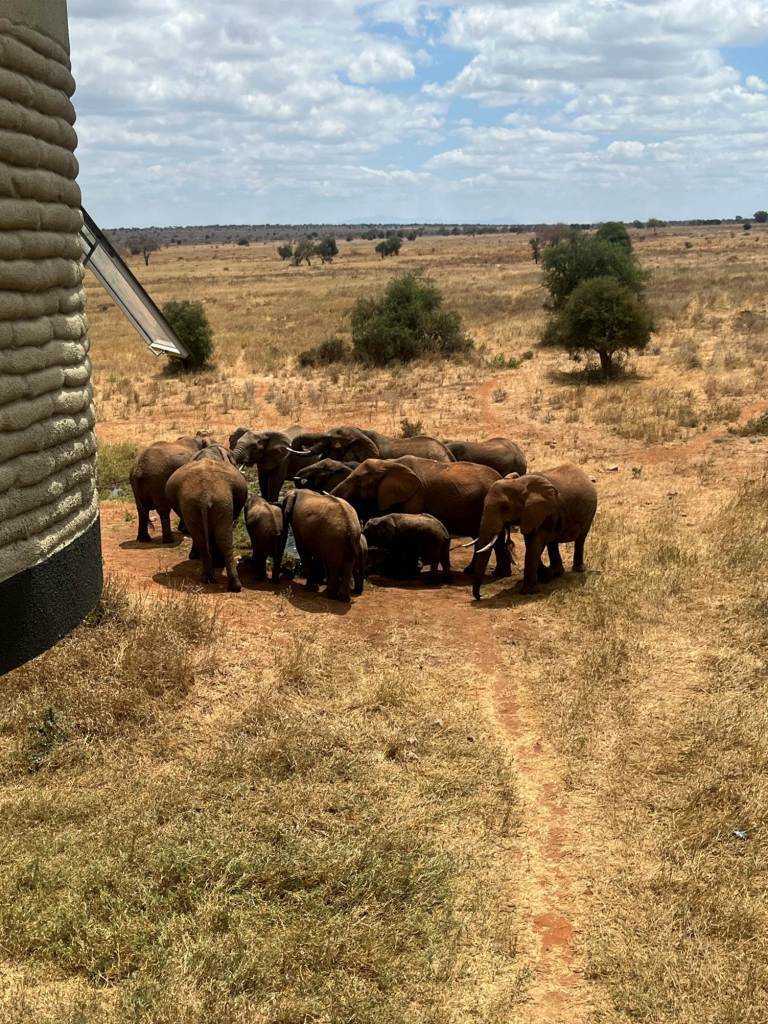
Our 4pm game drive, always captivating, was unfavourably quiet. Drier conditions were, supposedly, the culprit. We, plus many others, splashed out on a night game drive, this being an optional extra.
A lioness crunching and tearing through a wildebeest she’d killed is a sound unlikely to be forgotten. A near adult male lion lounged lazily on the roadside. Loving its heat retention qualities.
The night game drive proved an interesting diversion. Not an essential diversion. That is, unless like us, you live in a large city, and the stars and solar system are, seemingly, permanently elsewhere. Probably a first for me, the night sky set out in all its mystifying glory. Totally spellbinding. And recognising our utter insignificance.
And that was that. Our last game drive.
MOMBASA RESORT HOTEL
A five hour drive, unexpectedly swapping vehicles twice, brought us to White Sands Resort Hotel. A 1980s mildly faded dream. Nevertheless, an amicable companion for our last couple of nights. And a peaceful one.
Once installed on main road into Mombasa, one peculiarity was particularly noticeable. A distinct disparity between trash levels on the lefthand roadside and righthand roadside. The left was plastic peppered, the right, for the most part, wasn’t. Weird.
Kenya doesn’t have clean drinking water. A substantial amount of discarded plastic witnessed over the 2 weeks were plastic water bottles. One hopes clean drinking water is a priority.
Two days of swimming, sea and resort pools, relaxing and eating. Particularly eating. Enjoyable, perhaps even endured another day.
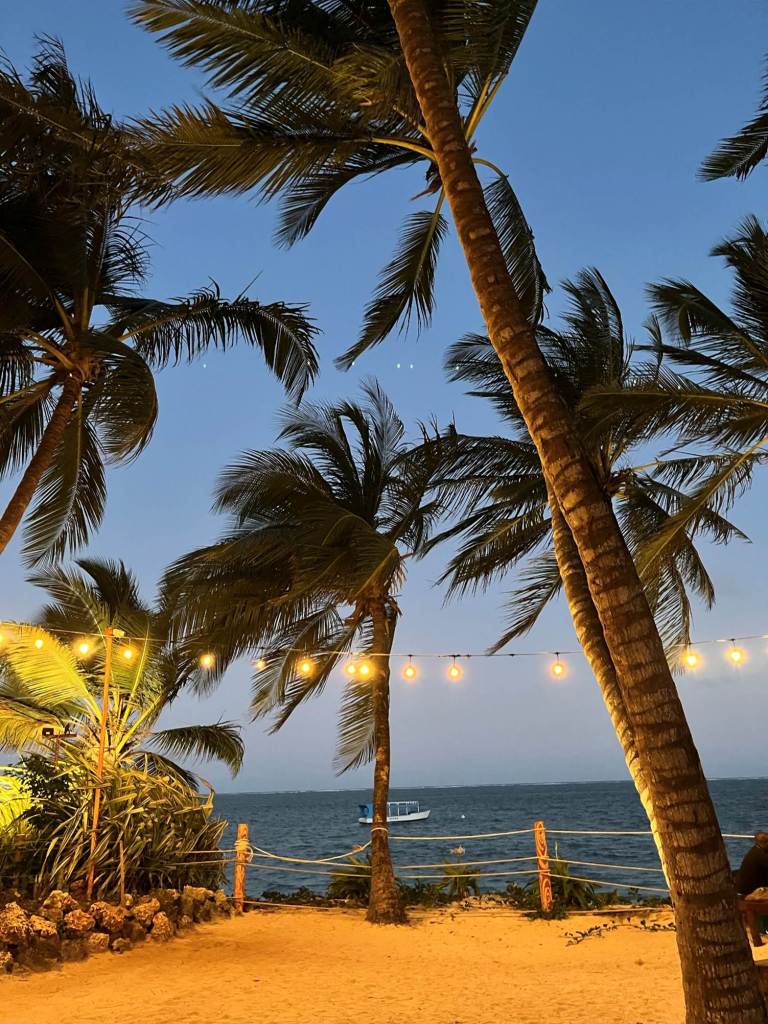
Saying that, vaguely flummoxed why anyone would extend their stay beyond 2-3 nights. We chatted to one group who’d booked a week. They also appeared vaguely flummoxed to why. Limited activities (the hotel complex was relatively small) and Mombasa is no Venice.
Meals become the main event. Or create your own murder mystery knocking off guests. Only the annoying ones.
We were picked up, as arranged, and delivered to Mombasa airport. Some confusion, but we survived security.
Twin prop (car engined) plane, seemingly half full of school children awaited. It was not a quiet flight. Mercifully, less than an hour.
Nairobi is a big city. Nairobi airport is not a big city airport. On landing on the domestic side, we looked in vain for obliging signs steering tired tourists to connecting flights. Nothing. Resorted to asking a security guard. Then across a busy road to international airport. More security checks and a guess to where passport control was. Inside things don’t especially improve. All in all, a bit of a mess.
One exception was Art Café. Good value food, a warm welcome.
And that is pretty much that. Apart from a 23 hour journey to chez us. Three hour delay and 4 screaming babies on an eight and a half hour flight. And we’d paid a small premium for the pleasure. London could not arrive quick enough.
SUMMARY
Cities
Both grateful we chose Nairobi to be a destination, not only a staging post. Both our Toyota chum couples flew in the night before the safari began.
It’s not perfect. You’d struggle to call Nairobi pretty, pollution is rife, the discrepancy between those that have and those that have not is blatant and growing. Where isn’t it.
Nevertheless, Nairobi is a fascinating city, gradually transforming into a modern city. It’s East Africa’s central hub and will only continue to modernise. Highly recommend catching a CBD walking tour. Offers a perspective of one of Africa’s fastest growing metropolises you wouldn’t otherwise get.
Not for everyone though would encourage all to give Nairobi a chance.
Mombasa is another city determined to modernise. Expressed in massive infrastructure projects, popping up apartment blocks and the appearance of new shopping malls. Our journey to our hotel, and 3 days later to the airport, had afforded us a glimpse.
We also passed through pleasant, reasonably affluent neighbourhoods close to our resort hotel and, perhaps more traditionally, a huge open market. Engulfed by tuk tuks.
Safari
Was more a Sus thing than a Tony thing. Sus has wished to safari for years. And, though we’ve visited Egypt, neither as adults has visited Africa proper. Sus actually lived in South Africa from about 6 months to 7 years old and still retains memories of that time.
A safari certainly isn’t everyone’s cup of wildebeest. Early starts, inordinate amounts of time spent in a wannabe Landrover, rarely resting for more than a single night in the same place. We never fully unpacked.
Nonetheless, it’s an incredible and heart warming way to fritter a few days. To enjoy these gorgeous, gorgeous creatures in their natural habitat is both a joy and privilege.
Favourite animal? Akin to choosing between a scotch egg, sausage roll or pork pie (pork pie for the record). Elephants, marginally. Such gentle, dignified, all knowing beasts. Though that comically cute, and surprisingly adept, warthog wasn’t far behind. The weirdest, ostriches. By some distance.
None of the wildlife disappoints, even after repeatedly observing. There was always something else to marvel at.
A safari, as I’ve mentioned, is not for everyone. It’s expensive and not an especially relaxing approach to any vacation. Nevertheless, if undecided, I urge you to at least investigate further. A week is not a prerequisite. Borrow a day, or perhaps a couple of days, from another holiday. Include a short safari into a longer break.
You won’t be disappointed. Unless, of course, you dislike animals. Then you might be.
Final Thoughts
Kenya, as did many countries, struggled for an identity post-independence. One party rule, ethnic tensions, social and economic woes all played their part in a difficult transition. And still applicable, perhaps, to much of our world today. Including my own country.
However, today Kenya is a democracy and, certainly to our eyes, felt very much the modern state it is hoping to become.
Jambo, in Swahili, translates as hello. This wonderfully welcoming and optimistic word perhaps best describes our experience of this magnificent country.
Many thanks for reading, Tony Leigh (October 2025).
Sent from my iPhone
 Tony's Travel Blog